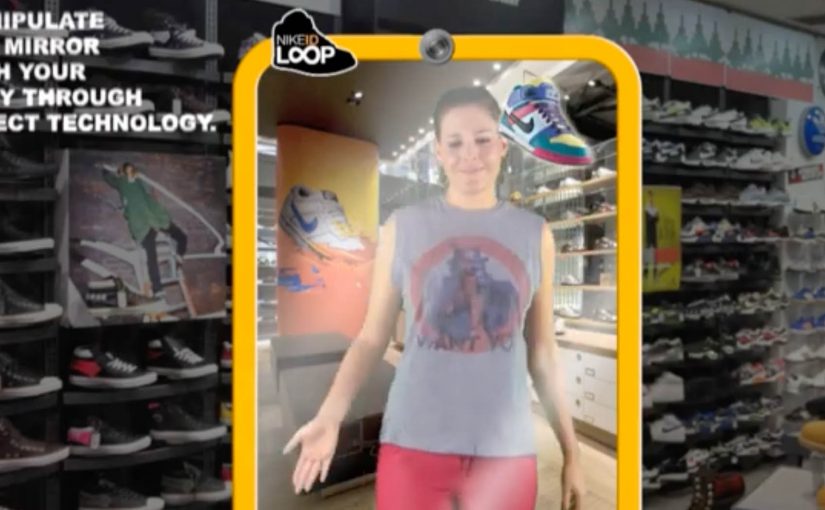
Here is another interesting concept coming out of Miami Ad School, this time for Nike.
Since Nike has a huge range of sneakers, it’s next to impossible to try each one of them at the store. In fact, it’s not even possible to find them all at the store.
So a unique interactive mirror using Microsoft’s Kinect technology was created to customize the sneakers on the user’s feet. This way, one could try on every pair of Nike sneakers ever made in record time.
The core problem this concept tackles
Retail has a physical constraint. Shelf space. Inventory. Time. Nike’s catalog depth makes “try everything” impossible, even in flagship stores.
This concept flips the constraint by moving variety from physical inventory into a digital layer, while keeping the try-on moment anchored in the body. By “digital layer” here, I mean a live overlay that swaps variants in the mirror without needing physical stock. Your feet. Your stance. Your movement.
The real question is how you let shoppers explore more options without turning the store into a warehouse or the decision into homework.
Why the mirror mechanic is powerful
Because the mirror tracks movement and renders variants instantly, it keeps the try-on believable in motion, which is what makes fast switching persuasive instead of gimmicky.
Extractable takeaway: When you can add choice in software while preserving an embodied try-on moment, you reduce assortment friction without reducing confidence.
- It keeps context real. You see the shoe on you, not on a product page.
- It compresses decision time. Rapid switching creates a new kind of “browsing”.
- It turns discovery into play. The experience is inherently interactive, which increases dwell time.
- It reduces inventory friction. The store can showcase breadth without stocking breadth.
In retail environments where shoppers want high-confidence fit and style decisions in minutes, embodied digital try-on can expand perceived assortment without expanding stock.
What this implies for customization and personalization
NikeID is already about making a product feel personal. A Kinect-style mirror extends that by making customization immediate and visual, which can increase confidence before purchase.
This kind of embodied customization is worth betting on, because it makes breadth feel real without demanding more shelf space.
The concept also suggests a future where “catalog” becomes a service layer. The physical store is the stage for decision-making, not a warehouse for options.
What to take from this if you run retail CX
- Start with the constraint. Space and assortment are physical limits. Digital can expand them.
- Keep the experience embodied. Seeing a product on yourself is stronger than seeing it on a screen.
- Design for speed. Rapid iteration can become a feature, not a compromise.
- Make the output actionable. The experience should flow naturally into saving, sharing, or ordering.
A few fast answers before you act
What is the NikeID Loop concept?
It is a Miami Ad School concept for Nike that uses an interactive mirror and Microsoft Kinect technology to let users customize and “try” different Nike sneakers on their feet digitally.
What problem does it solve in stores?
It addresses the fact that Nike’s full range of sneakers cannot be stocked or tried in one location, by shifting variety into a digital interface.
Why use Kinect or motion tracking?
Motion tracking lets the system align the visual shoe to the user’s feet in real time, keeping the experience believable as people move.
Is this a product or a concept?
In this case, it is presented as a concept coming out of Miami Ad School, showing a possible direction for interactive retail.
What is the transferable lesson?
If you can remove physical constraints through an embodied digital layer, you can increase choice, speed, and confidence without expanding inventory.