Ikea RGB Billboard

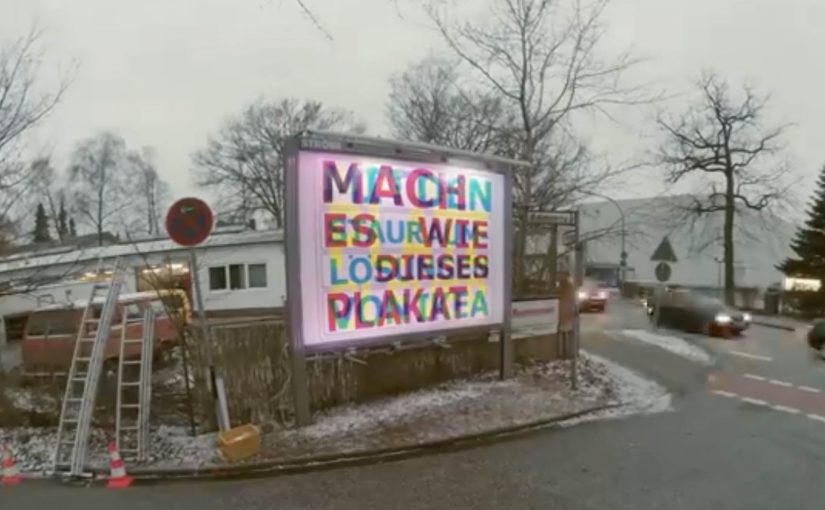
German ad agency Thjnk and production studio I Made This teamed up to create a unique RGB Billboard that revealed different messages depending on the colored lights.

The billboard featured three different messages in three different colors. Cyan, magenta and yellow. At night, the billboard was lit up by red, green and blue (RGB) light bulbs, which made the different messages visible depending on the shining light bulb.

The red showed the cyan text. The green made the magenta text visible. And the blue light revealed the yellow text. With this simple visual trick, the billboard made the most of its limited space and embodied Ikea’s space-saving message.

How the RGB trick works

The idea leans on a simple perception hack. You print multiple messages in different ink colors, then you control which one becomes dominant by changing the light color that hits the surface.

By switching between red, green, and blue lighting, the billboard effectively “filters” what you see. One physical surface. Multiple readable layers. No moving parts required.

Why this is a very IKEA way to communicate

IKEA’s promise often comes down to doing more with less space. This billboard does the same thing. It demonstrates the benefit while delivering the message. The medium becomes the proof.

It is also efficient. One placement delivers three messages, but it still feels coherent because the mechanism is consistent and easy to understand once you see it happen.

What to borrow for your next OOH idea

  • Make the constraint the concept. Limited space becomes the creative engine.
  • Use a mechanism people can explain. “Different lights reveal different messages” travels fast.
  • Build a repeatable reveal. The change over time, or over conditions like day and night, creates a reason to look twice.

A few fast answers before you act

What is the IKEA RGB Billboard?
It is a billboard designed to reveal different messages depending on whether it is lit by red, green, or blue light.

Who created it?
German ad agency Thjnk and production studio I Made This.

How many messages did it contain?
Three messages, printed in cyan, magenta, and yellow.

What lighting was used at night?
Red, green, and blue (RGB) light bulbs.

Why was it a good fit for IKEA?
It demonstrated a space-saving principle by making one billboard placement do the work of multiple messages.

Coca-Cola Hilltop Mobile Ad

In March I had written about Google’s advertising experiment where they set out to re-imagine and remake some of the most iconic ad campaigns from the 1960’s and 1970’s with today’s technology.

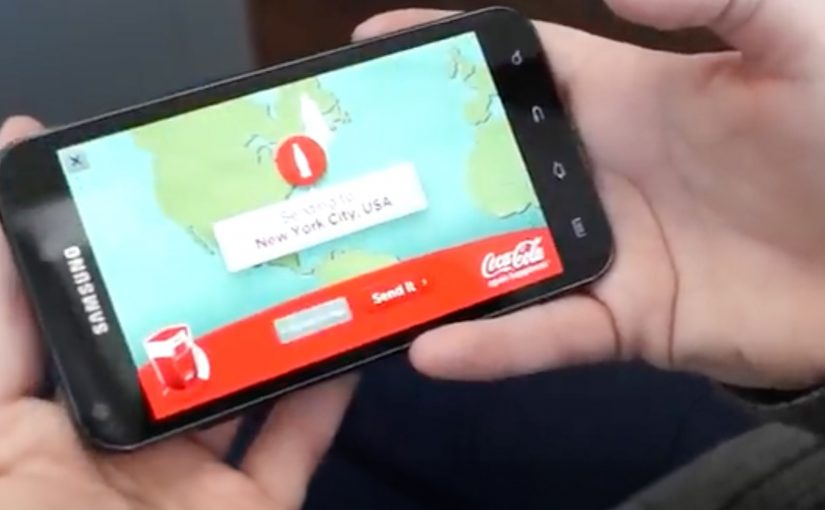
During these experiments the iconic Coca-Cola “Hilltop” ad campaign was re-imagined. Fulfilling the promise of the original ad, special vending machines were created that allowed users to instantly send a Coke around the globe to unsuspecting recipients.

Now the whole experience has been taken onto mobile and can be experienced through the Google AdMob network, across iOS and Android devices. Viewers can now truly ‘Buy the World a Coke’ with just a few taps on their mobile phones.

What changes when “Hilltop” moves to mobile

The original re-imagining leaned into physical surprise. A vending machine became a global gifting interface. Moving that same promise into an AdMob-delivered mobile experience changes the distribution model completely. Instead of waiting for someone to encounter a special machine, the interaction can show up wherever people already spend time on their phones.

That is the real upgrade here. Not just “mobile as a smaller screen,” but mobile as a friction-reducer for participation. A few taps can replicate the core gesture. Sending a Coke to someone else. Without requiring a specific location, a specific moment, or a special install.

Why this is more than a nostalgic remake

Remaking a classic can easily turn into pure tribute. What keeps this one relevant is that it tries to honor the original promise with a modern mechanic. “Buy the World a Coke” becomes a literal action, not just a line in a jingle.

It also underlines a useful creative rule. If you want a campaign to travel, design an action that people can complete quickly and understand instantly. Then make the “story” a byproduct of participation.

What to borrow for your next mobile campaign

If you are planning mobile work right now, this points to a few practical moves:

  • Design for one clear action. In this case, sending a Coke. Everything else is supporting detail.
  • Make sharing native to the mechanic. Gifting is inherently social and inherently repeatable.
  • Use mobile distribution for scale. An ad network can turn a niche experience into a widely reachable one, without relying on a single physical activation.

A few fast answers before you act

What is the Coca-Cola Hilltop Mobile Ad?
It is a mobile version of the re-imagined “Hilltop” campaign experience, delivered through Google’s AdMob network across iOS and Android devices.

How does this relate to Google’s advertising experiment?
It extends the re-imagining of iconic 1960’s and 1970’s campaigns, taking the Coca-Cola “Hilltop” concept from the experiment into a mobile execution.

What was the original re-imagined mechanic?
Special vending machines were created that allowed users to instantly send a Coke around the globe to unsuspecting recipients.

What is the key user promise in the mobile version?
That viewers can “Buy the World a Coke” with just a few taps on their mobile phones.

Why is the mobile move important?
It shifts the experience from a location-based activation to scalable distribution. Participation becomes possible anywhere, not only where a special vending machine exists.

The Sun spoofs Apple’s iPhone ads

It looks like an Apple iPhone ad at first. Then the tone flips. Glue London plays on the fascination with digital technology and the iPhone. It lands as a cheeky spoof for The Sun.

The punchline. “v 4.0, since 1969”

The film finishes with the words “v 4.0, since 1969”. It is a nod to The Sun’s 40th birthday anniversary this year, delivered in the visual language of tech versioning.

Why this works. Borrow a format people already trust

The execution borrows the look and rhythm of a category-defining ad format and uses it as a shortcut. Viewers recognize the structure instantly. That recognition makes the twist feel faster and the end line hit harder.


A few fast answers before you act

What is this ad?
A spoof of Apple’s iPhone advertising style for The Sun, created by Glue London.

What does “v 4.0, since 1969” refer to?
A reference to The Sun’s 40th birthday anniversary, expressed like a software version update.

What is the core creative tactic?
Use a familiar tech-ad format as a recognizable frame, then subvert it with a brand-specific punchline.

Why does it travel as a viral?
It is short, culturally legible, and built on a format people immediately recognize.