
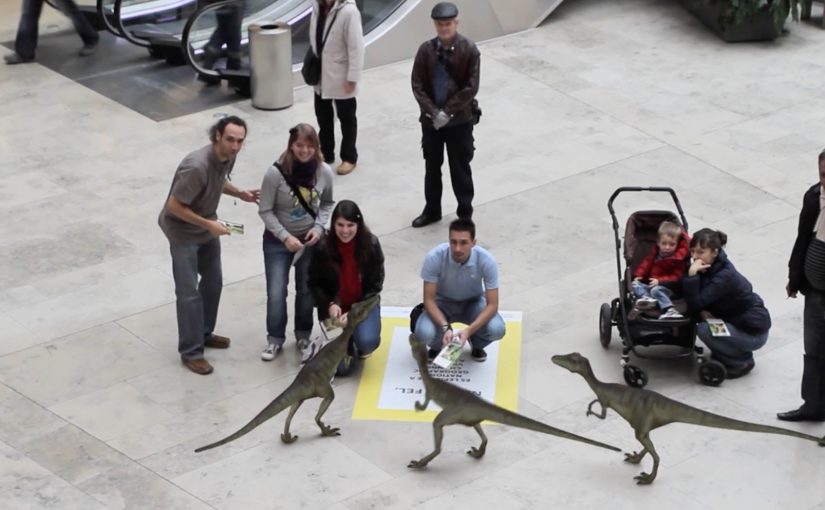
A passer-by steps in front of a live augmented reality installation and suddenly they are inside National Geographic content. Leopards appear beside them. An astronaut stands in-frame. Dolphins, storms, dinosaurs. The moment is immediate, public, and designed to be captured.
Here, live augmented reality means a public installation that composites the passer-by into a branded scene in real time.
What this activation does
Appshaker launches a large-scale way of immersing people in scenes from National Geographic’s extensive archive. The experience places people right inside the content and lets them move through multiple scenes in seconds.
It is a distribution engine disguised as an installation.
The content choices that make it work
The scenes are not subtle. They are instantly recognisable and visually dramatic, which is exactly what you need in a public space. Because the scenes read instantly, people understand the invitation at a glance and step into it before attention drops.
- Leopards
- Astronaut
- Dolphins
- Storms
- Dinosaurs
The loop it creates in the crowd
This plays out like live communication, not passive media. The real question is how you turn a public screen into something people want to perform inside and then distribute for you.
Extractable takeaway: When the participant becomes the proof, the installation stops being a one-location spectacle and starts working like portable brand media.
- People see themselves inside the scene.
- They capture the proof, photos and video.
- They share it, so the moment travels beyond the physical footprint.
In public-space brand activations, the scalable value is rarely the screen itself but the shareable proof that ordinary people were inside the story.
The scale signal, touring plus sharing
The reaction is described as huge. Tens of thousands interact with the National Geographic brand while it tours Hungary, and thousands share pictures and videos on Facebook. That combination is the point. Physical touring drives volume. Social sharing extends reach.
The business intent is clear. Use physical participation to generate social distribution that keeps extending the campaign after the crowd moves on.
A close parallel. Lynx “Fallen Angels” at Victoria Station
Sometime last year Lynx also runs a similar live augmented reality activity with its Fallen Angels in London’s Victoria Station. The mechanism is comparable. Put people into a surprising live scene, make it feel real in the moment, then let the footage do the distribution work.
If you plan something like this, what to design for
- Scene selection. Pick a small set of scenarios people want to step into immediately.
- Capture quality. Output framing and realism matter, because the output becomes the share unit.
- Throughput. Live installs win when the queue keeps moving and the experience is understood in seconds.
- Touring is the program. One location is a stunt. A route is reach.
A few fast answers before you act
What is “Live Augmented Reality” here?
A live, in-person AR installation that places people inside National Geographic scenes from its archive.
Who creates it?
Appshaker creates the installation.
What scenes are explicitly used?
Leopards, an astronaut, dolphins, storms, and dinosaurs.
Where does it run?
It tours Hungary and reaches a much larger audience through shared photos and videos.
What is the Lynx parallel?
A similar live augmented reality activity with Fallen Angels at London’s Victoria Station.