
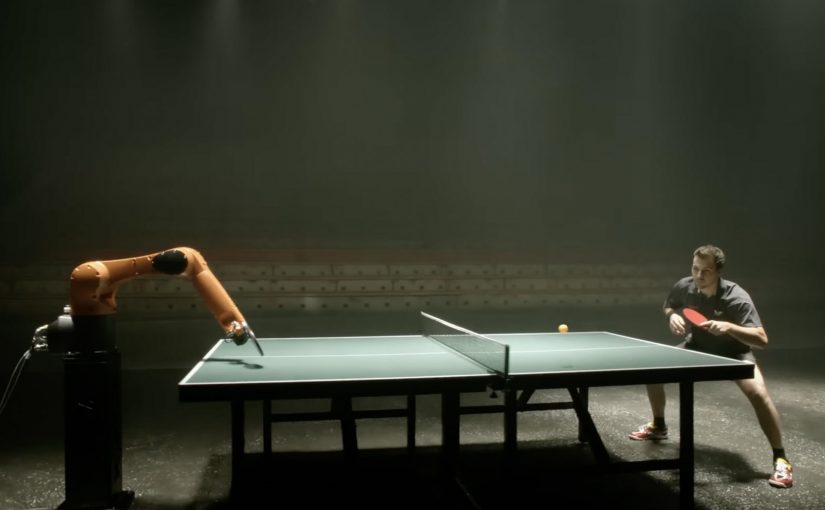
KUKA: The Duel – Timo Boll vs Robot Arm

KUKA is a market leader in industrial robotics. To provide a realistic vision of what robots can be capable of in the future and at the same time celebrate the opening of their new robotics factory in Shanghai, they got German table tennis champion and former world number one Timo Boll to take on a KUKA robot in what was billed as the first ever man versus robot (arm) table tennis match.

The match took place on March 11th in Sofia, Bulgaria. Since then the results of the match have been sliced and diced into the below final cut video that celebrates the inherent speed, precision, and flexibility of KUKA’s industrial robots in tandem with Boll’s electrifying and tactical prowess in competition.

A sports duel as an industrial demo

The mechanism is straightforward. Put a world-class human performer in a constrained arena. Put a robot arm in the same arena. Then shoot it like a movie. Tight angles, slow motion, dramatic beats, and a clear scoreboard narrative. The engineering message rides inside the entertainment. That works because the duel format makes speed, precision, and control visible before the viewer needs any technical explanation.

In B2B industrial categories, cinematic demonstration is often the fastest way to translate engineering attributes into mainstream attention.

The real question is how to make robotic precision feel obvious to people who will never read a spec sheet.

Why it lands

Table tennis is a smart choice because it compresses the value proposition into a single frame. Reaction time, repeatable precision, and control are all visible without a technical explanation. You do not need to understand robotics to understand a rally that never misses its mark.

Extractable takeaway: If your product advantage is “invisible” to most people, stage a head-to-head scenario where the advantage becomes legible in seconds, then edit the story so the viewer can feel the difference.

The intent behind the “first ever” framing

The “man vs. machine” line is a distribution strategy as much as a claim. It gives journalists, employees, and customers a simple hook. It also lets a factory opening travel beyond trade press, because the asset is watchable even if you have no interest in industrial automation.

What industrial marketers should copy

  • Turn specs into a duel: pick one human benchmark and make your performance measurable against it.
  • Choose a sport that explains you: the activity should naturally map to your differentiators.
  • Make the first 10 seconds self-explanatory: the premise should land without narration.
  • Edit for story, not documentation: the cut should create tension and release, not just show footage.
  • Provide a “making-of” layer: give engineers and buyers a deeper track once the headline video has earned attention.

A few fast answers before you act

What is “The Duel”?

It is a KUKA campaign video built around a staged table tennis match. Timo Boll plays against a KUKA robot arm, with the story edited like a cinematic showdown.

What is the campaign trying to prove?

Not that a robot “plays sport” like a human. The point is to make speed, repeatability, and precision feel real, fast, and memorable.

Why table tennis specifically?

Because the action is compact and readable. You can see reaction time and accuracy in a rally without needing technical context.

Is “man vs robot” the important part?

It is the packaging. The more transferable lesson is how the format turns complex capability into a simple, shareable demonstration.

What should B2B marketers copy from this?

Engineer a single, high-contrast scenario where your advantage is visible immediately, then ship both a headline cut for attention and a deeper “behind the scenes” layer for credibility.
Volvo Trucks: The Epic Split

Brands all over the world are trying to create branded content. Volvo did that with great success last month when they filmed a hamster drive their entire truck up a mountain.

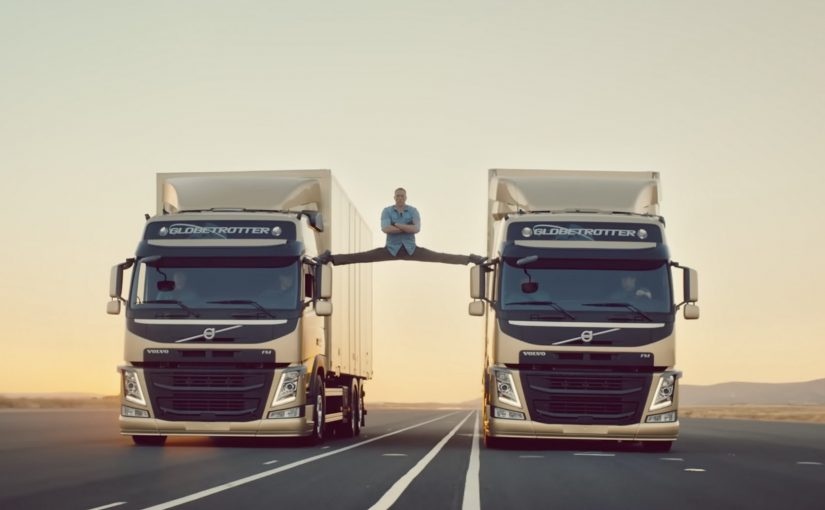
Now, Volvo demonstrates the precision and directional stability of its dynamic steering by getting Jean-Claude Van Damme to carry out his famous split between two reversing Volvo FM trucks. Here, “dynamic steering” refers to the steering system helping the truck hold a steady line under motion. The video, since release, is reported to have already passed 7 million views.

A feature demo disguised as spectacle

The mechanism is as clean as it gets. Take a technical claim, steering stability under motion. Express it in one unmistakable image that needs no explanation. Two trucks moving backwards in sync, a human balancing point-to-point between them, and the steering system as the silent hero.

In global industrial and automotive marketing, the most reusable branded content is engineered proof that compresses a technical benefit into a single, legible visual.

By “engineered proof,” I mean a demonstration where the product capability is the only plausible explanation for what you see.

Why the internet did the media buy for them

This lands because it is instantly readable and instantly arguable. People share it to say “this is real.” People share it to say “this is impossible.” Either way, the product claim travels with the argument.

Extractable takeaway: If your product advantage is hard to feel in a 30-second explanation, translate it into a one-frame “impossible” moment. The real question is “what made that possible.” Then let the audience debate the stunt while your feature becomes the answer.

It also avoids the common branded-content trap of overstorytelling. The brand stays in the background, the demonstration stays in the foreground, and the audience does the meaning-making in their own words.

How to borrow this pattern without a movie star

  • Start with one feature you can prove. Pick a claim that can be demonstrated, not merely asserted.
  • Design for instant comprehension. If a still frame cannot tell the story, simplify the setup.
  • Make the proof self-contained. The audience should not need a voiceover to understand what is being tested.
  • Keep the brand restraint. Overbranding weakens believability. Let the test carry the persuasion.

A few fast answers before you act

What is Volvo’s “The Epic Split” demonstrating?

It is designed to demonstrate the precision and directional stability of Volvo’s dynamic steering by showing two reversing trucks holding a steady path while Jean-Claude Van Damme performs a split between them.

Why does this count as branded content instead of “just an ad”?

The primary value is the demonstration itself. The content is built to be watched and shared as a feat, with the product benefit embedded in the feat rather than delivered as a sales message.

What makes a stunt like this more shareable than a typical product film?

Instant readability plus high stakes. A single image communicates the premise, and the audience immediately wants to test whether it is real, which drives sharing and discussion.

How do you know the spectacle is actually proving the feature?

If the moment works as a still frame, stays understandable without voiceover, and the technical claim is the only plausible explanation, then the spectacle is doing real demonstration work, not just decoration.

How can smaller brands apply the same approach?

Reduce the ambition, not the logic. Prove one feature with one clear test, make it understandable in one glance, and remove anything that distracts from the proof.

Volvo Trucks: The Hamster Stunt

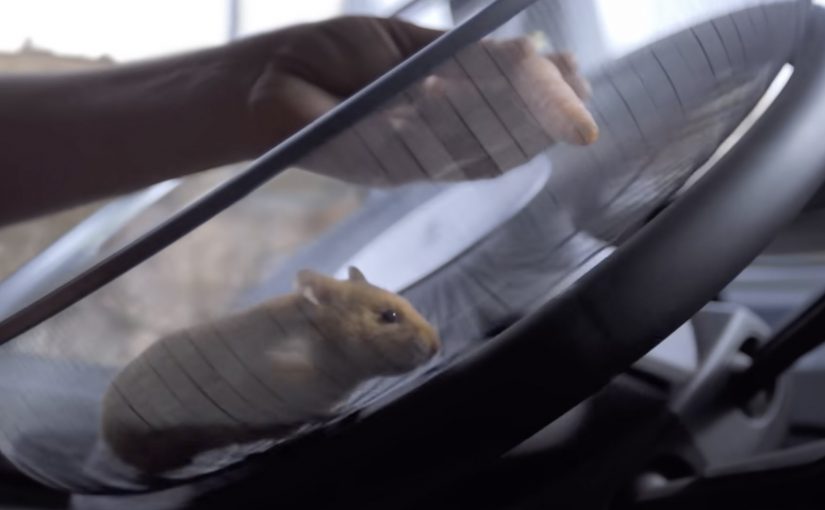
Brands everywhere are chasing branded content. Volvo Trucks picks a sharper route: it turns a technical feature into a spectacle by letting a hamster “steer” a Volvo FMX out of a quarry using Volvo Dynamic Steering.

The gag is simple to explain and hard to ignore. A hamster wheel is mounted to the steering wheel, and a precision driver handles pedals and safety while guiding the hamster with a carrot. The result feels like a ridiculous idea that somehow still proves something real.

When the product proof is the entertainment

Volvo Dynamic Steering is not an easy feature to dramatize in a way non-truck buyers want to watch. This film solves that by making “light steering” visually absurd, then grounding it with a credible live-test frame. A live-test frame is a visibly real setup that keeps the demonstration believable even when the idea is silly.

In global B2B and industrial marketing, this is a clean blueprint for turning an engineering benefit into mass-reach content without losing the proof.

The real question is whether your product proof can be watched by people who will never buy the thing.

B2B brands should bias toward demos that carry the claim in the image, not explanations that require patience.

Why the hamster works as a device

The hamster is not just cuteness. It is a proxy for “minimum force.” If a tiny animal can move the wheel, the viewer instantly understands the claim before any explanation arrives.

Extractable takeaway: If you can embody your benefit in a single visual proxy, the claim lands before the explanation.

That is the key branded-content trick: build an image that carries the message on its own, then let the technical story catch up afterwards.

Reported reach, and the deeper lesson

Volvo Trucks reports the film drew millions of views quickly, and industry press echoes that early momentum. The bigger point is not the number, it is the audience expansion. A feature aimed at fleet operators becomes something broadly watchable because the demonstration is designed like a story, not a spec.

What to copy from the hamster stunt

  • Turn the benefit into a visual impossibility that still stays true.
  • Keep the proof readable without narration, the image should carry the claim.
  • Use a live-test frame so entertainment does not undermine credibility.
  • Design a one-sentence retell, “a hamster steers a truck” is instant recall.

A few fast answers before you act

What feature is Volvo proving here?

Volvo Dynamic Steering, positioned as making the steering feel unusually light and precise even in demanding conditions.

Is the stunt “real” or purely visual effects?

It is presented as a controlled live test executed in a managed environment, with safety handled by a precision driver while the hamster influences the steering wheel.

Why does this count as strong branded content?

The product truth is inseparable from the story. The plot only works because the feature exists, which makes the content feel earned rather than bolted on.

What makes this approach effective for B2B brands?

It recruits non-buyers as viewers. When the demo is entertaining on its own, reach grows beyond the immediate purchase audience, while still reinforcing the proof.

What is the biggest risk when copying this pattern?

If the spectacle overwhelms the claim, people remember the stunt but not the feature. The visual must map cleanly to the benefit.