

S-Oil: HERE Balloons

Seoul is often described as having one of the world’s highest levels of gasoline consumption, and parking space is scarce. The everyday cost is not just frustration. It is fuel burned while circling for a spot. One widely cited estimate frames it as roughly 15km a month driven just to find parking, which can add up to about a litre of fuel wasted per driver.

To reduce that waste, South Korean oil brand S-Oil teamed up with Cheil Worldwide and tried a simple visibility hack. In practice, that means turning hidden parking availability into a physical signal drivers can read from a distance. Bright yellow HERE balloons were set up for each parking space. When a car parked, the balloon dropped. When the car left, it rose again. Drivers could spot the balloons from far away and head straight to open spaces without wandering.

A parking signal you can see from across the lot

The mechanism is low-tech but precise. Each space gets a tall, arrow-shaped balloon tethered so that occupancy physically pulls it down. Availability lets it float up. The whole system turns a hidden status. “Is this space free?” into a visible skyline of yes and no.

In dense Asian megacities where time, congestion, and emissions compound daily, the best “smart city” ideas are often the ones that remove searching rather than adding instructions.

The real question is how quickly you can make a hidden status visible enough to remove wasted movement at scale.

Why it lands

This works because it attacks a behaviour, not an attitude. Drivers do not need to be persuaded to care about fuel. They just need the environment to stop making them waste it. The balloons cut decision time, reduce aimless loops, and make the correct action obvious without signs, apps, or learning curves.

Extractable takeaway: When your outcome depends on reducing “search”, do not ask people to change intent. Change visibility. Make the correct option legible from far away, and the behaviour shifts on its own.

What the results are described to show

Campaign reporting describes the one-day test as saving about 23 litres of fuel across roughly 700 cars. The same reporting frames the real opportunity as scale. If you replicate a small efficiency across many lots and many days, the cumulative savings become meaningful.

What parking and place teams can steal

  • Turn status into a skyline. If availability is the problem, make it visible at distance.
  • Prefer passive systems over active ones. No app installs, no user training, no instructions needed.
  • Design for the first two seconds. The idea must be understood instantly from a moving car.
  • Measure the behavioural delta. Track circling reduction, time-to-park, and fuel impact, not just “awareness”.

A few fast answers before you act

What are S-Oil “HERE” balloons?

They are arrow-shaped balloons installed above parking spaces that rise when a space is free and drop when a car occupies it, so drivers can spot availability from a distance.

What problem does the idea solve?

It reduces fuel and time wasted while drivers circle looking for a space by making empty spots immediately visible.

Why use balloons instead of an app?

Balloons work for everyone instantly, without installs, connectivity, or attention on a screen. The signal is in the environment where the decision happens.

What results were reported?

Campaign reporting describes a one-day test where roughly 700 cars saved about 23 litres of fuel, with larger savings possible if scaled.

How can a city or brand adapt this approach?

Pick a “hidden” status that causes wasted movement, then create a physical signal that is readable at distance and updates automatically with the real-world state.
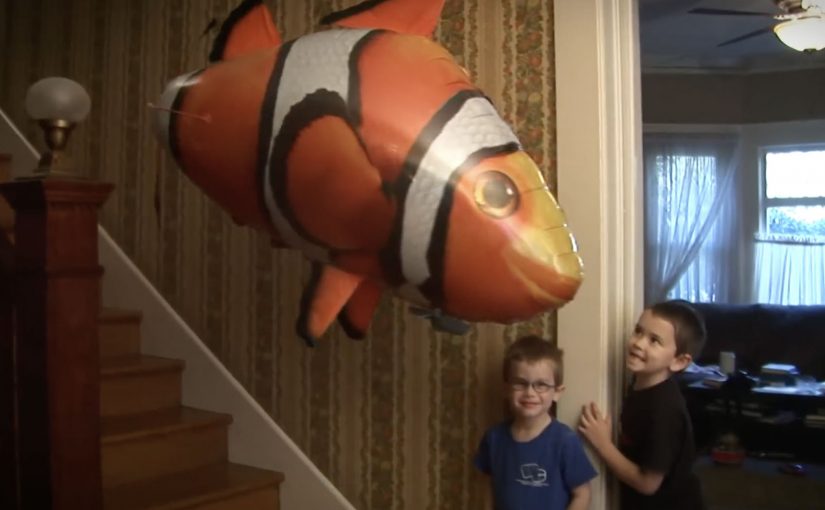
Air Swimmers: Flying Shark and Clownfish

Have you ever seen a fish that can swim in the air with smooth, life-like motion. Air Swimmers is a US-based company that developed these remote controlled, helium-filled flying fish.

They are designed for indoor fun even in small rooms. Air Swimmers describes them as running on four AAA batteries, one in the body and three in the controller, with up, down and 360 degree turning control.

How it works

The mechanism is lighter-than-air buoyancy plus simple steering controls. The helium does the lifting. The controller provides direction and small adjustments that make the movement read as “swimming” rather than “flying”. The technology fades into the background, and the illusion becomes the product.

In consumer retail for playful tech products, the fastest path from curiosity to purchase is a demo that looks impossible at first glance, but becomes obvious after ten seconds of watching it move.

The real question is how quickly your demo turns “that can’t be real” into “I want to try that”.

Lead with the impossible-looking motion first, and let the explanation come second.

Why it lands

It delivers a clean emotional sequence. Surprise first. Then control. The viewer sees it drift like a creature, then realises someone is steering it with precision. Because buoyancy handles the lift, small steering inputs read as effortless, which makes the motion feel alive and shareable. That makes it instantly shareable because the value is visible without narration or specs.

Extractable takeaway: If your product’s value is delight, design a demo that creates a visible illusion, then reveal just enough control to make people want to try it themselves.

Guerrilla activation lessons from Air Swimmers

  • Make the demo the message. If the value is visual, build your marketing around one clip that proves the experience in seconds.
  • Use “living motion” as the hook. Here, “living motion” means movement that reads like a creature rather than a machine, so people treat it as a moment worth filming.
  • Turn everyday space into a stage. Air Swimmers were also used as a guerrilla execution for SEA LIFE Speyer in Germany. Reported coverage describes Leo Burnett Frankfurt sending “flying sharks” through Frankfurt, including public locations and public transport, to turn the city into a temporary “aquarium” and build awareness for the aquarium in the Rhein-Main region.
  • Design for spectators, not only users. The best stunts create a second audience. Passers-by who do not control the object still get the full story.

A few fast answers before you act

What is an Air Swimmer?

A helium-filled balloon “fish” you steer indoors with a handheld controller, designed to move with a swimming-like motion through the air.

Why does it feel more impressive than other RC toys?

Because buoyancy handles the “floating,” so the control inputs translate into smooth, creature-like movement rather than noisy, mechanical flight.

What makes a product like this easy to market?

The demo is the message. One short clip communicates the full value without specs, because the motion is the proof.

Why was this a good fit for a SEA LIFE guerrilla execution?

Because it is thematically aligned with marine life, instantly attention-grabbing in public spaces, and it creates a moving spectacle people want to film and talk about.

What should the first ten seconds of the demo show?

Start with the “impossible” floating motion, then reveal the steering control quickly, so people understand it is real and want to try it.

Chang Soda: Fizzy Billboard

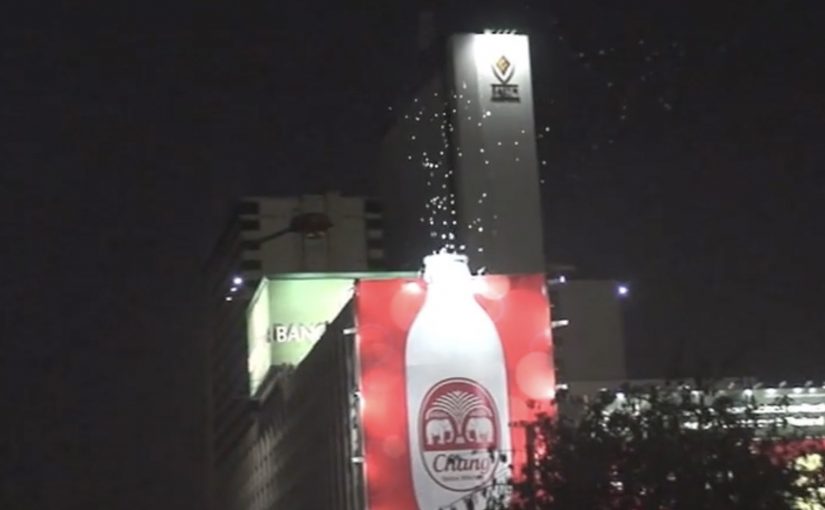
A giant Chang Soda bottle towers over a busy Bangkok shopping area. At the right moment, the cap “pops” and a burst of white balloons shoots out like carbonation escaping from a freshly opened drink.

Seeking new ways to create an impact in today’s sea of daily ad bombardment while taking into account shrinking budgets is quite a challenge. Chang’s Fizzy Billboard did just that, described as a reminder of how effective a great billboard idea can be when it turns a product truth, a single attribute the product can credibly own, into a public spectacle.

This is an outdoor activation that uses a physical effect, balloons released from the bottle, to dramatize “fizz” in a way that can be understood in a single glance.

The mechanism that makes it memorable

The creative leap is not the billboard. It is the “fizz”. Balloons are cheap, visible from far away, and they behave like bubbles in motion. Because of that, the claim becomes tangible even for people who only catch the moment in passing.

In FMCG categories where products are hard to differentiate at shelf, a single unmistakable physical metaphor in public space can outperform a week of polite messaging.

Why it lands as a shareable street moment

The payoff is time-based. People hear that “something happens” and they wait. When the burst comes, it reads instantly and creates a crowd reaction that becomes part of the communication. The effect also photographs well, which helps the idea travel beyond the street.

Extractable takeaway: If you want OOH to earn sharing, build a visible cause-and-effect that people can describe in one sentence, then make the payoff repeatable enough to be worth waiting for.

What the brand is really buying

This is a salience play. The goal is to make “Chang equals fizzy” stick through a short, repeatable spectacle, and to borrow the credibility of a real-world stunt rather than relying on a purely filmed illusion. The real question is whether you can turn one attribute into a repeatable moment people will stop for and retell. If you have to choose, back one literal, repeatable effect instead of spreading budget across polite static placements.

Steal-worthy rules for spectacle OOH

  • Make one product truth physical. Choose the one attribute you want remembered and build the effect around it.
  • Design for distance. If it does not read from across the street, it will not earn attention.
  • Use a predictable moment. A scheduled payoff creates anticipation and word of mouth.
  • Keep the metaphor literal. People should get it before they think about it.

A few fast answers before you act

What is Chang’s “Fizzy Billboard”?

An outdoor activation for Chang Soda where a giant bottle billboard appears to “pop” and release balloons like fizz, turning carbonation into a public spectacle.

Why use balloons for a soda message?

Balloons are inexpensive, highly visible, and they move like bubbles. That makes “fizzy” readable in one second from a distance.

What makes this kind of billboard more effective than a standard print-only OOH?

It creates a moment, not just an image. A time-based spectacle earns attention, crowd reaction, and secondary sharing that static posters rarely trigger.

What business outcome is this designed to influence?

Brand salience and attribute ownership. It aims to make the brand strongly associated with “fizz” versus competitors.

What is the biggest execution risk with spectacle billboards?

If the payoff is unclear or inconsistent, people feel tricked. The effect must be obvious, repeatable, and easy to explain in one sentence.