
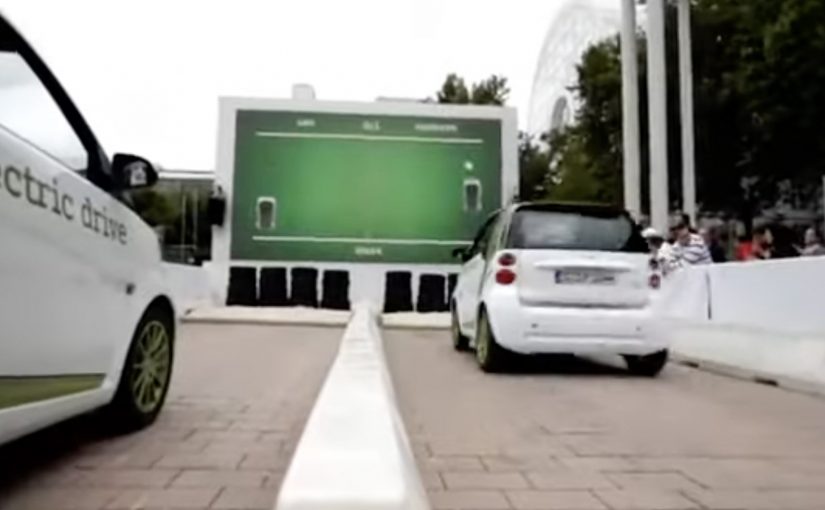
smart: eBall interactive ping pong duel

smart: eBall interactive ping pong duel

At the Frankfurt Motor Show (IAA) in 2011, Daimler promoted the third generation smart fortwo electric drive with a special interactive game event. Berlin-based Proximity BBDO designed a game called eBall that translates the joy of a highly responsive car into something visitors can play.

Visitors sign up with their driver’s license, get quick instructions on forward and reverse, and then step into a live ping pong duel. Instead of a controller, they use the car itself. Driving forward and back moves the “paddle,” with measurement technology tracking the rally on a large display.

When “responsive” becomes the gameplay

Electric drive messaging often struggles because it is full of abstractions. Efficiency, torque, responsiveness. eBall makes one of those claims physical. The faster and more precisely you control forward and reverse, the better you play. That is a rare alignment. The product behaviour is the mechanic.

Extractable takeaway: If your product promise is about control, speed, or precision, build an experience where performance is visible to a crowd and felt by the participant in under a minute.

In European automotive launches, live interaction works best when it turns a technical attribute into a simple skill people can feel and repeat.

The real question is whether your interaction turns the claim into a repeatable skill, not a slogan.

The tech trick is invisible on purpose

As described in coverage of the installation, the paddles on the LED wall are controlled by two real smart fortwo electric drive cars using laser measurement and transmission technology. The important detail is not the hardware. It is the immediacy. When the wall responds instantly, the player trusts the cause-and-effect and stays in the duel.

Why the driver’s license step matters

The license check does two jobs. It manages safety and liability, and it creates a small “this is real” threshold. You are not playing a simulator. You are operating a vehicle in a branded arena. That seriousness increases attention, and it makes the win feel earned.

What smart is really selling here

eBall does not try to convince you with specs. It frames the car as a fun, responsive object that behaves like a sports device in the hands of the driver. The subtext is clear. If it can play ping pong with precision, it will feel effortless in tight city driving too.

Moves worth copying in event mechanics

  • Translate one attribute into one action. “Responsive” becomes “hit the ball back.” No extra storytelling required.
  • Design for spectators. The LED wall makes the game readable from distance, so the crowd becomes the amplifier.
  • Keep the control model binary. Forward and reverse is legible, teachable, and low-cognitive-load.
  • Make the feedback immediate. Interactivity only feels truthful when response is fast.
  • Engineer the queue. A duel format naturally builds anticipation and repeat attempts.

A few fast answers before you act

What is smart eBall?

It is a live event game where visitors play a ping pong style duel by driving a smart fortwo electric drive forward and backward to control a digital paddle on a large screen.

Why does ping pong fit an electric city car story?

Because it is a precision game. It makes responsiveness and control visible in a way a brochure cannot, and it fits the “small, agile, quick” associations smart wants to own.

What makes this different from a normal driving simulator?

The controller is the vehicle, and the outcome is public. That changes the psychology from private play to performance, which increases energy, memorability, and word of mouth.

What is the biggest operational risk with this kind of activation?

Latency, safety, and throughput. If the system lags, people stop trusting the interaction. If safety or queue management fails, the experience becomes stressful instead of fun.

What should brands measure in a “playable product demo” like this?

Participation rate, average dwell time, repeat plays, audience size over time, and how many people capture and share the experience, plus any downstream test-drive or lead signals.

Mercedes-Benz Vans: Key to Viano

Mercedes-Benz Vans: Key to Viano

A commuter points a car key at a digital billboard and clicks the remote. The screen reacts. Suddenly, the advertising display stops behaving like outdoor media and starts behaving like interactive entertainment.

That is the core mechanic behind “Key to Viano”, an interactive outdoor event for Mercedes-Benz Vans created by Lukas Lindemann Rosinski on Wall AG’s digital out-of-home (DOOH) displays in Berlin’s U-Bahn station Friedrichstraße. Passers-by are invited to use their own remote car keys to control the content on the screens, turning a familiar everyday object into the controller.

In high-traffic urban DOOH environments, the quickest path to attention is to turn an existing habit into viewer control, with a payoff that feels immediate and public.

The experience works because the interaction is self-explanatory. Press the button you already know. Watch the screen respond. The line between ad and game collapses, and the crowd becomes part of the moment because everyone can see the “trigger” happen.

Why the car key is the perfect interface

No download. No new behaviour. No instruction manual. A car key is already a remote control in people’s hands, so the activation feels intuitive instead of “techy”. That simplicity is what makes the experience legible from a distance, and what makes bystanders stop and watch.

Extractable takeaway: If you want interaction in public space, pick an input people already carry and trust, then make the response visible to everyone around them.

What Mercedes-Benz Vans is really proving

The stunt is framed as entertainment, but it is also a product metaphor. “Key to Viano” implies access, convenience, and a premium feel. When the participant can “open” a digital experience with a key, the brand gets to borrow the emotional cues of unlocking a car, without talking about features.

The real question is whether your idea can be explained in one glance, without staff, signage, or a QR code.

Interactive DOOH should earn its place by being instantly legible, not by adding layers of “smart” complexity.

What to borrow from Key to Viano

  • Use a controller people already trust. Familiar inputs reduce friction and increase participation.
  • Make the interaction visible. If the crowd can see what caused the screen to change, attention multiplies.
  • Keep the loop fast. Trigger. Response. Reward. A slow loop loses commuters.
  • Let the location do the targeting. Stations deliver high volume and natural dwell time without extra explanation.

A few fast answers before you act

What is “Key to Viano”?

It is an interactive digital out-of-home activation where passers-by control advertising screens using their own remote car keys, under the Mercedes-Benz Vans “Key to Viano” concept.

Where did the activation run?

It ran on digital displays at Berlin’s U-Bahn station Friedrichstraße.

Why does using a car key work so well?

Because it is an input people already understand. It removes download friction and makes the interaction feel natural and premium.

What is the main benefit of interactive DOOH like this?

It converts passive exposure into participation. Participation creates longer attention, stronger memory, and visible social proof from the crowd watching.

What is the biggest risk with interactive screens in transit spaces?

Complexity. If the interaction is not instantly clear, people walk past. The mechanic must be obvious in seconds.

MINI: Photo Box Billboard

MINI: Photo Box Billboard

A billboard that turns fans into the creative

MINI has launched an innovative electronic billboard on Berlin’s Kurfürstendamm shopping boulevard. The billboard is connected to a Photo Box booth that captures the faces of MINI fans and puts them onto a massive screen along with each participant’s favourite MINI model, for a chance to win their preferred car.

Contestants have four colours and four models to choose from, including the MINI Hatch, Convertible, Clubman and Countryman.

The mechanism: Photo Box in Berlin. Facebook everywhere else

On the street, you step into the Photo Box, clamp on a pair of headphones, pick your colour and model, and the system outputs a ready-to-share moment on a giant public screen.

Fans from around the world can also join through the MINI Facebook app, where you can snap a picture with your webcam wearing a pair of virtual headphones in your favourite MINI colour.

In high-footfall city retail corridors, interactive out-of-home turns passersby into opt-in media, where participants choose to become the message through participation.

The real question is whether you can turn a simple preference into a public moment people want to share.

Why it feels modern: ecommerce choice, but on a building

The experience borrows the best part of online shopping. Configuration, without forcing the rest of it: specs, comparisons, and checkout. Because the billboard outputs a finished result in seconds, the act of choosing feels like content, not a form.

Extractable takeaway: When the environment publishes a participant’s choice at street scale, social proof becomes the distribution, and the moment feels bigger than a personal post.

The business intent: acquisition through identity

This is acquisition marketing that avoids hard selling. MINI lets people declare a preference. model plus colour. and then wraps that declaration in a contest mechanic. The brand gets reach, participation data, and a stream of shareable assets without asking people to create anything from scratch.

What to steal for your next interactive OOH build

  • Make the choice set small and satisfying. Four colours and four models is enough to feel personal, without feeling complex.
  • Design one iconic prop. Here, the headphones act as a visual signature that unifies street and Facebook participation.
  • Let the environment do the distribution. A giant screen creates built-in attention and bystander reach.
  • Mirror the experience online. The Facebook version keeps the same core mechanic so the idea travels beyond the location.

A few fast answers before you act

What is MINI’s Photo Box Billboard?

It is an interactive out-of-home billboard in Berlin where fans take a photo, choose a MINI model and colour, and see themselves displayed on a massive public screen, tied to a chance to win their preferred car.

How does the street mechanic work, step by step?

Step into the Photo Box. Pick your colour and model. The system captures your photo and outputs a finished, public “moment” on the billboard that is easy to share and talk about.

How does the Facebook app extend the same idea?

It mirrors the participation loop online. Fans take a webcam photo, add the campaign’s signature headphones motif in their chosen colour, pick a model, and participate without being in Berlin.

What role do the headphones play in the concept?

They are the visual signature that links the physical Photo Box experience to the Facebook version. One iconic prop makes the campaign instantly recognizable across channels.

Why does this work as acquisition marketing, not just a stunt?

It turns preference into a visible artifact. People declare model and colour, then the street-scale screen adds social proof and bystander reach while the brand collects intent signals.

What should you measure if you build something like this?

Participation rate, completion rate, average time to choose, shares, and downstream lead or test-drive intent. Also track whether the billboard creates bystander attention, not only participant engagement.