
Adshels with Difference: IKEA LEDshel and ANAR

Here are two adshel innovations currently doing rounds online. An adshel is a street shelter advertising unit, typically at a bus stop. Both use the media surface itself as the message, not just a place to hang a poster.

Ikea LEDshel

IKEA swapped the regular neon tubes found in adshels around Vienna with its LED range. The product becomes the medium, and the demonstration happens at full scale in the street. Credited to DDB Tribal Vienna, the move turns “better light” into something you can experience, not just read about.

Only for children

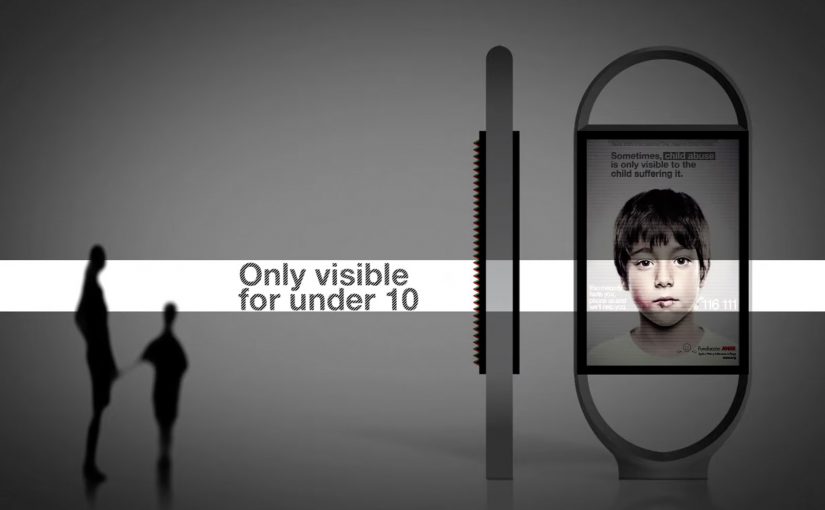
In an effort to give abused children a safer way to reach out for help, the Spanish organization Fundación ANAR created an ad that displays a different message to adults and children at the same time.

The poster uses a lenticular top layer to show different images at varying angles and heights. An adult sees the image of a sad child with the line: “sometimes, child abuse is only visible to the child suffering it.” A child sees bruises and a direct help message with a phone number. This work is widely credited to Grey Group España.

What makes these “adshels with difference”

The shared mechanism is simple: upgrade the shelter from a passive frame into an active communicator. One example changes the hardware so the ad site demonstrates the product. The other changes the optical layer so the message adapts to who is looking.

Because the shelter itself performs the claim, the viewer can grasp the argument in seconds, which is why these ideas travel in public space.

In European city out-of-home media, small physical changes to the site often persuade more powerfully than a clever headline alone.

The real question is whether your out-of-home idea still works when the media unit itself has to do the explaining.

These are the out-of-home ideas worth borrowing because the medium carries the proof, not just the copy.

Why it lands

It makes the proof unavoidable. IKEA does not claim “LED looks better.” It lets the street lighting show it. ANAR does not claim “victims can’t speak safely.” It builds a channel that protects the child in plain sight.

It respects context. Adshels sit in public space where attention is brief. Both ideas communicate at a glance, because the medium itself is doing part of the explanation.

It uses targeting without data. The lenticular execution “targets” by viewpoint and height, not cookies. It is a physical interface decision, not a digital one.

Extractable takeaway: Out-of-home innovations travel when the site behavior carries the argument. If the medium demonstrates the product, or adapts the message to the viewer’s vantage point, the campaign becomes self-explanatory and hard to ignore.

Borrowable adshel moves

  • Turn the placement into the demo. If the product has a sensory benefit, make the environment show it.
  • Use physical segmentation. Angle, distance, height, light, and motion can personalize a message without any personal data.
  • Design for public constraints. Fast comprehension wins. The structure should communicate before the copy finishes.
  • Let the medium do the persuasion. When the execution is the proof, the message needs fewer claims.

A few fast answers before you act

What is an “adshel” in this context?

A street shelter advertising unit, typically at bus stops, that combines a poster frame with lighting and protective glass.

What is the IKEA LEDshel idea actually demonstrating?

LED lighting quality in real conditions. The shelter itself becomes a live showroom for the light range.

How does the ANAR poster show two messages at once?

Through a lenticular layer that changes what is visible based on viewing angle and height, so adults and children see different visuals and text.

Why is this more effective than a standard awareness poster?

Because it delivers a help message to the child without alerting the accompanying adult, which is the real constraint in the situation.

What is the reusable principle across both examples?

Make the media unit behave like the idea. When the medium demonstrates, adapts, or protects, the campaign does not need heavy explanation.
World’s Biggest Hug: Christ the Redeemer PSA

A monument-sized gesture

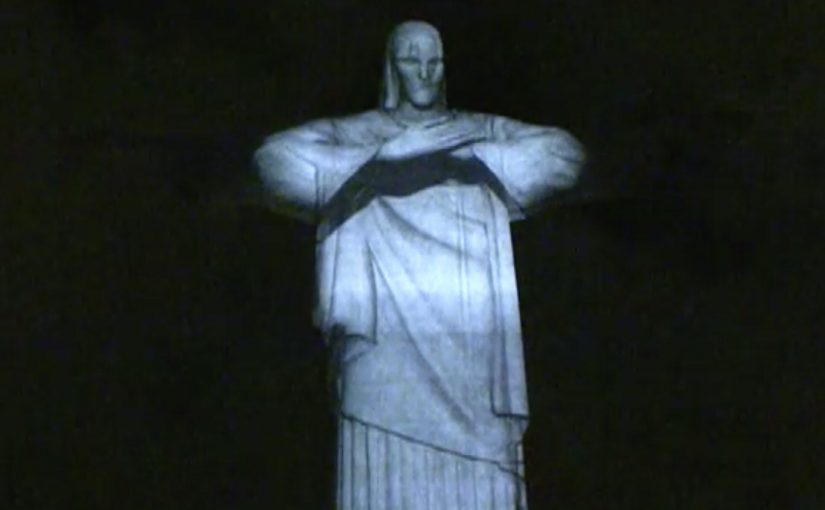
In October 2010, Conselho Nacional do SESI ran a campaign described as the “world’s biggest hug” by using the Christ the Redeemer statue in Rio de Janeiro as the canvas.

Across two nights, the statue’s spotlights were switched off and replaced with projections and 3D imagery that made it look like Christ was closing his arms around the city. The moment linked back to the Carinho de Verdade (“True Affection”) campaign, built to raise awareness of sexual abuse affecting children and teenagers and to promote healthier relationships of trust.

Visualfarm Brazil created the projection using Coolux Germany’s Pandoras Box technology. Below is the recorded footage of the projection itself.

How the illusion works. A quick mechanics recap

The execution combines three things: a landmark people already read as a symbol of protection, a temporary “blackout” that resets attention, and projection mapping that makes a static surface feel alive.

Projection mapping is the practice of aligning video to the exact geometry of a 3D surface so the object appears to change shape, gain depth, or move, even though nothing physical moves.

In global public-awareness communications, landmark-scale stunts work best when the symbolism is instantly legible and the path from emotion to action is frictionless.

Why it lands when it could have been “just a stunt”

The hug is a universal gesture with a clear meaning. It does not need translation, and it carries warmth without feeling like a lecture. Using the Christ the Redeemer silhouette makes that meaning immediate at city scale, then the darkness-to-light reveal gives it a shared “you had to be there” quality that naturally travels by word of mouth and video.

Extractable takeaway: If your message is difficult, start with a human gesture everyone understands, then let the medium amplify it, and only then introduce the cause and the action you want people to take.

The intent behind the hug

This is cause communication that uses emotional clarity as a bridge into a harder conversation. The strongest public-awareness work starts with an emotionally legible act before it asks people to absorb the harder message. The real question is how to turn a monument-scale emotional moment into a cause message people can approach instead of avoid. The job is not only awareness. It is to make the topic speakable, reduce avoidance, and give the public a simple next step that feels aligned with the warmth of the symbol.

What to steal from this for your next public-facing campaign

  • Pick one unmistakable symbol. Use a form people recognize in under a second, then change it in a way that supports the message.
  • Engineer a “collective moment.” Limited time windows create urgency and social proof, especially when the result is visibly shareable.
  • Design for cameras, not just crowds. If it does not read clearly on a phone video, it will not scale beyond the live audience.
  • Keep the CTA emotionally consistent. If you lead with care, the action should feel like care too, not like a hard switch to bureaucracy.

A few fast answers before you act

What was “The World’s Biggest Hug” campaign?

It was a Carinho de Verdade campaign moment in Rio where projections on Christ the Redeemer created the illusion of the statue hugging the city, used to draw attention to child and teen sexual abuse and encourage healthier trust-based relationships.

How did the projection create a “hug” effect?

The statue’s normal lighting was turned off, then mapped visuals were precisely aligned to the statue’s 3D surface so the arms and body appeared to move and close around the city.

Why use a monument instead of a standard ad placement?

A monument compresses meaning. People already attach emotion and identity to it, so the message is understood faster and shared more willingly than a conventional placement.

What role did the campaign site play?

It provided the action path. The public moment created attention and emotion, and the site anchored the message, participation, and follow-through.

What is “projection mapping” in one sentence?

Projection mapping is video projected onto a real-world object with the visuals warped and timed to the object’s geometry so it appears to transform or move.

What is the main transferable principle?

Use a simple, human symbol to earn attention, then make the next step feel effortless and consistent with the emotion you created.