
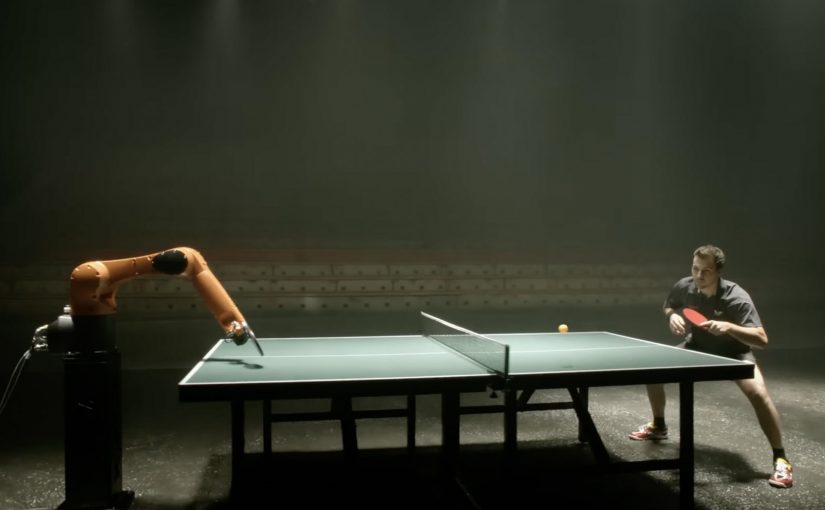
KUKA: The Duel – Timo Boll vs Robot Arm

KUKA is a market leader in industrial robotics. To provide a realistic vision of what robots can be capable of in the future and at the same time celebrate the opening of their new robotics factory in Shanghai, they got German table tennis champion and former world number one Timo Boll to take on a KUKA robot in what was billed as the first ever man versus robot (arm) table tennis match.

The match took place on March 11th in Sofia, Bulgaria. Since then the results of the match have been sliced and diced into the below final cut video that celebrates the inherent speed, precision, and flexibility of KUKA’s industrial robots in tandem with Boll’s electrifying and tactical prowess in competition.

A sports duel as an industrial demo

The mechanism is straightforward. Put a world-class human performer in a constrained arena. Put a robot arm in the same arena. Then shoot it like a movie. Tight angles, slow motion, dramatic beats, and a clear scoreboard narrative. The engineering message rides inside the entertainment. That works because the duel format makes speed, precision, and control visible before the viewer needs any technical explanation.

In B2B industrial categories, cinematic demonstration is often the fastest way to translate engineering attributes into mainstream attention.

The real question is how to make robotic precision feel obvious to people who will never read a spec sheet.

Why it lands

Table tennis is a smart choice because it compresses the value proposition into a single frame. Reaction time, repeatable precision, and control are all visible without a technical explanation. You do not need to understand robotics to understand a rally that never misses its mark.

Extractable takeaway: If your product advantage is “invisible” to most people, stage a head-to-head scenario where the advantage becomes legible in seconds, then edit the story so the viewer can feel the difference.

The intent behind the “first ever” framing

The “man vs. machine” line is a distribution strategy as much as a claim. It gives journalists, employees, and customers a simple hook. It also lets a factory opening travel beyond trade press, because the asset is watchable even if you have no interest in industrial automation.

What industrial marketers should copy

  • Turn specs into a duel: pick one human benchmark and make your performance measurable against it.
  • Choose a sport that explains you: the activity should naturally map to your differentiators.
  • Make the first 10 seconds self-explanatory: the premise should land without narration.
  • Edit for story, not documentation: the cut should create tension and release, not just show footage.
  • Provide a “making-of” layer: give engineers and buyers a deeper track once the headline video has earned attention.

A few fast answers before you act

What is “The Duel”?

It is a KUKA campaign video built around a staged table tennis match. Timo Boll plays against a KUKA robot arm, with the story edited like a cinematic showdown.

What is the campaign trying to prove?

Not that a robot “plays sport” like a human. The point is to make speed, repeatability, and precision feel real, fast, and memorable.

Why table tennis specifically?

Because the action is compact and readable. You can see reaction time and accuracy in a rally without needing technical context.

Is “man vs robot” the important part?

It is the packaging. The more transferable lesson is how the format turns complex capability into a simple, shareable demonstration.

What should B2B marketers copy from this?

Engineer a single, high-contrast scenario where your advantage is visible immediately, then ship both a headline cut for attention and a deeper “behind the scenes” layer for credibility.
Time Out Shanghai: The Stolen Phone Tour

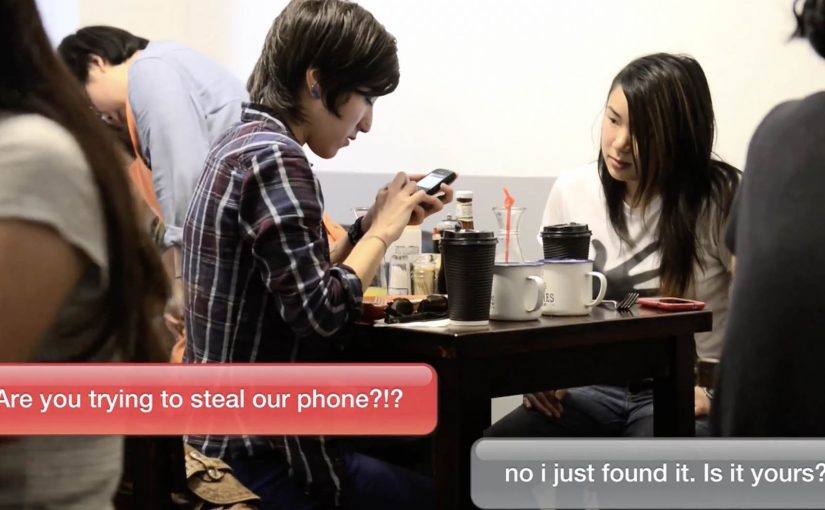
A phone lies abandoned on a Shanghai street. Someone eventually picks it up. Seconds later, the device starts talking back through text messages.

Time Out Shanghai uses that setup to promote its city guide with a stunt built with Energy BBDO Shanghai. The magazine purposely “loses” a phone at random. The moment a passerby takes it, the phone instructs them to “return” it by getting into a London taxi that pulls up right where they are. From there, the finder is driven across the city to a sequence of unexpected stops, guided only by messages on the phone, and captured through hidden cameras.

A guide that proves itself, one pickup at a time

The mechanic mirrors the product promise. Time Out Shanghai claims it digs deeper than obvious tourist checklists. So the campaign turns “discover hidden gems” into a lived tour, with the London cab acting as a moving stage and the phone acting as the guide. Reported write-ups describe stops that range from small local joints to high-concept dining and landmark nightlife, all chosen to signal insider curation rather than generic attraction lists. Here, insider curation means places that feel locally known rather than obviously tourist-facing. Because the participant experiences the recommendations in sequence instead of reading about them, the guide’s editorial promise feels proven rather than claimed.

In global city marketing and publishing, the fastest way to make “insider knowledge” believable is to demonstrate it as a guided experience, not explain it as editorial positioning.

Why the taxi twist works

The stunt manufactures a story that people want to finish. First curiosity, why is the phone messaging me. Then escalation, why is a London taxi here in Shanghai. Then payoff, the city reveals itself through a sequence of places the participant did not plan. The London cab is not just a visual gag. It is a nod to Time Out’s roots and a clear brand signature that makes the footage instantly recognizable.

Extractable takeaway: If your product claim is “we help you discover what you would miss,” build a live proof where the user stumbles into the benefit, then structure the journey so each step reinforces the claim without additional explanation.

What Time Out is really selling

This is less about a single guide edition and more about trust in curation. The real question is whether a city guide can make its curation feel trustworthy before anyone opens an issue. The campaign frames Time Out as an honest, street-level editor. Someone who can take you from random street corner to a surprising itinerary, and do it with confidence. That trust is what makes a city guide worth paying attention to in a market flooded with lists.

What brand-led city guides can copy

  • Turn your promise into a route. A sequence of experiences is more persuasive than a headline claim.
  • Use one unmistakable brand asset. The London cab functions as a moving logo without feeling like a logo.
  • Let the audience be the protagonist. The finder’s reactions do the selling more credibly than narration.
  • Design for retellability. “They lost a phone, then a cab picked you up” is a one-sentence hook that travels.

A few fast answers before you act

What is “The Stolen Phone Tour”?

A Time Out Shanghai stunt where a purposely “lost” phone guides the person who picks it up into a London taxi and across a curated set of city stops, filmed via hidden cameras.

Why use a phone as the guide mechanic?

Because it matches real behavior. People already rely on phones to navigate cities. The campaign turns that habit into a story engine that delivers location-by-location discovery.

What does the London taxi add beyond novelty?

It provides a distinctive brand signature and a clear narrative device. A taxi arriving to “retrieve” the phone is an immediate escalation that keeps the participant moving.

What is the biggest risk with a stunt like this?

Participant trust and safety. The experience must feel surprising but not threatening, and the instructions must keep the participant in control at every step.

When is this approach a good fit?

When your value is curation, expertise, or access. If you can demonstrate the benefit as a guided sequence, you can replace skepticism with lived proof.

Subway “Daredevil Delivery”

Subway was facing massive competition from other fast food chains in China. Mobile agency iconmobile was given the task to claim the mindsets of their target audience in an innovative way that also triggered sales.

A mobile game was created to let users step into the role of a subway delivery guy. Rather than just providing an emotional benefit, the app also included…

  • a map that provided direction to shops nearby
  • a click-2-call order function
  • a mobile coupon channel to trigger sales according to the users behaviour

Here, a mobile coupon channel means offers delivered through the phone based on what the user does in the experience, not a generic discount blast.

Why the mechanics matter

The idea combines three practical conversion tools with gameplay. A nearby-store map reduces “where do I go”. Click-to-call reduces “how do I order”. Coupons reduce “why now”. The game gives all of it a reason to be opened in the first place. This is smart mobile thinking because it makes the route from attention to order materially shorter. The real question is how to turn a branded interaction into a faster path to purchase.

Extractable takeaway: entertainment works harder when it removes friction at the exact moment interest is highest.

In mobile-led fast food categories, this matters because attention is easy to win for a moment, but ordering friction still kills intent fast.

What Subway is really trying to do

The business intent is to turn branded play into store discovery, faster ordering, and timed coupon redemption.

What to borrow for mobile campaigns

  • Attach utility to entertainment. Games can drive attention, but the built-in tools drive action.
  • Keep the path to purchase short. If ordering is a tap away, intent has less time to cool down.
  • Use behaviour to time incentives. Coupons work better when they match what the user is doing in the moment.

A few fast answers before you act

What is Subway “Daredevil Delivery”?

A mobile game campaign in China that put users in the role of a Subway delivery guy, paired with tools that could trigger real orders.

Which agency created it?

iconmobile.

What features connected the game to sales?

A nearby-store map, a click-to-call ordering function, and a mobile coupon channel based on user behaviour.

Why is this stronger than a branded game on its own?

Because the game creates attention, while the map, call function, and coupon channel give that attention a direct path to store visits and orders.

What is the key lesson for mobile?

Pair a fun mechanic with immediate utility, so the experience can convert curiosity into action without friction.