
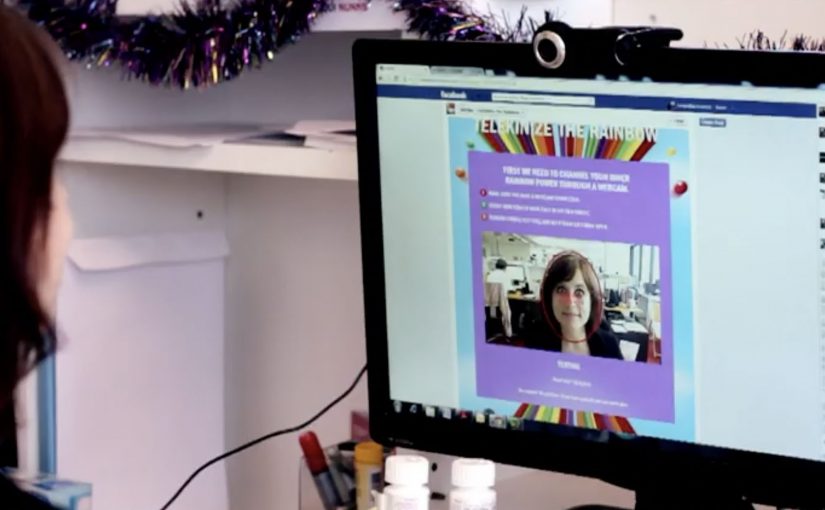
Skittles: Telekinize the Rainbow

You look at a single Skittle on a white surface, and it starts to move. The moment plays like telekinesis, the illusion that your mind can move an object. It is not a visual trick on a screen. It is a live feed of real Skittles being nudged around in the real world.

Skittles Australia and Clemenger BBDO build this as a Facebook experience because, as the case frames it, only a small minority of fans engage with a brand’s page after liking it. The goal is to make “like” feel like a superpower, not a dead end.

The trick is not mind control. It is eye control

The mechanism is webcam tracking plus a physical rig. Your eye movements, captured via webcam, are translated into commands sent to Wi-Fi-controlled robots attached to Skittles, so the candy moves in response to where you look.

In global consumer brands on social platforms, “engagement” only scales when interaction feels immediate and personal.

The real question is whether your activation turns a passive like into an active loop in under ten seconds.

In social platforms, turning passive likes into active participation usually comes down to one thing. Give people an interaction loop that feels immediate, personal, and worth showing to someone else.

Why it lands

It creates a clean “I need to try this” reaction in seconds. The live camera feed removes skepticism, and the physical motion makes the experience feel bigger than a typical Facebook app. It also bakes in a share-worthy narrative: the fan is not consuming content. The fan is controlling a real object.

Extractable takeaway: If you want engagement rather than reach, stop asking for attention and start granting control. A tiny moment of viewer control, tied to a brand asset, can outperform bigger content drops because the audience feels like the protagonist.

Campaign write-ups report that users spent an average of around four minutes interacting with the experience, and that page growth and app ranking spiked during the run.

What to steal for your next social activation

  • Make the mechanic visible. Live proof beats claims. If the audience can see it is real, they trust it faster.
  • Turn the brand into the interface. Here the “UI” is literally the product. That keeps the experience on-brand without extra messaging.
  • Design for one-person amazement and second-person sharing. The first user is impressed. The second user wants to replicate it.
  • Keep the loop short. Look. Move. React. Repeat. The faster the feedback, the longer people stay.

A few fast answers before you act

What is Telekinize the Rainbow?

A Facebook experience that lets people move real Skittles through eye movements captured by a webcam, with the motion executed by Wi-Fi-controlled robotics.

Is it actually mind control?

No. The “telekinesis” framing is the story. The control signal is eye movement, translated by software into physical movement.

Why is the live webcam feed important?

It proves the effect is happening in real space, which makes the experience feel more magical and more credible than a purely on-screen interaction.

Do you need eye tracking to borrow the pattern?

No. The transferable pattern is a tight input-to-output loop where the audience action clearly changes what they see, fast enough to feel like “power,” not a UI.

What is the main risk in copying this approach?

If setup friction is high or latency is noticeable, the illusion collapses. Experiences built on “power” need instant response to feel real.


Fantastic Delites: Human lab mice wheel stunt

People zip into mouse suits, step into a giant wheel, and start running. Keep the pace. Do not tumble. Hold the speed long enough and the reward drops. A free pack of Fantastic Delites, earned the hard way.

This “human lab mice” stunt from Fantastic Delites and agency Clemenger BBDO follows the earlier interactive vending machine installation, where the Delite-o-matic pushed people through button mashing and silly tasks for the same prize. Here, “human lab mice” means real people dressed as mice, running the wheel like a lab experiment. The idea stays consistent. If the snack is worth it, you will work for it.

The mechanism is brutally clear. The audience understands the rules in one glance, then sticks around for the inevitable slips, recoveries, and wipeouts. That is what makes it shareable. The product is the trophy, but the entertainment is the price of entry.

In Australian FMCG sampling, the fastest way to earn attention is to turn trial into a story people want to watch, not a handout people walk past.

Why the “lab mice” framing works

It flips the usual sampling dynamic. Instead of the brand chasing you with freebies, you chase the freebie. The mouse wheel is a physical metaphor for craving and persistence, and the costumes make the whole thing socially safe to laugh at.

Extractable takeaway: When you can make the “try” itself entertaining and socially safe, the crowd becomes your distribution, and the product becomes a trophy instead of a handout.

What the brand is really buying

This is not a rational product argument. It is a proof-by-behaviour message, meaning the audience infers quality from what people do, not what the brand claims. When real people are willing to look ridiculous for a snack, the snack gets a shortcut to “it must taste good.” The activation also turns one giveaway into many impressions, because spectators become the media. This kind of sampling is worth doing only when the challenge is the content and the reward stays modest. The real question is whether your sampling earns spectators before it earns trial.

Sampling takeaways for challenge-for-reward

  • Make the rules readable from 10 meters away. If people cannot explain it instantly, they will not stop.
  • Build a loop that produces moments. Near-fails, fails, retries, wins. That is natural entertainment.
  • Keep the reward proportional. Small prize, big fun. The contrast is the joke.
  • Design for a crowd. If spectators are part of the experience, distribution comes for free.

A few fast answers before you act

What happens in the Fantastic Delites “lab mice” stunt?

Participants wear mouse costumes and run inside a giant wheel. They have to maintain speed long enough to earn a free pack of Fantastic Delites from the Delite-o-matic.

Why does this count as effective sampling?

Because it turns product trial into a public spectacle. The giveaway is small, but the attention is large, and the story is easy to retell.

How is this connected to the Delite-o-matic?

It uses the same behavioural premise. People will do surprisingly effortful things for a free snack, and that behaviour becomes the message.

What is the key design principle behind this kind of activation?

Clarity plus consequence. Clear rules create instant understanding. Visible failure creates tension and humour. Together they keep people watching.

What is the biggest risk with “challenge for reward” stunts?

Making the challenge feel unfair or too slow. If success looks impossible, the crowd loses interest. If success looks too easy, there is no drama.

NAB: The Honesty Experiments

Australian bank NAB positions Australians as an honest lot, and argues they deserve honest credit cards to match. To bring that promise to life, they conducted a series of “honesty experiments” and published the results on YouTube.

Incorrect Change

Lost Wallet

Leaky Pockets

From a product claim to a public proof loop

The mechanism is a classic credibility builder. A “public proof loop” means turning a claim into a repeatable test, then publishing the outcome so the audience can judge it. Run simple real-world tests where people can choose honesty, film the outcome, then let the audience do the judging rather than the brand doing the telling.

In retail banking categories, trust is built faster through observable behaviour than through promises and price claims.

The real question is whether a trust claim can be converted into something people can judge for themselves.

For trust-starved categories, this is a stronger play than another round of product-feature messaging.

Why it lands

These films work because they invite a low-friction emotional conclusion. People want to believe the best of others, and the experiments are structured to deliver that relief, then attach it to the brand stance. The content is also inherently shareable because it is about character, not about banking mechanics.

Extractable takeaway: If you want to own “trust,” do not describe it. Show a behaviour that audiences can recognise as trust in action, then connect it back to the product promise in one simple line.

Then NAB escalates to “thank you” in real time

To say thanks in the biggest possible way, NAB followed the experiments with a real-time stunt that thanked honest passers-by immediately after they returned lost objects.

What the second phase adds that video alone cannot

  • Immediate reciprocity. Honesty is met with an instant reward, not abstract praise.
  • A bigger emotional beat. Surprise gratitude creates a stronger memory than “you did the right thing.”
  • Proof at street level. The brand shows up in the moment of integrity, not after the fact.

What to replicate from NAB’s honesty experiments

  • Pick one human truth. “Most people are honest” is clearer than a bundle of values.
  • Design the choice point. The story lives in a single decision. Keep it simple and legible.
  • Let people self-identify. The viewer should be able to imagine themselves in the situation.
  • Add a second act. If phase one proves the belief, phase two can reward it and deepen the brand role.
  • Protect credibility. Be transparent about rules and ensure the reward does not feel staged or selective.

A few fast answers before you act

What are the “honesty experiments” in one sentence?

A set of filmed, real-world tests where strangers can choose to act honestly, used to support NAB’s “honest credit cards” positioning.

Why do social experiments work for trust-based brands?

They replace claims with observable behaviour. Viewers decide what the outcome means, which feels more credible than advertising language.

What does the real-time thank-you stunt add?

It turns the brand from narrator into participant, rewarding honesty immediately and creating a stronger emotional memory.

What is the biggest risk with this format?

Credibility erosion. If viewers suspect manipulation, selective editing, or unclear rules, the trust message can backfire.

What should you measure beyond views?

Brand trust lift, message association with the product, sentiment, share rate, and whether the work changes consideration versus competitors in the same period.