
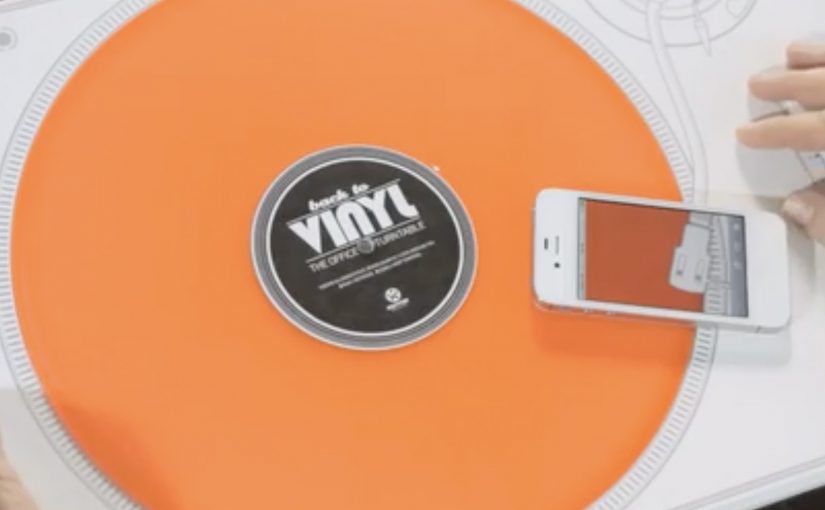
Back to Vinyl: The Office Turntable

Demo CDs created by music labels are often treated like spam. So to promote a new track from DJ Boris Dlugosch, Kontor Records decided to send out a bright orange vinyl along with a 2D turntable as part of a direct mailing.

The people who received the mailing activated the turntable by scanning the QR code on it. That simple action enabled the missing piece of the turntable on the user’s smartphone, which then allowed them to play the music by placing the phone over the “deck”.

Making the mailer do the work

The mechanism is a tight little trick. The envelope becomes the turntable. The QR code becomes the start button. The smartphone becomes the “needle”. It is analogue theatre powered by a digital unlock, meaning the physical format itself becomes a short performance the recipient has to complete, and it forces the recipient to complete the experience instead of ignoring it.

In B2B marketing where your audience is drowning in promos, the fastest way to earn attention is to turn the first interaction into a short, satisfying action that cannot be skipped.

Why it lands

This works because it turns listening into participation. You do not just receive a track. You assemble the moment, and the novelty is directly tied to the product. The design also flatters the target. It treats creative directors like DJs. People with taste and a fondness for well-made objects. Because the recipient has to scan, place, and play, the mechanic turns passive exposure into participation, which makes the track harder to ignore and easier to remember.

Extractable takeaway: If your content is easy to ignore, do not beg for attention with more messaging. Engineer a simple physical or digital action that unlocks the content, and make that action feel like a reward rather than a chore.

The real question is how you make the format itself impossible to ignore before the message even starts. This is a stronger approach than sending another promo that asks for attention without earning it.

The numbers are the proof

According to campaign case-study reporting, 71% of 900 mailings were activated via the QR code. The same reporting notes that 42% of recipients also visited the Kontor site. For a target group known for deleting promos on sight, that is the clearest signal that the mechanic did its job.

How to make direct mail behave like a product

  • Build a “first step” that is irresistible. If the first step is fun, the rest of the funnel happens almost accidentally.
  • Fuse the medium and the message. Here, the packaging is the product experience, not just a container.
  • Use phones as functional components. Not as a second-screen gimmick, but as a literal missing part.
  • Target the ego carefully. Positioning recipients as tastemakers, not “buyers”, increases the odds they will engage.

A few fast answers before you act

What is “The Office Turntable”?

It is a direct mail piece for Kontor Records where the envelope folds into a paper turntable, and a smartphone activated via QR code completes the player so the recipient can listen to a vinyl release.

Why use vinyl instead of a promo CD?

Because vinyl is a status object and a curiosity trigger. It signals “this is different” before any copy is read.

What role does the QR code play?

It is the activation switch. Scanning it unlocks the mobile component that makes the paper turntable usable.

What results were reported?

Case-study reporting cites 71% activation across 900 mailings, and 42% of recipients visiting the Kontor site.

How do you apply this pattern without copying it?

Turn your distribution format into a usable object, then make one simple action unlock the content. The best versions feel like a clever tool, not a stunt.
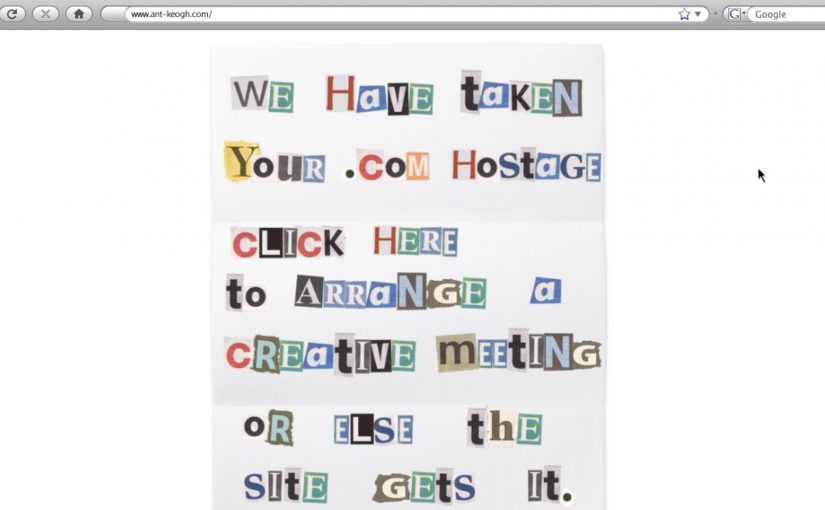
The Creative Ransom: Domain Hijack Job Hunt

In May 2010 an aspiring creative from the USA used Google to play upon the vanity of some top American creatives and land himself interviews and eventually a job.

Then in July 2011 a Dutch creative team created “The Twitter Hustle” to land a job with a big agency in the Netherlands.

Now an Aussie creative team consisting of Andrew Grinter and Lee Spencer-Michaelsen take the job hunt to the next level. Their approach is to stand out from the crowd by buying domain names matching top creative directors in Melbourne, then sending ransom notes that point each target to their “hostage” URL.

The daring move gets them interviews. They are reported to have worn ski masks to those interviews, and still managed to get hired. The duo are also reportedly working for DTDigital, a division of Ogilvy Melbourne.

Ransom as a résumé

The mechanism is engineered interruption. First, choose a tiny list of people who can actually say “yes”. Next, buy the unclaimed name domains that would naturally belong to them. Then send a physical ransom note that forces a single action. Type the URL. When they land, the “ransom page” is really a portfolio pitch, personalised through the director’s own name.

In creative industry hiring markets where inbox outreach gets ignored, targeted disruption works when it is unmistakably personal and immediately resolves into craft.

Why it gets meetings

This is high-wire theatre with a simple psychological hook. You cannot half-notice your own name on a domain. The note creates curiosity and a tiny sense of urgency, and the landing page converts that spike of attention into proof of creative thinking.

Extractable takeaway: If you need decision-maker attention, design a one-to-one interruption that is impossible to confuse with spam, then make the first click deliver immediate evidence of your value.

The line between bold and dumb

There is a reason this one divides opinion. “Ransom” framing and identity-adjacent tactics can feel aggressive, even if the domains were available to buy. The stunt works as a story because it is extreme. That also makes it easy to copy badly.

The real question is whether the stunt creates enough admiration for the thinking before the intimidation becomes the headline.

What to steal without copying the threat

  • Steal the targeting. Make a short list of the only people who matter, and design for them.
  • Steal the personalisation. Use a bespoke hook that cannot be forwarded without losing its power.
  • Steal the proof-on-click. The first interaction should instantly demonstrate craft, not promise it.
  • Drop the menace. Keep the theatre, remove the coercion. Surprise beats intimidation.

A few fast answers before you act

What is “The Creative Ransom”?

A self-promotion job hunt where a Melbourne creative duo buys domain names matching senior creative directors, then uses ransom-style notes and landing pages to force a portfolio view and secure interviews.

What is the core mechanism?

Highly targeted interruption plus extreme personalisation. The target’s own name becomes the channel, and the landing page becomes the pitch.

Why does it work as a piece of communication?

It compresses a full narrative into one action. Open note. Type URL. See personalised page. The story is instantly retellable.

What should I copy from this, safely?

Copy the focus on a tiny list, the one-to-one hook, and the immediate proof of ability. Avoid coercive framing and anything that could be read as a threat.

What is a modern equivalent?

A personalised experience that appears exactly where a decision-maker already looks, then delivers unmistakable proof in seconds. Think bespoke microsites, tailored prototypes, or targeted creative drops, without the intimidation layer.