
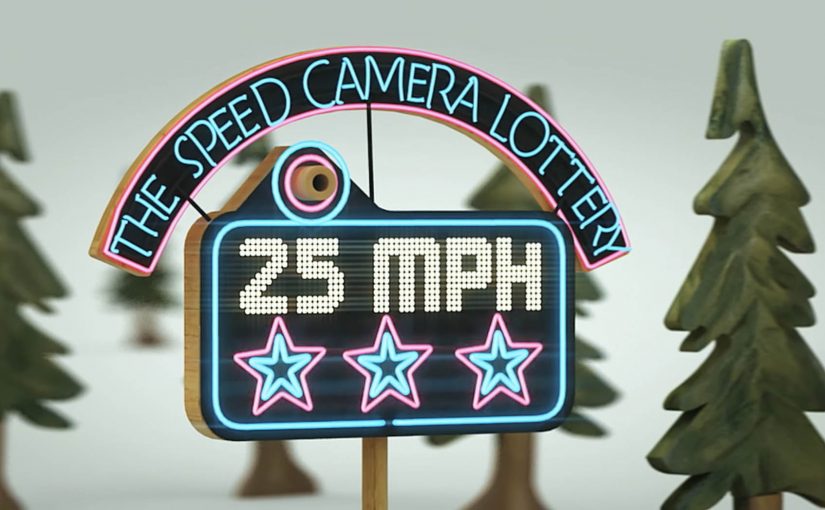
The winning idea of the Volkswagen fun theory award was submitted by Kevin Richardson, USA.
Can we get more people to obey the speed limit by making it fun to do. This is the question Kevin’s idea answers, and Volkswagen, together with The Swedish National Society for Road Safety, makes the idea real in Stockholm, Sweden.
A speed camera that rewards, not just punishes
The core twist is simple. The concept is described as a lottery wrapped around a speed camera. Drivers who pass at or under the speed limit are entered into a draw. The prize money is described as coming from the fines paid by drivers who speed.
That inversion matters because it changes the emotional frame. Instead of “the camera is there to catch me”, the camera becomes “a chance to win if I do the right thing”.
The mechanic: turn compliance into a game loop
The loop is short and repeatable:
- Trigger: you approach the monitored zone.
- Action: you choose to stay within the limit.
- Reward: you are entered into a lottery, and someone wins.
- Reinforcement: the story travels because “I won by driving properly” is novel.
Why it lands: it makes “doing the right thing” emotionally positive
Most enforcement is built on fear of loss. This flips motivation into the hope of gain, without removing consequences for speeding. It keeps the stick, but adds a carrot that people actually want.
Extractable takeaway: If you want everyday behavior to change, do not only increase the cost of the bad action. Add a visible, repeatable reward for the good action, and make the reward easy to understand in one glance.
In urban road-safety environments, messaging often underperforms because it feels like punishment instead of shared benefit.
The real question is how to make compliance feel desirable often enough that people repeat it without being re-taught each time.
What the brand really gets from this
Volkswagen is not selling a feature here. It is sponsoring a philosophy. Make better choices feel desirable, and the brand becomes associated with modern, optimistic problem solving rather than lecturing.
That is also why the execution travels so well as a film. It is a simple story with a surprising twist, and it is easy to retell without technical explanation.
What to steal for your own behavior-change campaign
- Pay attention to framing: the same rule feels different when it is presented as “win” versus “don’t get caught”.
- Make the rule legible instantly: people must understand the mechanic in seconds.
- Design for repeat exposure: behavior change needs loops, not one-off impressions.
- Fund rewards credibly: link the reward source to the problem so it feels fair.
- Keep it measurable: define the behavior metric first, then build the experience around it.
A few fast answers before you act
What is the Speed Camera Lottery?
It is a road-safety concept where drivers who obey the speed limit are entered into a lottery, making compliance feel rewarding rather than purely punitive.
Why does adding a lottery change behavior?
It introduces a positive incentive that people talk about. The hope of gain can be a stronger daily motivator than the fear of a fine for many drivers.
Does this replace enforcement?
No. The idea is described as keeping normal enforcement for speeding, while adding a reward layer for drivers who comply.
What makes this a “Fun Theory” idea?
It tries to prove that fun, not just rules, can shift behavior. The experience makes the better choice feel more attractive in the moment.
What should you measure if you copy this?
Average speed and speed variance at the intervention point, compliance rate over time, and whether the effect persists once novelty fades.
