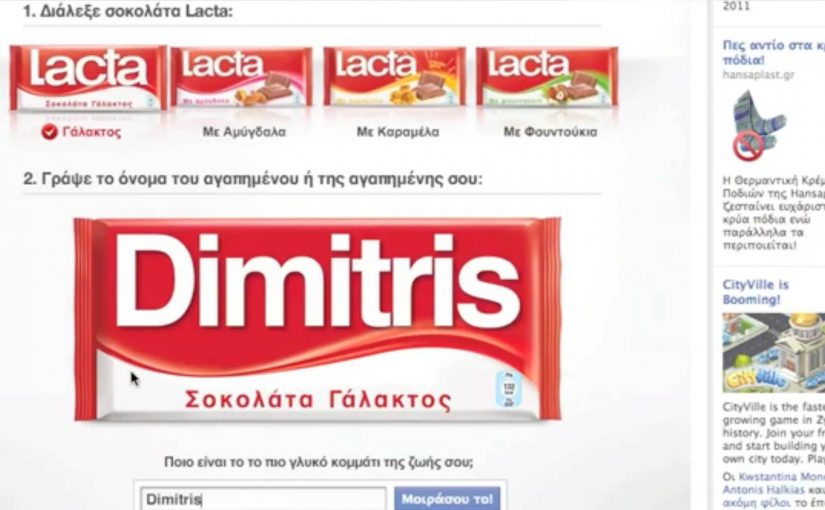
You open the Lacta Chocolate Facebook app, type your loved one’s name, and customise a Lacta wrapper around them. The app matches them to a Lacta flavour, then you push it out as a wall-to-wall post, meaning a highly visible Facebook share that others can see, react to, and copy. In seconds, your “love message” becomes something your friends can respond to and replicate.
The app idea. Turn affection into something people want to publish
The app is built around a simple insight. People naturally compare their loved ones with chocolates. Lacta turns that behaviour into a lightweight creation tool, so the output is personal, visual, and instantly shareable. This works because the branded asset carries the user’s own relationship signal, so posting it feels expressive rather than promotional.
Why some Facebook apps explode while others flop
Plenty of Facebook apps chase scale and get nothing. The real question is why anyone would want to publish the result in the first place. The strongest social tools do not ask people to share a campaign. They give people something about themselves worth sharing.
Extractable takeaway: Social tools spread when the output helps people express identity or affection in public, because the brand travels inside a social signal the user already wants to send.
1) Simplicity
A couple of clicks to get to the app and to the point of action.
2) Shareability
All the standard sharing features that make it easy to spread.
3) Insight
Something a fan might actually use, comment on, and share.
Who builds it, and what the traction looks like
Once again OgilvyOne Athens gets into action and creates an app that lets people customise a Lacta chocolate wrapper in their loved one’s name and compare them to a particular Lacta flavour, before using the wall-to-wall post feature to get the message across.
For Lacta, the business intent is clear. Turn private affection into branded public visibility that fans distribute for free.
In consumer brands using social platforms as lightweight participation channels, this matters because the strongest ideas convert self-expression into distribution without adding friction.
In just over a month the app generates over 150,000+ fans, with thousands using personalised chocolate wrappers as profile pics.
What to steal if you build shareable social tools
- Make the output the share. The personalised wrapper is the thing people want to publish, not a link to the app.
- Keep the creation flow brutally short. Name input plus one decision is enough to get to a finished artefact.
- Use a familiar emotional trigger. Affection and gifting makes the action feel socially safe, not promotional.
- Design for copying behaviour. Seeing someone else’s personalised wrapper naturally prompts “make mine”.
A few fast answers before you act
What is the Lacta Chocolate Facebook app in one sentence?
It is a simple Facebook app that lets you personalise a Lacta wrapper with a loved one’s name, match them to a flavour, and share it as a wall-to-wall post.
Why does this app spread?
Because the output is personal and visual, the creation flow is fast, and the sharing mechanic is built into the final step.
What are the three success factors highlighted here?
Simplicity, shareability, and a real insight that people actually want to express publicly.
What is the business value behind the interaction?
It turns a private affection signal into branded public visibility, so distribution happens through what users already want to share.
What is the key execution lesson to copy?
Make the “thing people share” the natural end product of the interaction, not an optional add-on after the fact.