
Volvo Trucks: The Hamster Stunt

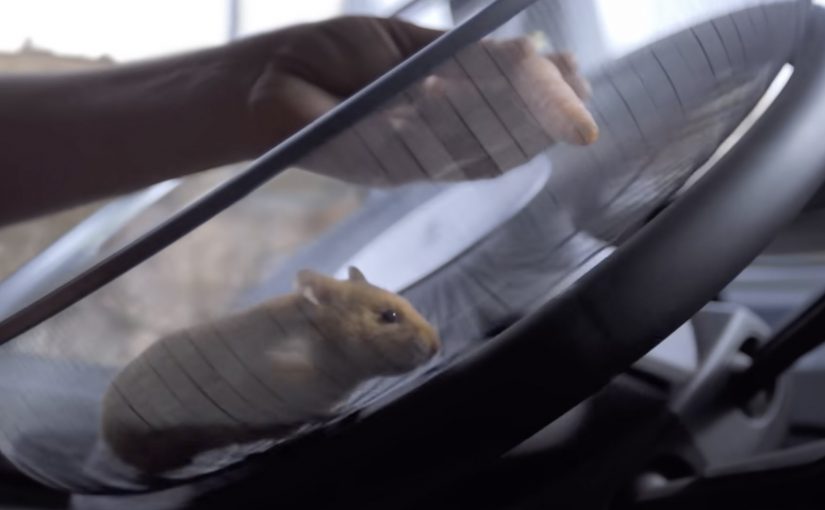
Brands everywhere are chasing branded content. Volvo Trucks picks a sharper route: it turns a technical feature into a spectacle by letting a hamster “steer” a Volvo FMX out of a quarry using Volvo Dynamic Steering.

The gag is simple to explain and hard to ignore. A hamster wheel is mounted to the steering wheel, and a precision driver handles pedals and safety while guiding the hamster with a carrot. The result feels like a ridiculous idea that somehow still proves something real.

When the product proof is the entertainment

Volvo Dynamic Steering is not an easy feature to dramatize in a way non-truck buyers want to watch. This film solves that by making “light steering” visually absurd, then grounding it with a credible live-test frame. A live-test frame is a visibly real setup that keeps the demonstration believable even when the idea is silly.

In global B2B and industrial marketing, this is a clean blueprint for turning an engineering benefit into mass-reach content without losing the proof.

The real question is whether your product proof can be watched by people who will never buy the thing.

B2B brands should bias toward demos that carry the claim in the image, not explanations that require patience.

Why the hamster works as a device

The hamster is not just cuteness. It is a proxy for “minimum force.” If a tiny animal can move the wheel, the viewer instantly understands the claim before any explanation arrives.

Extractable takeaway: If you can embody your benefit in a single visual proxy, the claim lands before the explanation.

That is the key branded-content trick: build an image that carries the message on its own, then let the technical story catch up afterwards.

Reported reach, and the deeper lesson

Volvo Trucks reports the film drew millions of views quickly, and industry press echoes that early momentum. The bigger point is not the number, it is the audience expansion. A feature aimed at fleet operators becomes something broadly watchable because the demonstration is designed like a story, not a spec.

What to copy from the hamster stunt

  • Turn the benefit into a visual impossibility that still stays true.
  • Keep the proof readable without narration, the image should carry the claim.
  • Use a live-test frame so entertainment does not undermine credibility.
  • Design a one-sentence retell, “a hamster steers a truck” is instant recall.

A few fast answers before you act

What feature is Volvo proving here?

Volvo Dynamic Steering, positioned as making the steering feel unusually light and precise even in demanding conditions.

Is the stunt “real” or purely visual effects?

It is presented as a controlled live test executed in a managed environment, with safety handled by a precision driver while the hamster influences the steering wheel.

Why does this count as strong branded content?

The product truth is inseparable from the story. The plot only works because the feature exists, which makes the content feel earned rather than bolted on.

What makes this approach effective for B2B brands?

It recruits non-buyers as viewers. When the demo is entertaining on its own, reach grows beyond the immediate purchase audience, while still reinforcing the proof.

What is the biggest risk when copying this pattern?

If the spectacle overwhelms the claim, people remember the stunt but not the feature. The visual must map cleanly to the benefit.
Faktum Hotels: Book a Night Outside

Gothenburg in Sweden is reported to have about 3,400 homeless people. Most find a roof over their heads with a friend or at a refuge, but some even sleep in the open air.

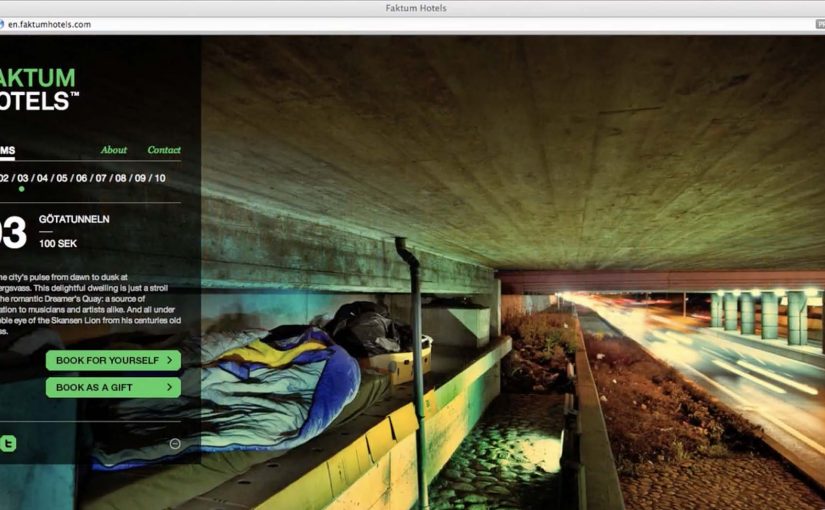
So in a charity campaign that tries to harness the spirit of giving and consideration, Forsman & Bodenfors chose ten places where people might spend the night and made it possible for any one of us to book them, just like any hotel. All the money raised through this www.faktumhotels.com project is then directed towards Faktum’s work for the homeless.

A hotel with no walls

The mechanism is brutally literal. Take locations that are normally ignored, photograph them like “rooms”, write the descriptions in the familiar language of travel booking, and put a price on the night. The booking flow becomes the donation flow, and the “inventory” is a list of public places that should not be inventory at all.

In European cities, social impact campaigns often struggle to turn sympathy into a concrete action that is simple, immediate, and shareable.

Why the idea hits so quickly

It works because it steals a format people trust. A hotel booking interface is a comfort ritual, full of predictable signals. Then it swaps the comfort for cold reality. That contrast creates instant moral clarity without a lecture, and it invites action without asking people to research charities or navigate guilt.

Extractable takeaway: When awareness is not the problem but inertia is, borrow a mainstream interface people already know, and map your desired behaviour onto it. Reduce the action to one familiar choice and one familiar transaction.

What the “booking” really means

Because these are public places, the booking is best understood as symbolic support, not a guaranteed reservation. In this case, symbolic support means paying to fund Faktum’s work, not claiming the place for personal use. The point is not to encourage tourism-by-hardship. The point is to make the hidden visible, and to route money to Faktum’s work through a frictionless, culturally legible mechanic.

The real question is how to turn a familiar commercial action into an ethical act of support without diluting the reality behind it.

This is not about selling the experience of homelessness. It is about converting recognition into support.

Proof, not a promise

The concept is also a craft statement. The photography and the deadpan hotel language do the persuasion work. The campaign received major industry recognition, including a Guldägg and a One Show Gold Pencil for its craft, which underlines how well the execution carries the idea.

What to steal from the booking mechanic

  • Hijack a trusted format. Use an interface or ritual your audience already understands, then subvert it with purpose.
  • Make the donation feel like a normal purchase. Familiar steps reduce hesitation and increase completion.
  • Let craft do the arguing. Straight photography and restrained copy can outperform emotive pleas when the concept is strong.
  • Design for sharing without adding share buttons. If the mechanic is surprising, people share it naturally.

A few fast answers before you act

What is Faktum Hotels?

It is a fundraising concept that presents outdoor sleeping locations as “hotel rooms” you can book online. The payment functions as a donation to support Faktum’s work related to homelessness.

Why use a hotel booking mechanic?

Because it is familiar and low-friction. The contrast between a comfortable interface and uncomfortable reality creates attention and makes the next step obvious.

Is the booking a real reservation?

No. The locations are public, so the booking is best treated as symbolic support rather than a guaranteed spot.

Who created the campaign?

It was created for Faktum with Forsman & Bodenfors credited as the agency behind the idea and execution.

What is the transferable lesson for other causes?

Turn support into a simple, recognisable transaction. Borrow a mainstream choice model, then route the payment directly into impact.