
ChatGPT Model Changes: Who Pays?

ChatGPT reported that an approved document update was blocked and sent the task to ChatGPT Work. When I checked, it had prepared the updated file but never tried to save the changes to Google Drive.

I spent three days trying to get my existing setup working reliably with the newer ChatGPT models. Instead, I was carrying more of it in my head. There were documented execution failures, but no controlled evidence that a model change caused them.

This is the transition cost I want to make visible. Transition cost is the human effort needed to keep an established workflow dependable through an AI model change. For marketing, CRM and customer experience leaders, the practical lesson is to test workflow completion and recovery alongside the quality of the answer.

The working system: more than a conversation

I use ChatGPT with a Second Brain. Second Brain is my maintained collection of working notes, reference material and agreed rules. Those rules cover current sources, approval boundaries, document staging, verification and temporary-file cleanup.

In earlier posts, I explored how my Second Brain became an operating model, the work left after AI says it has finished and why greater AI capability does not automatically mean greater value. This experience raised another question: what happens to an established working system when the model changes?

My Second Brain setup is eight months old, and I’ve refined its workflows and governance over that time. The move from GPT-5.6 Sol to GPT-6 Astra in ChatGPT Work was the first time I had to revise its governance instructions for a major model update. My existing instructions were not being followed consistently. I went back to GPT-5.6 Sol and worked with it to create an onboarding process to check how a new model would work with my Second Brain.

That process made the checks explicit: which current sources the assistant should use, which actions were technically available, which were authorized, and how completed work should be verified. It gave me a structure for checking whether the new model could work within the agreements I had already established.

I also reviewed whether my instructions and governance needed adjustment. For Astra, I did make changes. Stable governance did not mean keeping every sentence untouched.

The experience felt like rebuilding part of the working relationship. I was only trying to establish continuity within the system I already used.

I later investigated another round of problems while working with GPT-6 Sol and GPT-6.1 Sol. The investigation recorded cases where an action was already authorized and a procedure existed, but the assistant still did not carry the work through.

The execution gap: prepared is not completed

For the stalled update, a file-based recovery procedure had already been documented. The assistant prepared the replacement Markdown and obtained a usable file reference, but did not call the action that would update the existing document.

That distinction matters. An attempted update rejected by a service is one kind of evidence. An update never submitted is another. ChatGPT had not tried to save the changes to Google Drive, so there was no failed save attempt to support its claim that the update was blocked.

I still needed the document saved. ChatGPT Work completed that particular handoff and verified the result. Later, when I explicitly directed regular ChatGPT to use the documented Python-based fallback, it updated the existing file and verified the complete saved contents.

Those were useful recoveries. They also required me to remember the working procedure, challenge the diagnosis and direct the next step.

I needed to know whether ChatGPT would complete authorized work without me managing the route to completion.

The human cost: supervising the supervisor

I was checking more than the quality of an answer. I was checking whether an action had been attempted, whether a blocker had evidence and whether the assistant was judging the right scope.

Coordination returned to me because the workflow depended on my remembering successful procedures, correcting interpretations and prompting the next authorized action.

For marketing, CRM and customer experience teams, that is a risk to evaluate wherever an assistant participates in briefs, approvals or handoffs.

I also had to check ChatGPT’s own checks. In one case, it claimed that all the conversation’s material knowledge had been preserved, then withdrew that claim after acknowledging it had reviewed only selected excerpts. In another, it saved the passage I had requested but called the task incomplete because other parts of the conversation were missing. I had never asked it to save those parts.

I had to correct both the work and the assessment of the work.

As more recovery moved into ChatGPT Work, I also encountered capacity pressure. I reset my ChatGPT Work usage limit twice in 24 hours and began questioning whether I needed a more expensive subscription. That did not establish that paying more would repair the failures.

The experience left me with a fairly uncomfortable conclusion:

I started out trying to train AI to work for me. Three days later, I realised I had become its debugger, supervisor and quality-control department.

The diagnosis: no single proven cause

The write history included failures under both tested models. Reconnecting the Google account and reinstalling the Drive plugin was followed by successful writes, but later sessions still reported blockers. Two subsequent updates also passed verification with the prior content and file identity preserved.

Those successful updates contradicted what Gemini had told me: that regular ChatGPT could not save those changes to Google Drive. They did not establish a permanent repair across sessions or explain why an available action had been left unattempted.

I also believe model upgrades can expose weaknesses in the instructions themselves. Wording can be ambiguous, checks can trigger too broadly, and rules can accumulate in the wrong place.

OpenAI’s own Astra guidance discusses how inherited instructions can overconstrain the model or encourage it to stop before the work is complete. It also describes problems with overly broad triggers and unnecessary checks. This is guidance about coding-agent workflows, not a diagnosis of my ChatGPT system, but it makes the counterargument worth taking seriously.

The answer is not to add a rule after every disappointment. First check whether an existing rule already covers the requirement and whether the assistant applied it. If the wording is unclear, improve it. If a technical handoff fails, investigate that failure. If an authorized step was never attempted, do not rename the omission as a proven platform limitation.

Revising my instructions should not mean giving ChatGPT more authority. The same approval and access boundaries still apply. A pause can be justified when authorization or a file’s eligibility for deletion is genuinely unclear. That is different from reopening a decision already supplied.

Connection state, tool handoffs and instruction-following problems were not cleanly isolated. That uncertainty limits the technical conclusion, not the human effort I experienced.

The acceptance test: measure unprompted completion

Workflow continuity means completing established work after a model change under the same rules for sources, approvals and verification. It belongs in the acceptance criteria for a ChatGPT model change.

A demonstration of a good answer is too narrow for that purpose. The real question is whether the replacement can finish familiar work without making the user reconstruct the process.

I would start with three representative tests:

  • Update an approved campaign brief. Use a noncritical document, preserve unrelated content and the existing file, then verify the saved result.
  • Carry a corrected decision forward. Save it in the right record and use the corrected version in the next step, without reopening a resolved decision.
  • Handle a blocker properly. Establish what was attempted and what failed, use an available authorized recovery route, or provide a complete handoff that retains the task and its approval boundaries.

Start with the current instructions. Keep inputs, available tools, execution surfaces and relevant settings consistent when comparing models. Repeat the checks in fresh sessions and record where the human had to intervene. If an instruction needs revision, make the smallest evidenced change and check the result again.

Separate necessary approvals from repeated approval requests. Separate a corrected result from first-attempt completion. A test that succeeds only after I supply the forgotten procedure demonstrates a recovery path, not unprompted reliability.

I have not tested a coordinated multi-model setup. Using several models could add interpretations of the same instructions and more handoffs to check. Clear responsibilities and common checks might limit that extra work.

ChatGPT continuity: include the recovery work

For a team adopting ChatGPT, someone should own the transition checks and record the recovery work. Otherwise, a successful final output can conceal the effort required to obtain it. My experience does not provide a universal cost figure. It provides a reason to count that effort before declaring an upgrade successful.

Takeaway: Before adopting a new ChatGPT model more widely, test representative work under the same instructions, approval boundaries and verification expectations. Record human corrections, repeated instructions, recovery steps and additional usage alongside the result. Change rules only when evidence identifies a need, preserve their safeguards and retest. Treat a successful recovery as evidence of that recovery, not proof of a dependable routine.


A few fast answers before you act

What is the human transition cost of a ChatGPT model change?

The human transition cost of a ChatGPT model change is the effort needed to keep established work dependable through the transition. It can include diagnosing interruptions, clarifying instructions, checking completion claims and directing recovery. The amount must be observed in the actual workflow, not assumed for every release.

Does a failure after a ChatGPT model change prove a regression?

A failure after a ChatGPT model change does not by itself prove that the replacement model caused it. Instructions, available context, connections, tools and permissions may also affect execution. Causal comparison requires matched conditions and evidence of actual attempts and results.

Does a successful ChatGPT file update prove that reliability is restored?

A successful ChatGPT file update establishes that the tested operation worked under those conditions. It does not prove consistent behavior across sessions or explain earlier failures. Repeated tests should distinguish independent completion from success achieved after corrective human prompting.

Should every ChatGPT execution failure lead to another instruction?

A ChatGPT execution failure should first be checked against the instructions already in place. Establish whether the rule was missing, ambiguous, unavailable or not followed. Revise wording only for an evidenced need, preserve safeguards and test the adjustment rather than assuming that another rule fixes execution.

Does a more capable ChatGPT model need broader authority?

A more capable ChatGPT model does not automatically need broader authority. Reading, editing, deleting and publishing are separate permissions. Keep existing approval boundaries unless the user explicitly changes them, while allowing already-authorized work to proceed within its agreed scope.

What practical test should precede wider adoption of a replacement ChatGPT model?

Test a new ChatGPT model on familiar, noncritical work and record both the result and the human intervention required. Repeat under matched conditions, including fresh sessions. Can the replacement model complete the same representative task under the same rules, with the same approval boundaries and verification expectations?
Use vs Integrate: AI Tools That Transform

The pilot phase is over. “Use” loses. “Integrate” wins.

Those who merely use AI will lose. Those who integrate AI will win. The experimentation era produced plenty of impressive demos. Now comes the part that separates winners from tourists. Making AI an operating capability that compounds.

Most organizations are still stuck in tool adoption. A team runs a prompt workshop. Marketing trials a copy generator. Someone adds an “intelligent chatbot” to the website. Useful, yes. Transformational, no.

The real shift is “use vs integrate”. By “integrate”, I mean embedding AI into governed, measurable workflows teams can repeat, not ad hoc tool experimentation. The real question is whether you can make AI repeatable, governed, measurable, and finance-credible across workflows that actually move revenue, cost, speed, and quality.

Because the differentiator is not whether you have access to AI. Everyone does. The differentiator is whether you can make AI repeatable, governed, measurable, and finance-credible across workflows that actually move revenue, cost, speed, and quality.

If you want one question to sanity-check your AI maturity, it is this: Who owns the continuous loop of scouting, testing, learning, scaling, and deprecating AI capabilities across the business?

What “integrating AI” actually means

Integration is not “more prompts”. It is process integration with an operating model around it.

In practice, that means treating AI like infrastructure. Same mindset as data platforms, identity, and analytics. The value comes from making it dependable, safe, reusable, and measurable.

Here is what “AI as infrastructure” looks like when it is real:

  • Data access and permissions that are designed, not improvised. Who can use what data, through which tools, with what audit trail.
  • Human-in-the-loop checkpoints by design. Not because you distrust AI. Because you want predictable outcomes, accountability, and controllable risk.
  • Reusable agent patterns and workflow components. Not one-off pilots that die when the champion changes teams.
  • A measurement layer finance accepts. Clear KPI definitions, baselines, attribution logic, and reporting that stands up in budget conversations.

When these components are standardized, variance drops and accountability increases, which is why integrated AI can scale beyond individual champions and one-off pilots.

This is why the “pilot phase is over”. You do not win by having more pilots. You win by building the machinery that turns pilots into capabilities.

In enterprise operating models, AI advantage comes from repeatable workflow integration with governance and measurement, not from accumulating tool pilots.

The bottleneck is collapsing. But only for companies that operationalize it

A tangible shift is the collapse of specialist bottlenecks.

Extractable takeaway: If the bottleneck moves but governance and measurement do not, speed turns into chaos instead of compounding advantage.

When tools like Lovable let teams build apps and websites by chatting with AI, the constraint moves. It is no longer “can we build it”. It becomes “can we govern it, integrate it, measure it, and scale it without creating chaos”.

The same applies to performance management. The promise of automated scorecards and KPI insights is not that dashboards look nicer. It is that decision cycles compress. Teams stop arguing about what the number means, and start acting on it.

But again, the differentiator is not whether someone can generate an app or a dashboard once. The differentiator is whether the organization can make it repeatable and governed. That is the gap between AI theatre, demo-driven activity with no repeatable integration, and AI advantage.

Ownership. The million-dollar question most companies avoid

I still see many organizations framing AI narrowly. Generating ads. Drafting social posts. Bolting a chatbot onto the site.

Those are fine starter use cases. But they dodge the million-dollar question. Who owns AI as an operating capability?

In my view, it requires explicit, business-led accountability, with IT as platform and risk partner. Two ingredients matter most.

  1. A top-down mandate with empowered change management

    Leaders need a shared baseline for what “integration” implies. Otherwise, every initiative becomes another education cycle. Legal and compliance arrive late. Momentum stalls. People get frustrated. Then AI becomes the next “tool rollout” story. This is where the mandate matters. Not as a slogan, but as a decision framework. What is in scope. What is out of scope. Which risks are acceptable. Which are not. What “good” looks like.

  2. A new breed of cross-functional leadership

    Not everyone can do this. You need a leader whose superpower is connecting the dots across business, data, technology, risk, and finance. Not a deep technical expert, but someone with strong technology affinity who asks the right questions, makes trade-offs, and earns credibility with senior stakeholders. This leader must run AI as an operating capability, not a set of tools.

    Back this leader with a tight leadership group that operates as an empowered “AI enablement fusion team”. It spans Business, IT, Legal/Compliance, and Finance, and works in an agile way with shared standards and decision rights. Their job is to move fast through scouting, testing, learning, scaling, and standardizing. They build reusable patterns and measure KPI impact so the organization can stop debating and start compounding.

    If that team does not exist, AI stays fragmented. Every function buys tools. Every team reinvents workflows. Risk accumulates quietly. And the organization never gets the benefits of scale.

AI will automate the mundane. It will transform everything else

Yes, AI will automate mundane tasks. But the bigger shift is transformation of the remaining work.

AI changes what “good” looks like in roles that remain human-led. Strategy becomes faster because research and synthesis compress. Creative becomes more iterative because production costs drop. Operations become more adaptive because exception handling becomes a core capability.

The workforce implication is straightforward. Your advantage will come from people who can direct, verify, and improve AI-enabled workflows. Not from people who treat AI as a toy, or worse, as a threat.

There is no one AI tool to rule them all

There is no single AI tool that solves everything. The enterprise job is to map tools to workflow roles inside the stack you already run, then govern how they connect to content, CRM, analytics, service, and commerce workflows.

Also, not all AI tools are worth your time or your money. Many tools look great in demos and disappoint in day-to-day execution.

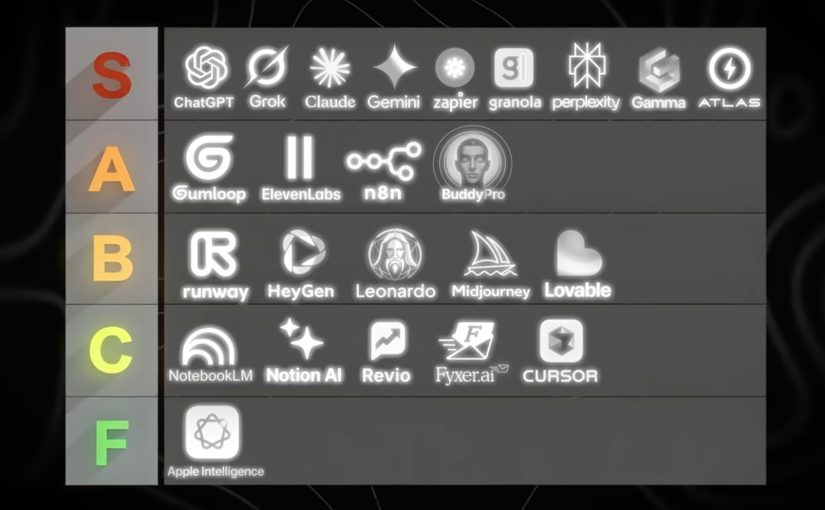
So here is a practical way to think about the landscape. A stack, grouped by what the tool does.

Here is one good example of a practical AI tool stack by use case

Foundation models and answer engines

  • ChatGPT: General-purpose AI assistant for reasoning, writing, analysis, and building lightweight workflows through conversation.
  • Claude (Anthropic): General-purpose AI assistant with strong long-form writing and document-oriented workflows.
  • Gemini (Google): Google’s AI assistant for multimodal tasks and deep integration with Google’s ecosystem.
  • Grok (xAI): General-purpose AI assistant positioned around fast conversational help and real-time oriented use cases.
  • Perplexity AI: Answer engine that combines web-style retrieval with concise, citation-forward responses.
  • NotebookLM: Document-grounded assistant that turns your sources into summaries, explanations, and reusable knowledge.
  • Apple Intelligence: On-device and cloud-assisted AI features embedded into Apple operating systems for everyday productivity tasks.

Creative production. Image, video, voice

  • Midjourney: High-quality text-to-image generation focused on stylized, brandable visual outputs.
  • Leonardo AI: Image generation and asset creation geared toward design workflows and production-friendly variations.
  • Runway ML: AI video generation and editing tools for fast content creation and post-production acceleration.
  • HeyGen: Avatar-led video creation for localization, explainers, and synthetic presenter formats.
  • ElevenLabs: AI voice generation and speech synthesis for narration, dubbing, and voice-based experiences.

Workflow automation and agent orchestration

  • Zapier: No-code automation for connecting apps and triggering workflows, increasingly AI-assisted.
  • n8n: Workflow automation with strong flexibility and self-hosting options for technical teams.
  • Gumloop: Drag-and-drop AI automation platform that connects data, apps, and AI into repeatable workflows.
  • YourAtlas: AI sales agent that engages leads via voice, SMS, or chat, qualifies them, and books appointments or routes calls without humans.

Productivity layers and knowledge work

  • Notion AI: AI assistance inside Notion for writing, summarizing, and turning workspace content into usable outputs.
  • Gamma: AI-assisted creation of presentations and documents with fast narrative-to-slides conversion.
  • Granola AI: AI notepad that transcribes your device audio and produces clean meeting notes without a bot joining the call.
  • Buddy Pro AI: Platform that turns your knowledge into an AI expert you can deploy as a 24/7 strategic partner and revenue-generating asset.
  • Revio: AI-powered sales CRM that automates Instagram outreach, scores leads, and provides coaching to convert followers into revenue.
  • Fyxer AI: Inbox assistant that connects to Gmail or Outlook to draft replies in your voice, organize email, and automate follow-ups.

Building software faster. App builders and AI dev tools

  • Lovable: Chat-based app and website builder that turns requirements into working product UI and flows quickly.
  • Cursor AI: AI-native code editor that accelerates coding, refactoring, and understanding codebases with embedded assistants.

Why this video is worth your time

Tool lists are everywhere. What is rare is a ranking based on repeated, operational exposure across real businesses.

Dan Martell frames this in a way I like. He treats tools as ROI instruments, not as shiny objects. He has tested a large number of AI tools across his companies, then sorts them into what is actually worth adopting versus what is hype.

That matters because most teams do not have a tooling problem. They have an integration problem. A “best tools” list only becomes valuable when you connect it to your operating model, your workflows, your governance, and your KPI layer.

For consumer-facing organizations, the real test is where a tool plugs into the content supply chain, CRM journeys, site experience, service workflows, analytics, and commerce operations.

Practical moves to integrate AI

If you are a CDO, CIO, CMO, or you run digital transformation in any serious way, here is the practical stance.

  • Stop optimising for pilots. Start optimising for capabilities.
  • Decide who owns the continuous loop. Make it explicit. Fund it properly.
  • Build reusable patterns with governance. Measure what finance accepts.
  • Treat tools as interchangeable components. Your real advantage is the operating model that lets you reuse, scale, and improve AI capabilities across content, CRM, service, analytics, and commerce workflows over time.

That is what “integrate” means. And that is where the winners will be obvious.


A few fast answers before you act

What does “integrating AI” actually mean?

Integrating AI means embedding AI into core workflows with clear ownership, governance, and measurement. It is not about running more pilots or using more tools. It is about making AI repeatable, auditable, and finance-credible across the workflows that drive revenue, cost, speed, and quality.

What is the difference between using AI and integrating AI?

Using AI is ad hoc and tool-led. Teams experiment with prompts, copilots, or point solutions in isolation. Integrating AI is workflow-led. It standardizes data access, controls, reusable patterns, and KPIs so AI outcomes can scale across the organization.

What is the simplest way to test AI maturity in an organization?

Ask who owns the continuous loop of scouting, testing, learning, scaling, and deprecating AI capabilities. If no one owns this end to end, the organization is likely accumulating pilots and tools rather than building an operating capability.

What does “AI as infrastructure” look like in practice?

AI as infrastructure includes standardized access to data, policy-based permissions, auditability, human-in-the-loop checkpoints, reusable workflow components, and a measurement layer that links AI activity to business KPIs.

What KPIs make AI initiatives finance-credible?

Common KPIs include cycle-time reduction, cost-to-serve reduction, conversion uplift, content throughput, quality improvements, and risk reduction. What matters most is agreeing on baselines and attribution logic with finance upfront.

What is a practical first step leaders can take in the next 30 days?

Select one or two revenue or cost workflows. Define the baseline. Introduce human-in-the-loop checkpoints. Instrument measurement. Then standardize the pattern so other teams can reuse it instead of starting from scratch.