
Nike Golf: No Cup Is Safe

Nike Golf has released a TV spot in which Tiger Woods and Rory McIlroy turn a practice session into a small competition on the golf course. The joke is simple. When two world-class players share a range, even the targets feel under threat.

A practice range that plays like a duel

The mechanism is a clean escalation. Start with casual shots. Introduce a visible target. Add one-upmanship. Then let the athletes do what they do best. Make the impossible look repeatable. The “no cup” line is the punchline because it turns accuracy into a kind of harmless menace. That works because a simple duel structure makes elite skill legible in seconds.

In performance-driven sports categories, the fastest brand wins are often built on demonstrations that feel like entertainment rather than instruction.

Why it lands

The spot works because it respects the viewer’s intelligence. No spec sheet. No product sermon. Just elite talent, a familiar rivalry energy, and a challenge you can understand in one second. It sells Nike Golf as the gear behind precision and confidence, without ever having to say those words.

Extractable takeaway: If your product promise is “performance”, design a proof that reads instantly. Use a simple rule, a clear target, and a visible outcome that makes the capability undeniable.

What Nike is really doing here

This is also roster storytelling, where the pairing itself signals what kind of competitive culture the brand owns. The real question is whether Nike can turn a practice-range stunt into a broader signal of competitive credibility.

Nike gets this right because pairing Woods with McIlroy frames the brand as the home of golf’s competitive edge across generations. The tone stays light, but the subtext is serious: these are the players you associate with winning, and they are wearing this swoosh while they do it.

How Nike turns proof into a brand asset

  • Turn a feature into a game. Accuracy becomes a challenge, not a claim.
  • Let the product stay “off camera”. When the proof is strong, the brand earns belief without showing close-ups.
  • Build with escalation. Start normal, then raise the stakes in small steps so the payoff feels inevitable.
  • Make the line a summary, not a slogan. “No Cup Is Safe” works because the viewer already saw why.

A few fast answers before you act

What is Nike Golf’s “No Cup Is Safe” spot?

It is a Nike Golf commercial built around Tiger Woods and Rory McIlroy turning a practice session into a target competition where cups become the bullseye.

What is the main message?

Elite precision is entertaining, and Nike Golf is positioned as the brand behind that performance mindset.

Why use two athletes instead of one hero?

Competition creates story. Rivalry gives the viewer a reason to watch longer, and it makes the proof feel earned rather than staged.

What does the line “No Cup Is Safe” communicate?

That the shots are so accurate the targets are in danger. It is a humorous shorthand for confidence and control.

How can other brands apply this pattern?

Find a single capability you can prove visually, wrap it in a simple game mechanic, and let the outcome do the persuasion work.
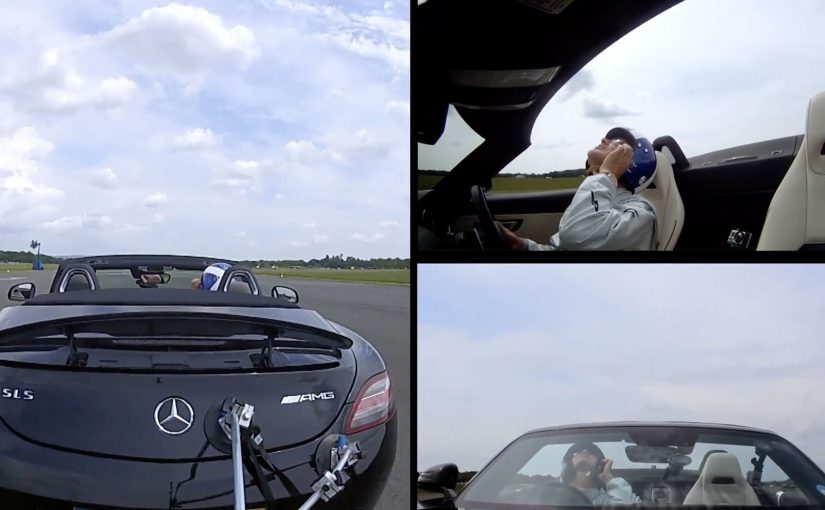
Mercedes-Benz: Golf Ball Catch World Record

Mercedes-Benz recently uploaded a video of former Formula 1 driver David Coulthard and pro-golfer Jake Shepherd setting a Guinness World Record with a Mercedes-Benz SLS AMG Roadster.

To set the record, Coulthard caught a golf ball hit by Shepherd while driving. The ball was traveling at 178mph and was caught 275 metres from the tee, setting the record for the farthest golf shot caught in a moving car. At the time of posting, the video had already crossed the one-million-view mark within days.

A record attempt built on timing and trust

The mechanism is clean and measurable: a golfer launches a high-speed drive down a runway, a driver accelerates to meet its trajectory, and the open cockpit becomes the “catcher’s mitt”. If the car, speed, and timing are even slightly off, the attempt fails in a very visible way.

In performance-led automotive marketing, certified stunts turn engineering credibility into a piece of entertainment people want to pass on.

The real question is whether your proof is visible enough that the audience can judge it without trusting your narration.

Because you can clearly see whether it worked, the performance claim feels earned rather than explained.

Why it lands

It turns abstract performance into a single, replayable challenge with clear stakes, and then lets Guinness define what “success” means.

Extractable takeaway: World-record style stunts work as marketing when the measurement is simple, the failure mode is obvious, and third-party verification turns spectacle into credible proof.

It makes performance legible. Horsepower and handling are abstract until you attach them to a task with consequences. A moving catch at extreme speed is instantly understood.

It borrows external validation. The Guinness framing gives the clip a built-in reason to exist beyond “brand content”. It signals that this is not just a cool shot, it is a verified attempt with a defined outcome.

It is engineered for replay. The audience watches once for disbelief, then again for mechanics: speed, distance, and the exact moment the ball drops into the car.

Borrowable moves from the record attempt

  • Anchor the story to a number. Distance, speed, and a named record create instant stakes.
  • Make the “proof moment” unmissable. The catch is the single frame people share, and the decisive proof that the claim happened.
  • Use experts as the interface. Specialist talent makes the impossible feel attempted rather than faked.
  • Build the edit around clarity. Viewers should understand what success looks like before it happens.

A few fast answers before you act

What record did Mercedes-Benz, Coulthard, and Shepherd set?

The farthest golf shot caught in a moving car, using a Mercedes-Benz SLS AMG Roadster.

What were the headline numbers?

The drive was clocked at 178mph and was caught 275 metres from the tee.

Why does Guinness World Records matter here?

It provides an external definition of “success” and a trusted validation layer that separates a stunt from a simple brand claim.

What is the business intent behind a stunt like this?

To make vehicle performance feel tangible and memorable, while generating earned reach through a shareable “did you see that?” moment.

What is the most transferable lesson?

If you want proof to travel, wrap it in a single measurable challenge, show the decisive moment clearly, and keep the explanation simple enough to repeat.

Golf Digest: Desert Disruption

Golf Digest wanted to remind golf enthusiasts that they can improve their game with the magazine. Rather than saying it in a predictable headline, Memac Ogilvy Dubai chose a faster route to attention. A prank designed to disrupt the region’s biggest golf event and get people to pick up the magazine.

The point is not to out-shout the tournament. It’s to create a moment of interruption that only resolves when you engage with the brand asset sitting right there in your hands.

Disruption as distribution

A prank at a live event works when it forces a choice. Ignore it and stay confused. Or reach for the one object that explains what’s happening. In this case, the magazine becomes the “decoder”, meaning the one object that explains what’s happening, which makes pickup feel like participation, not like being sold to.

In sports event marketing, a well-timed interruption can convert spectators into participants, as long as the payoff is immediate and easy to understand.

Why this lands

This works because it ties the brand benefit to a behaviour you can measure. Magazine in hand. Pages opened. Content consumed. The prank is not the product. It is the trigger that makes people re-experience Golf Digest as a practical tool for better play, instead of as background media. The real question is whether the interruption makes the magazine feel more useful, not merely more visible.

Extractable takeaway: If you need to revive a “useful” product people have stopped actively choosing, design an event moment where the product is the simplest way to regain control and understand what’s going on.

What to steal from event disruption

  • Make the brand the resolution. The disruption should only make sense once someone engages with your asset.
  • Use the right arena. Do it where your core audience is already emotionally invested.
  • Keep the explanation short. If the prank needs a long briefing, the moment dies.
  • Turn interest into a physical action. Pickup, flip, keep. Behaviour beats impressions.

A few fast answers before you act

What is Golf Digest’s “Desert Disruption” idea?

It’s a prank-based event activation designed to interrupt attention at a major golf event and prompt spectators to pick up the magazine as the way to understand the moment.

Why use a prank to sell a magazine?

A prank creates immediate curiosity. If the magazine is positioned as the fastest explanation or payoff, pickup becomes a natural reaction.

What does this communicate about Golf Digest?

That it is not only entertainment. It is positioned as a practical resource for improving your game.

What is the key success condition for this pattern?

The disruption must be legible quickly, and the magazine must clearly resolve the confusion with an instant payoff.

What can go wrong with event disruption?

If it feels unsafe, disrespectful to the sport, or unclear, it can trigger annoyance instead of curiosity. The tone and timing matter as much as the idea.