
Bud Light: Ian Up for Whatever

Bud Light: Ian Up for Whatever

Super Bowl ads are the miniature version of the film industry. There is huge money involved and brands are torn between creating something new and noteworthy or falling back on established formulas.

So for its 2014 Super Bowl commercial, Bud Light throws in a stack of famous faces including Arnold Schwarzenegger, Don Cheadle, and Minka Kelly, plus one unsuspecting “normal guy” called Ian Rappaport. The story is built as a rapid escalation. One small choice becomes a night that keeps getting stranger, bigger, and more unbelievable.

A stunt disguised as a spot

The mechanism is simple and ruthless. A regular guy is offered a Bud Light and asked if he is “up for whatever’s next”. Then the ad turns into a filmed chain reaction of increasingly absurd moments, reported as captured with hidden-camera choreography rather than traditional performance. The celebrity cameos are not decoration. They are the accelerant that keeps raising the stakes.

In US mass-reach advertising, Super Bowl spots act as high-budget cultural moments where brands compete on surprise, talk value, and rewatchability.

Why it lands

This works because it behaves like a dare the viewer can imagine accepting. The idea is not “Bud Light tastes better”. The idea is “your night can go anywhere”. Ian is the audience proxy, so every escalation feels like it is happening to you, not to a paid spokesperson.

Extractable takeaway: When you want a broad audience to share your story, give them a single, relatable choice at the start, then let that choice trigger visible escalation. The audience should understand the rule in one sentence and predict the next beat, then still be surprised by the size of the payoff.

What Bud Light is buying with this format

The real objective is platform reset, meaning one mass-reach moment that makes a positioning line feel newly believable. The real question is whether the brand feels like the trigger for spontaneity or just the label attached to it. Bud Light gets this right because the brand behaves like the trigger for the entire experience, not a sponsor bolted on afterward. “Up for Whatever” is a positioning line that needs proof, not repetition. This spot supplies proof by turning the brand into the permission slip for spontaneity, and by using celebrity not as endorsement but as narrative fuel.

What to steal from Bud Light’s escalation playbook

  • Cast the audience, not a hero. Use an everyperson lead so the fantasy feels attainable.
  • Make escalation the structure. A clear upward curve keeps attention better than a clever line alone.
  • Use fame as a plot device. Cameos should change the situation, not just decorate the frame.
  • Anchor the brand to the first decision. If the brand is the trigger, it earns credit for the whole ride.

A few fast answers before you act

What is “Ian Up for Whatever”?

It is Bud Light’s 2014 Super Bowl commercial built around a regular guy, Ian Rappaport, who gets pulled into a celebrity-filled night after agreeing to be “up for whatever’s next”.

What is the core creative mechanism?

Hidden-camera style escalation. One small choice triggers a chain of increasingly surprising moments, reinforced by celebrity cameos.

Why does the “normal guy” casting matter?

It makes the audience project themselves into the situation. The fantasy becomes “this could happen to me”, not “this is happening to a spokesperson”.

What does the ad actually sell?

Positioning. Bud Light as the beer that fits whatever happens, rather than a functional product claim.

How can a brand replicate the pattern without copying the stunt?

Start with one relatable choice, design a clear escalation curve, and ensure each beat is a consequence of the choice, not a random sequence of gags.
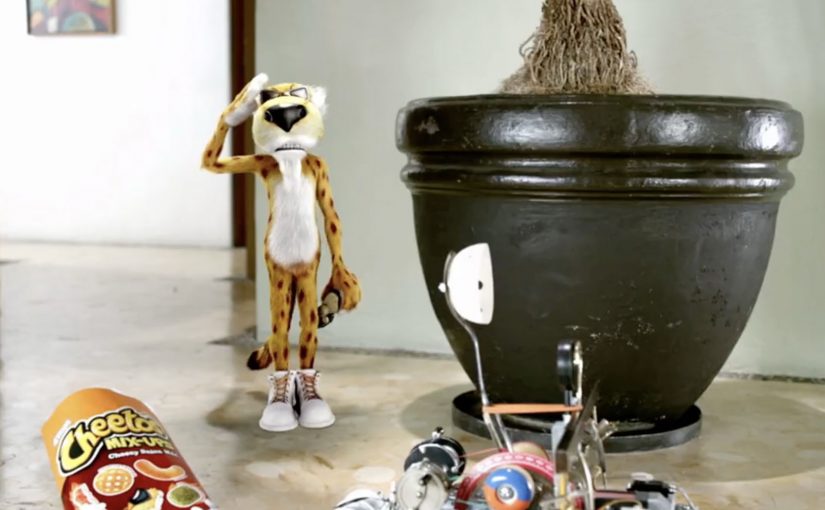
Cheetos Mix-Ups: Cheetahpult Dual-Screen Game

Cheetos Mix-Ups: Cheetahpult Dual-Screen Game

In March I had written about how Google had inspired developers to convert mobile phones and tablets into remote controls for desktop browsers via a simple mobile URL. Now Cheetos, an American brand of cheese-flavored puffed cornmeal snacks, has successfully tapped this technology to engage with viewers as they watch a regular TV commercial on YouTube.

Viewers watching the Cheetos Mix-Ups ad on YouTube get a dual-screen experience. They can fling the new Cheetos Mix-Ups snacks from their phone into a video playing on their desktop. The campaign creates a new way to engage with the ad, and to get to know the product’s new shapes and colors through play.

At this point, the video is reported to have reached 8.5 million views on YouTube. People who played the game are reported to have stayed for an average of 7 minutes and 17 seconds, and flung an average of 56 Cheetos per game.

A YouTube ad that behaves like a game

The trick is simple and surprisingly scalable. Your desktop stays on YouTube, playing the film. Your phone becomes the controller via a lightweight URL experience, so interaction happens in your hand while the “world” of the ad stays on the big screen.

How the dual-screen catapult works

Instead of treating the mobile device as a companion banner, the experience treats it as an input device. You aim, fling, and see the result immediately in the desktop video frame, which turns passive viewing into a loop of action, feedback, and repeat.

In global FMCG launches, second-screen interactivity works best when it turns product attributes into gameplay, and makes “learning the product” feel like time well spent.

Why this lands while people are “just watching YouTube”

It hijacks a familiar behavior. People already watch ads on desktop while their phone is in hand. Cheetahpult converts that split attention into viewer control, and uses physics and repetition to teach what Mix-Ups actually is, in a way a standard product shot cannot. The real question is whether the interaction helps people understand Mix-Ups faster than a normal product shot would. In this case, it does, because the mechanic turns product variety into something people learn by doing.

Extractable takeaway: If your product is hard to describe in one sentence, let people handle it. Build a micro-game where the mechanic is the product benefit, and the reward is comprehension.

What Cheetos is really buying here

This is product education disguised as entertainment. The intent is to turn a new SKU with multiple shapes and flavors into something memorable, then associate that memory with the brand, so the next shelf moment feels familiar.

What Cheetos teaches about interactive video

  • Design for the device people already hold. Dual-screen works when the phone is the controller, not an afterthought.
  • Make the mechanic teach the product. If the game can be reskinned for any brand, it is not specific enough.
  • Keep the loop short and replayable. Fast rounds create “just one more try” behavior, which is where learning happens.
  • Use the main video as the stage. The desktop frame should feel like the real world, and the phone should feel like the tool.

A few fast answers before you act

What is Cheetahpult?

Cheetahpult is a dual-screen YouTube experience that turns a Cheetos Mix-Ups video into a simple physics-style game, with the phone acting as the controller and the desktop video acting as the playfield.

Why does second-screen interaction help an ad?

It converts passive reach into active time. When people interact, they process product details more deeply, and the ad becomes something they did, not just something they saw.

What makes this different from a typical “interactive ad”?

The interaction is not layered on top as buttons. The phone becomes a controller, and the main video becomes the environment, so the ad and the game feel like one system.

When should a brand use this pattern?

When a launch needs fast product education, and when the product has attributes that benefit from repetition, variation, and play, like shapes, combinations, flavors, or configurations.

What should a brand avoid when copying this idea?

Avoid mechanics that are fun but unrelated to the product. If the interaction does not teach something specific about the item being launched, the brand gets playtime but not product understanding.

Molson Canadian: The Beer Fridge

Molson Canadian: The Beer Fridge

First various brands created campaigns with red buttons, then came one with a pink phone, and now Molson, a Canadian beer brand, revolves a whole campaign around bright red refrigerators.

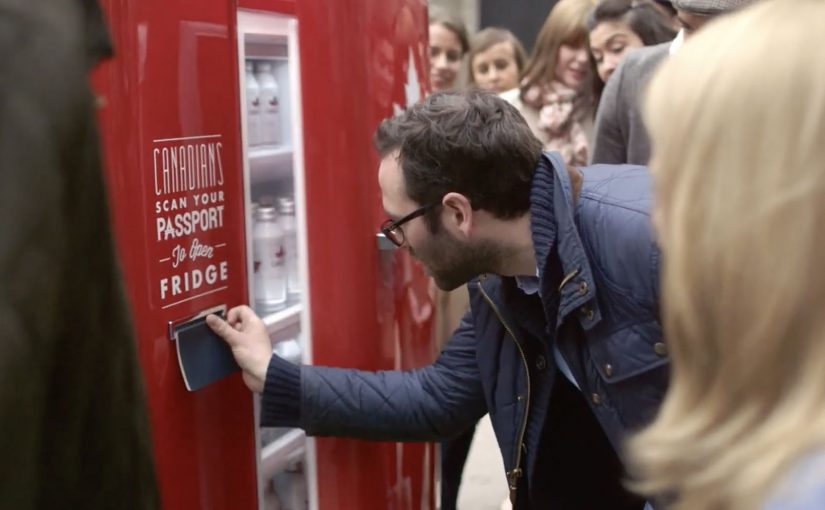
These eye-catching fridges were filled with Molson Canadian beer and strategically placed across a variety of European locations to attract crowds. The catch is simple. The fridge can be opened only by scanning a Canadian passport.

The campaign was created by Rethink Canada to bring back the classic tagline, “I Am Canadian.” The footage collected from the different locations was then cut into a longer online film and a shorter TV ad, described as running during the Stanley Cup Finals.

A gate that turns identity into a moment

The mechanism is a physical “access rule” everyone understands. Here, the access rule is simple: only a scanned Canadian passport opens the fridge. A fridge full of free beer is a magnet. The passport scan turns that magnet into a social filter, because the only way anyone drinks is if a Canadian is present and willing to open it. In one move, the crowd goes from spectators to collaborators.

In multinational brand building, national identity can easily become abstract. This makes it concrete in public, in seconds, with a prop people instinctively gather around.

Why it lands

It works because the restriction creates a mini-drama with a friendly payoff. People try. People fail. Then the “right” person arrives, the door opens, and the whole crowd benefits. The brand gets an emotional signature without needing to over-explain heritage, or wave flags on screen.

Extractable takeaway: If you want a brand idea to travel, design a simple rule that forces strangers to interact. Make the rule easy to understand, visibly enforced, and rewarding for everyone, not only the “qualified” participant.

What Molson is really reviving

The fridge is the stunt, but the strategic job is memory refresh. “I Am Canadian” is not a new line. The activation re-earns the right to say it by staging a situation where being Canadian is the key that unlocks a shared experience.

The real question is whether a legacy national tagline can earn fresh relevance without sounding like a rerun. Molson gets this right because the stunt turns identity from a slogan into a shared public reward.

What brand teams can take from it

  • Use a physical object as a social trigger. Fridges, doors, vending machines, and switches pull people in because they promise an outcome.
  • Let the rule do the storytelling. One constraint can communicate positioning faster than a paragraph of copy.
  • Make the payoff collective. If only one person wins, the crowd turns cynical. If everyone wins, the crowd turns into distribution.
  • Film what the rule creates. The best “campaign video” is documentation of real behavior the mechanic generates.

A few fast answers before you act

What is Molson Canadian’s “Beer Fridge” campaign?

It is an activation built around bright red fridges placed in public locations. The fridge opens only when a Canadian passport is scanned, turning identity into the key that unlocks free beer.

Why require a Canadian passport?

The passport requirement creates instant tension and a clear story. It forces a social moment where Canadians become the enablers, and everyone around them shares the reward.

What does this have to do with “I Am Canadian”?

The mechanic makes “Canadian-ness” functional rather than symbolic. The tagline lands as a conclusion the crowd just witnessed, not a claim the ad simply states.

Why place the fridges in Europe?

Because it creates contrast and visibility. A Canadian-only key in a non-Canadian setting produces curiosity, crowds, and a stronger “identity unlocks access” narrative.

How can another brand apply this pattern?

Choose one brand truth, translate it into an access rule, and attach a collective payoff. Then design the experience so the resulting human interactions are worth filming.