
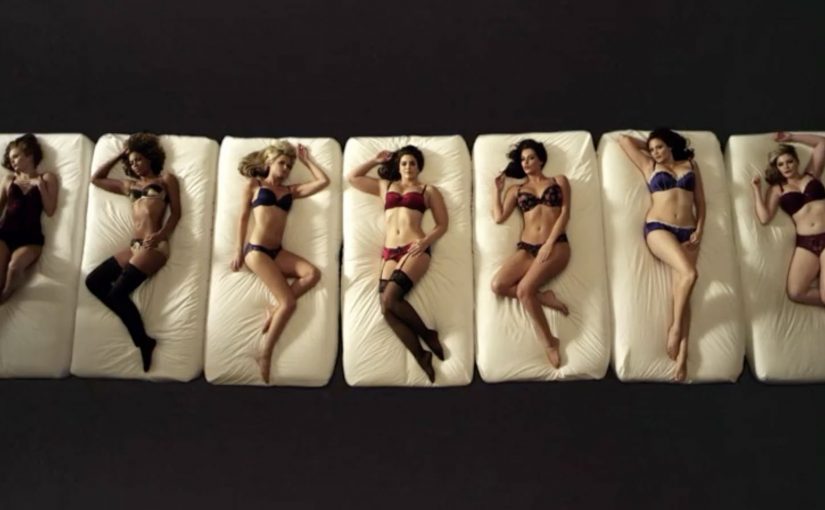
In this holiday video from London ad agency Karmarama, Canada-based lingerie maker La Senza presents a novel Christmas choir. Women in their underwear lie on a puffy piano, each singing the musical note represented by their bra size, from A to G.
A Christmas choir built from cup sizes
The hook is immediate. A to G becomes a scale. The set becomes a keyboard. The cast becomes the instrument. It is a simple idea that explains itself in seconds, and it gives the viewer a reason to watch again just to catch how the “notes” are assigned.
How the mechanic sells the range
Instead of listing products, the film turns product variety into a performance system. Each cup size is framed as a distinct note, and the choreography is built around sequencing those notes into a familiar holiday tune.
In holiday retail marketing, the quickest way to earn attention is to turn the product range into entertainment people can instantly understand.
Why it lands as a share
The format is cheeky, high-contrast, and easy to summarize. That makes it naturally social, because people can describe it in one sentence and still do it justice. The “keyboard” visual also creates a clear pattern, so even casual viewers feel like they are in on the joke.
Extractable takeaway: When your product offer is breadth, not one hero feature, convert that breadth into a simple system the audience can see and repeat, and the message sticks without explanation.
The intent behind the wink
This is brand entertainment with a retail job to do. It keeps La Senza top-of-mind during a gifting season and spotlights that the brand serves a wide range of sizes, while the tone keeps it light enough to travel beyond existing customers.
The real question is whether the performance makes that size range memorable enough to travel beyond the existing customer base.
How to turn range into a shareable system
- Make the organizing idea visible. A to G as notes is instantly legible.
- Use a familiar frame. A holiday tune lowers comprehension cost.
- Sell the range without “catalog copy”. Show variety as a system, not as a list.
- Keep the runtime tight. Short spectacle beats long explanation for sharing.
- Let the craft do the persuasion. Production, choreography, and rhythm carry the message.
A few fast answers before you act
What is the core idea of The Cup Size Choir?
Assign musical notes to bra cup sizes and build a performance that turns product range into a simple, watchable system.
Why does this work as holiday advertising?
It is easy to understand, easy to retell, and it uses a seasonal structure people already recognize, so the message lands quickly.
What is the main brand message?
That the brand offers a broad size range, communicated through entertainment rather than product claims.
What is the biggest risk with this kind of execution?
If the tone feels gratuitous or distracting, the audience remembers the stunt but forgets the brand or the point.
How can a different category copy the approach safely?
Translate “range” into a clear system. Use a familiar cultural frame. Keep the mechanic obvious, and let the craft carry the story.
