
Coca-Cola Peace Machines

Small World Machines. India and Pakistan meet through a Coke

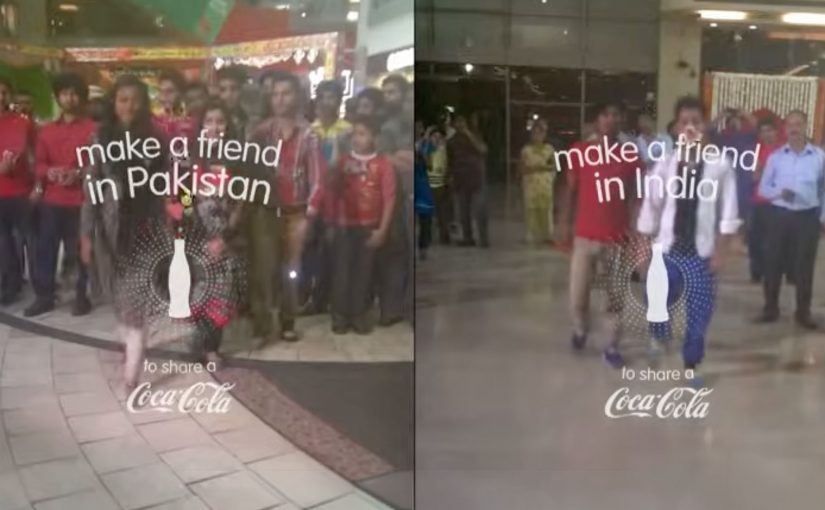
Over the years Coca-Cola keeps experimenting with vending machines and tries to make them much more than the average soda-spitter-outer. It places two machines, one in India and the other in Pakistan, and turns them into a communication portal. These “Small World Machines” allow citizens from both countries to interact with each other and complete shared tasks. Here, “shared tasks” means actions designed to be completed together, not alone. The machines reward them with a Coke. The results…

Fair Play Machines. Inter and Milan fans can only give to rivals

The success of that has inspired Coca-Cola to once again bring fighting parties together. Now instead of bringing together nations at odds, it has tapped into the rivalry between Italian soccer teams Inter and Milan.

To ease the aggression between the fans, Coca-Cola installed their “Fair Play Machines” on opposite sides of Milan’s San Siro stadium as the teams faced off. Pressing the button of one machine dropped a Coke can down the chute of that on the side of the rival team. So this way rivals could only receive Cokes from each other. The results…

The real question is whether you can design an interaction where the easiest way to get your reward is to give something to the other side first.

In global consumer brands, especially when audiences are polarized, experience rules travel further than slogans.

What this teaches about “peace” as a design problem

The strongest move is not messaging. It is creating a constraint that makes cooperation the easiest path to a reward. A constraint is a built-in rule of the experience that limits options so the intended behaviour becomes the easiest one. This works because the reward is gated behind a cooperative act, so the social friction becomes part of the game instead of a barrier. When a machine encodes that rule, behaviour shifts without anyone needing to preach.

Extractable takeaway: If you want two sides to act differently, stop asking for goodwill. Change the rules of the interaction so the smallest “yes” becomes the default move.

Design moves you can borrow from Peace Machines

  • Gate the reward behind a give-first action. Make the path to getting something run through giving something to the other side.
  • Keep the rule legible in one glance. If people need an explanation, the moment is gone.
  • Turn tension into a shared task. Use a simple co-action that feels like play, not reconciliation.

A few fast answers before you act

What are Coca-Cola “Peace Machines” in this context?

They are vending machine concepts that turn a simple Coke transaction into a social interaction, designed to reduce tension between rival groups.

What is the core mechanic of the Fair Play Machines?

Pressing the button on one machine sends a Coke to the machine on the rival side. Rivals can only receive Cokes from each other.

How do Small World Machines relate to this?

They use the same principle. A machine becomes a bridge, enabling people in opposing contexts to interact and complete shared tasks that lead to a reward.

What does “constraint” mean in experience design?

It is a built-in rule that limits options so the intended behaviour is the easiest one to choose.

What is the main design lesson for brands?

If you want behaviour change, build the rule into the experience. Make the cooperative action the trigger for the reward, and keep it simple enough to understand instantly.
ActionAid: Donate Your Profile

ActionAid is an organisation committed to many projects, like fighting hunger and poverty. But in Italy it is known primarily for sponsoring children.

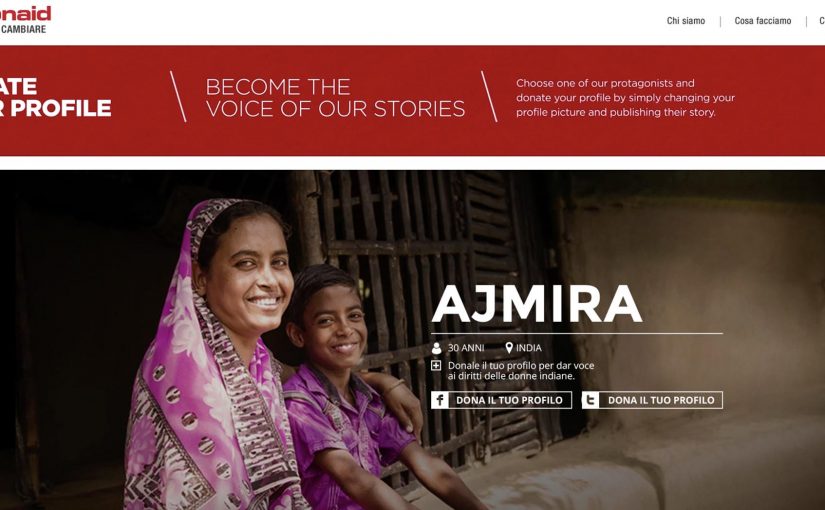
To communicate the broader work of ActionAid with a small media and production budget, DLV BBDO created “Donate Your Profile”. Participants donated their Facebook and Twitter profile pictures so that awareness could be generated for the stories of people ActionAid helped.

How “Donate Your Profile” worked

The mechanism is a simple identity swap. People hand over the most visible square in their social presence. Their profile photo. In return, they display a campaign image tied to a real person’s story, so every comment, like, and share carries that story into everyday social traffic.

Support from Radio 105, Radio Deejay, La Stampa, Marc Marquez and other Italian celebrities and brands helps normalise the behaviour. Once well-known accounts participate, the “donate your picture” action looks safe, easy, and socially endorsed.

In Italian cause marketing, borrowing social identity can outperform paid media when budgets are tight, because it turns personal networks into distribution.

The real question is how to turn a low-budget act of support into something people carry through their normal social behaviour.

Why the profile swap spreads

This works because it converts passive support into a visible, persistent signal. A profile picture is not a post that disappears in a feed. It is a durable badge that travels wherever you show up online, and it prompts questions that naturally lead to explanation and sharing.

Extractable takeaway: If you need earned reach without heavy spend, move the call to action from “share a post” to “change a default”. When people change a default surface, the campaign rides along with their normal behaviour.

The reported impact

The project was described as becoming the 5th most trending topic on Twitter and generating over 79 million media impressions, with more people joining in as the support network grew.

What to borrow from the profile-swap pattern

  • Pick a high-frequency surface. Defaults like profile photos travel more than one-off posts.
  • Make the action reversible. People participate faster when the commitment feels temporary.
  • Seed with credible partners. Media brands and recognisable faces reduce hesitation.
  • Turn participation into a conversation starter. The best mechanics invite questions, not just clicks.

A few fast answers before you act

What is “Donate Your Profile”?

It is a campaign where people replace their Facebook and Twitter profile pictures with a campaign image, so ActionAid stories gain awareness through everyday social interactions.

Why use profile pictures instead of posts?

A profile picture is persistent and high-visibility. It shows up repeatedly across comments and interactions, so the message travels without requiring constant re-posting.

How did the campaign scale beyond early participants?

Reportedly through support from media brands and celebrities, which makes the behaviour feel normal and increases follow-on participation.

What results were reported?

Reported results included reaching the 5th most trending topic on Twitter and generating over 79 million media impressions.

What is the main risk with this pattern?

Trust. If people are unclear about what is being changed, for how long, and what they are authorising, participation drops. The exchange must be transparent and easy to undo.

Lexus Trace Your Road: life-sized racing game

To promote its new high-performance hybrid car, Lexus, together with Saatchi & Saatchi Italy, creates “Trace Your Road”, an experiential event featuring Formula 1 driver Jarno Trulli.

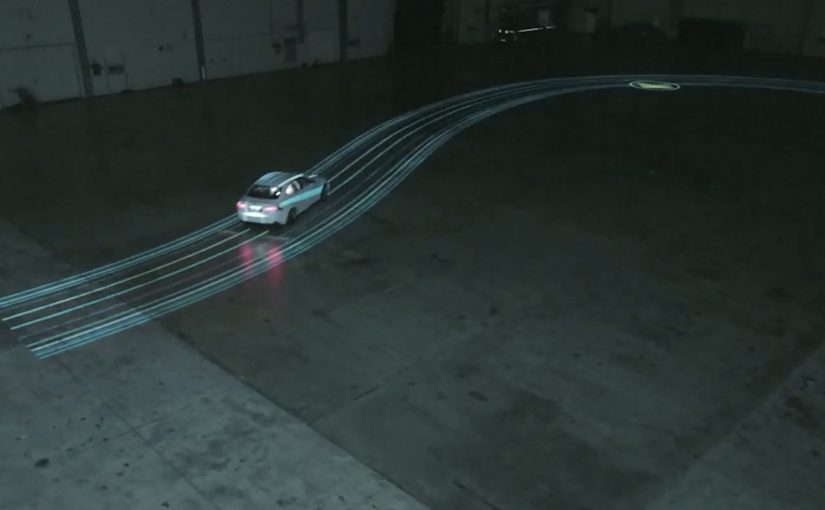
Ten Lexus fans are selected from hundreds of applicants on Lexus’ Facebook page. Each winner rides in the passenger seat of the hybrid while Trulli drives, and the passenger “draws” the course on an iPad. That path is projected onto the floor of an aircraft hangar using special projectors, while a custom high-resolution infrared (IR) camera system tracks the car’s position in real time.

How the experience works

The format is a life-sized driving game with the audience literally designing the track. The event flow is built around three moving parts.

  • Live track creation. The passenger traces a route on the iPad, creating spontaneous turns, straights, and corners.
  • Real-world projection. The route appears at scale on the hangar floor, so the “racetrack” becomes a physical space.
  • Real-time tracking. An IR camera system follows the car so penalties and scoring can be applied accurately.

What makes it competitive, not just cinematic

Trulli’s driving is put to the test as he attempts to follow the improvised paths at speed. Penalty points are given when the car goes outside the projected route or touches the hangar walls. The goal is to hit seven selected touch points in the quickest time, and the fan with the best score wins.

In automotive launches and premium brand marketing, turning a test drive into a participatory game makes performance feel experienced, not explained.

The real question is whether your launch makes the product truth the win condition, not just the headline.

Why it lands: performance becomes legible

Hybrid performance can be hard to dramatize without slipping into numbers. Because the passenger-designed route and visible penalty rules force precision, control and handling become legible without a spec sheet, while the story stays human through the passenger’s real-time choices and Trulli’s visible skill.

Extractable takeaway: When you can turn a product claim into a rule set with visible penalties, the audience understands it instantly and the content becomes inherently shareable.

What Lexus proves with “Trace Your Road”

The brand is not only saying “this car performs”. It is staging a situation where performance is the only way to succeed. This is a stronger way to market performance than listing specs, because it forces the car to prove itself under constraints. The experience also rewards participation: winners influence the outcome, spectators understand the rules instantly, and the filmed content has a clear narrative arc.

Make the claim playable: launch moves worth copying

  • Let the audience shape the challenge. When participants create the rules in real time, attention spikes because outcomes are unpredictable.
  • Translate product claims into constraints. Handling, control, and precision become visible when the environment punishes mistakes.
  • Build a scoring model people can explain. Simple penalties and a clear finish condition make the story travel.
  • Use tech as infrastructure, not the headline. Projection and tracking matter most when they disappear into the experience.

A few fast answers before you act

What is Lexus “Trace Your Road”?

It is an experiential event where a passenger draws a racetrack on a tablet and the route is projected onto a hangar floor, while Jarno Trulli drives a Lexus hybrid along that path in real time.

How is the racetrack created and shown?

The passenger traces the course on an iPad, and the design is projected at scale onto the floor using multiple projectors so the track becomes a physical space to drive in.

How does the system know if the car stayed on the route?

A custom high-resolution IR camera tracking system monitors the car’s position against the projected route so penalties can be applied when it leaves the path.

What makes this more than a one-off stunt?

The format produces repeatable rounds, clear scoring, and a strong spectator story, which makes it easy to capture as a campaign film and behind-the-scenes content.

What is the main lesson for experience design?

Make the product truth the win condition. When success requires the product’s strengths, the message feels demonstrated rather than claimed.