
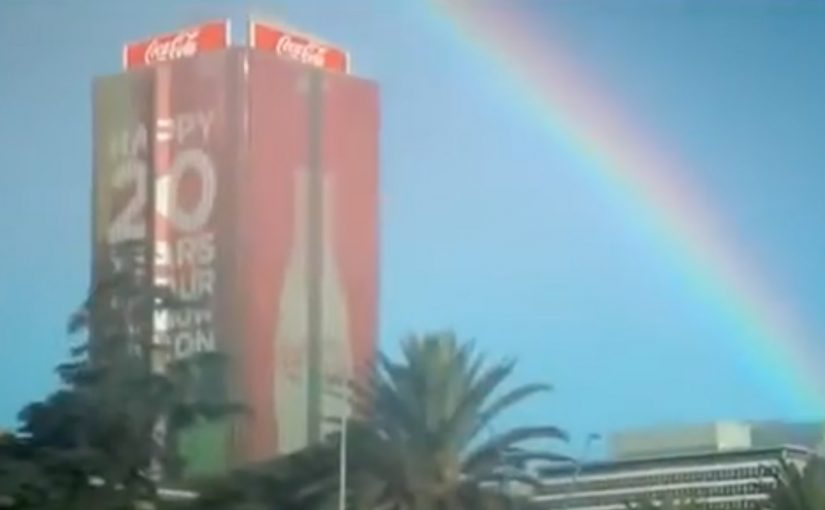
Coca-Cola: Rainbow Nation Rainbows

A rainbow you can actually chase across Johannesburg

Twenty years ago, South Africa elected Nelson Mandela in the country’s first-ever democratic election. This led Archbishop Desmond Tutu to coin the phrase “The Rainbow Nation,” referring to the country’s diverse people.

Now to celebrate this 20th anniversary of democracy, Coca-Cola decided to literally create rainbows. Using sunlight, water, some fancy science and a little bit of magic, they made rainbows pop up all over Johannesburg. Some rainbows even reached the ground, for those who sought to discover where they ended.

The trick: make the symbol physical

This is not a graphic. It is a phenomenon placed into normal streets. And the moment the rainbow reaches the ground, the campaign stops being something you watch. It becomes something you can follow. This works best when the symbol becomes a physical invitation, not a slogan.

The real question is whether people can choose their way into the meaning, instead of being told what it means.

Why discovery beats declaration

You are not told what to feel. You either stumble into it and smile. Or you choose to go looking for the end. That voluntary participation is what makes it feel like magic, not messaging.

Extractable takeaway: If you want participation, turn the message into a small quest people can opt into, not a statement they are asked to agree with.

In city-scale brand activations, the strongest participation comes from turning a familiar symbol into a discoverable experience people can physically encounter.

What it was really celebrating

Twenty years of democracy, expressed through a shared symbol, brought to life in the city.

Ideas worth borrowing

  • Turn an abstract story into something people can encounter in the real world.
  • Add a simple “seek and find” layer so curiosity becomes the call-to-action.
  • Keep the explanation light. Let the experience carry the meaning.

A few fast answers before you act

What did Coca-Cola do for “Rainbow Nation”?

They made rainbows appear across Johannesburg to celebrate twenty years of South African democracy, including rainbows that reached the ground.

Why is the phrase “Rainbow Nation” used?

Archbishop Desmond Tutu coined “The Rainbow Nation” to describe South Africa’s diverse people following the country’s democratic transition.

What was the viewer experience?

People encountered rainbows in public space, and some could be followed to the ground to discover where they ended.

What is the core creative mechanic?

Transforming a cultural symbol into a real-world phenomenon people can discover in the city.

How do you recreate this idea without a rainbow?

Pick a symbol your audience already recognizes, make it physically encounterable, and add a simple “seek and find” hook so people choose to participate.
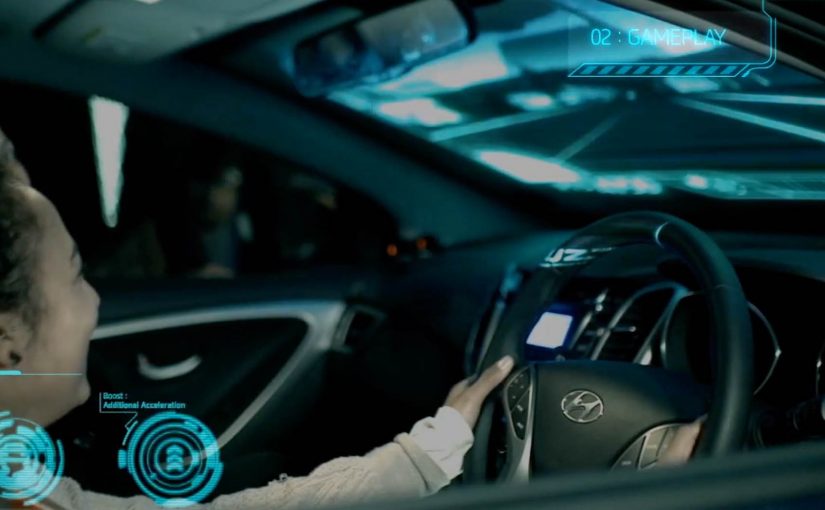
Hyundai i30: Light Drive Test Drive Game

To launch the new generation i30 in South Africa, Hyundai reinvented the test drive with the Hyundai i30 Light Drive. It is a virtual racing game projected onto the i30’s front windscreen, played from inside the car.

Instead of waiting for people to visit a dealership, Hyundai took the experience to South Africa’s hottest nightspots in Johannesburg, Durban and Cape Town. Anyone, at any time, could step in, experience the car’s slick dynamic features, and compete for the top spot on the leader board.

A test drive that behaves like entertainment

The mechanism is smart because the “drive” is no longer a polite sales ritual. It is a game with stakes, progress, and a score. Two-man teams work together on the track to collect icons. Each icon represents an i30 specification, and collecting them powers up the car and boosts the team’s score.

That turns feature education into gameplay. Specs are not listed. They are earned. The i30’s story is embedded in the rules of the experience.

In experiential automotive launches, product education lands best when features are translated into gameplay mechanics that people can learn by doing.

The real question is whether your product education can be designed as a loop people want to repeat in public.

Why it lands in a nightlife setting

Nightspots are where people are already in a social, competitive mood. A leader board gives instant status. A queue becomes part of the atmosphere rather than a frustration, because everyone can watch and anticipate their turn. Hyundai amplified that social energy with HD cameras streaming the live test drive to a large screen outside the car. The crowd can watch the teams compete in real time, which makes the experience feel bigger than the physical footprint of the vehicle.

Extractable takeaway: In social environments, make learning visible. Use a score people can chase and a spectator view people can watch, so the product story spreads while the line forms.

Facebook Connect turns players into publishers

Hyundai linked the i30 Light Drive to Facebook Connect, turning participation into a shareable identity moment. Photos of the teams are posted instantly onto their timelines, extending the experience beyond the venue and turning “I played” into “I was seen playing”.

Even the waiting time is engineered. People queuing to play are educated and entertained with a touch screen brochure on the i30’s rear windscreen. It is product information, but delivered in an interactive format that matches the energy of the activation.

The intent: make the i30 feel modern before anyone compares price

The business intent is clear. Hyundai wants the i30 to feel like the next generation. Not just in features, but in attitude. By turning a test drive into an interactive spectacle, the brand signals innovation, tech confidence, and social relevance. The car becomes an event.

Moves to borrow from Hyundai i30 Light Drive

  • Move the experience to the audience. Take the product out of the showroom and into high-traffic social contexts.
  • Teach through interaction. Turn product features into game mechanics so learning is part of play.
  • Design for spectators. Live screens and streaming make the activation bigger than the footprint.
  • Make sharing native. Identity-based posting works best when it is built into the flow, not bolted on later.
  • Use the queue. If people are waiting, give them interactive content that reinforces the product story.

A few fast answers before you act

What is Hyundai i30 Light Drive?

It is an in-car virtual racing game projected onto the i30’s windscreen, designed to turn a test drive into an interactive competition.

How does it communicate the i30’s features?

Teams collect icons on the track that represent i30 specifications. Those icons act as power-ups, so the specs become part of the game’s reward loop.

Why target nightspots instead of dealerships?

Nightlife venues provide a ready-made social crowd. Competition and spectacle fit the context, and the experience spreads through observation and sharing.

What role does live streaming play in the activation?

HD cameras stream the gameplay to a large screen outside, turning players into performers and the crowd into an audience, which increases participation and energy.

What is the key takeaway for experiential launches?

Design an experience that people want to play and watch. When product education is embedded inside a compelling interaction loop, attention follows naturally.

POWA: Waking Up the Neighbourhood

This social experiment was carried out using hidden cameras in a townhouse complex in Johannesburg. The message is pretty clear: “Don’t condone violence by doing nothing”.

It is structured as a test of what people will react to. When something is merely annoying, neighbors complain quickly. When something is genuinely harmful, the same neighbors often hesitate, rationalize, or stay silent.

How the experiment is engineered

The mechanism is simple and uncomfortable: place residents in a situation where intervention feels “socially costly”, then reveal how easily people default to inaction even when the signals are obvious. Here, “socially costly” means risking awkwardness, conflict, or reputational blowback with the people you live next to. That engineered discomfort is why the film persuades. It forces the viewer to notice the exact moment hesitation becomes a decision.

In close-quarter urban living, social friction often gets managed faster than serious harm because “not getting involved” is treated as the safest norm.

Why it lands

It attacks the real barrier. Many people do not support violence, but they also do not act. The work focuses on that gap between belief and behavior.

Extractable takeaway: Anti-violence communication changes behavior when it targets the bystander decision point. Make inaction feel like a choice with consequences, and intervention feel like the socially supported default.

It reframes intervention as normal. By showing how readily people mobilize for minor disturbances, it implies that speaking up about violence should be even more expected.

It removes the viewer’s excuses. The hidden-camera format makes “I wasn’t sure” feel less credible, because the audience sees the same signals and the same hesitation play out.

The real question is whether you want to be the neighbor who notices and still stays silent. Campaigns should be judged on whether they move bystanders into safe action, not on whether they earn agreement.

Design cues that wake bystanders

  • Design for the moment people freeze. Identify the exact instant where hesitation happens, then build the story around breaking it.
  • Use contrast to make the point undeniable. A “small problem” people act on is a sharp mirror for the “big problem” they avoid.
  • Keep the message actionable. A clear instruction beats a general plea, especially for behavior people are scared to perform.

A few fast answers before you act

What is the core message of this experiment?

That doing nothing enables violence. If you suspect abuse, silence is not neutral. It is permission.

Why use hidden cameras for a topic like this?

Because it captures real hesitation, not rehearsed opinions. The credibility comes from watching ordinary behavior under social pressure.

What behavior is the campaign trying to change?

It aims to reduce bystander inaction. The target is the moment someone hears or suspects violence and chooses not to intervene.

What makes this approach effective compared to statistics?

It is experiential. Viewers can imagine themselves in the same setting, which makes the moral choice feel immediate rather than abstract.

What is the most transferable lesson for brands or NGOs?

If you want action, dramatize the decision point, show the cost of inaction, and make the desired intervention feel socially acceptable and doable.