
A melting cone that asks the street to help
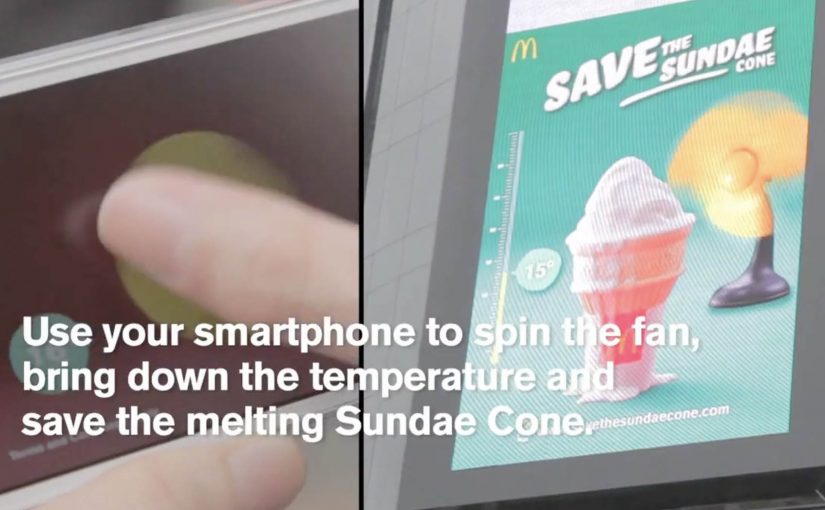
Summer is here and McDonald’s is back with an interactive outdoor campaign built around one simple problem. A giant LED billboard in Bukit Bintang, one of Kuala Lumpur’s best-known shopping districts, showcases the iconic Sundae Cone. But it is melting.
To save it, people use their smartphones to spin a fan on the billboard, bring the temperature down, and stop the cone from disappearing.
The mechanic: one shared control, one visible outcome
The execution translates an abstract idea, “cool it down,” into a single piece of viewer control. You open the experience on your phone and spin a fan. The billboard responds in real time. When more people join in, the cooling effect accelerates, so the experience naturally becomes collaborative rather than solo.
In some write-ups, participation is also rewarded with a Sundae Cone e-voucher that arrives on the phone, adding a clean payoff to the play.
In high-footfall retail districts, interactive DOOH, meaning public digital screens that react to what people do, works best when the action is obvious, social, and instantly rewarded.
In high-density urban retail districts, the win is not interactivity by itself but a public action that converts attention into nearby store traffic.
Why it lands
It is instantly legible from a distance. Something is melting. A crowd can fix it. Because the phone gesture maps directly to the visual problem on the screen, people understand the task instantly and the crowd can follow the result without explanation. That clarity creates a low-friction loop: notice. join. watch the shared progress. earn the reward. The “melting” constraint also adds urgency without needing any heavy messaging, and the big screen makes every participant feel like they are influencing something larger than a banner.
Extractable takeaway: If you want people to interact in public, reduce the mechanic to one familiar gesture, make the result visible to everyone, and design the reward so participation feels worth it even for a 30-second engagement.
What McDonald’s is really buying
The real question is whether the screen can turn public play into store-proximate action before attention drifts. This is a strong retail DOOH execution because the interaction, the product promise, and the path to redemption all reinforce each other. This is not only awareness. It is behavior. Get people to take out their phone, do a playful action tied to heat and refreshment, and then convert that attention into a reason to walk into a nearby store. The billboard becomes a live demo of “cool relief,” not a static claim.
What retail teams should borrow
- Design for crowds first. If spectators cannot immediately understand what participants are doing, participation stalls.
- Make progress collective. Shared outcomes create social proof and naturally recruit more people.
- Keep the gesture native. One simple interaction beats a clever multi-step flow in outdoor environments.
- Tie reward to proximity. If you can convert engagement into a nearby redemption moment, the media becomes a traffic engine.
A few fast answers before you act
What is “Save the Sundae Cone”?
It is an interactive digital out-of-home campaign in Kuala Lumpur where a billboard shows a melting Sundae Cone and invites the public to cool it down using their smartphones.
How do people control the billboard?
They use their phone to spin a fan mechanic that cools the on-screen temperature. More participants increase the effect, making it collaborative.
Why is the melting mechanic effective?
Melting creates urgency that anyone understands, and it turns participation into a visible “save” moment the crowd can watch.
What makes this a strong example of interactive DOOH?
The action is obvious, the feedback is immediate, and the experience becomes social because progress is shared on a large public screen.
What is the key takeaway for other brands?
Use one native gesture, show real-time feedback in public, and reward participation quickly so interaction feels like a fair trade.
