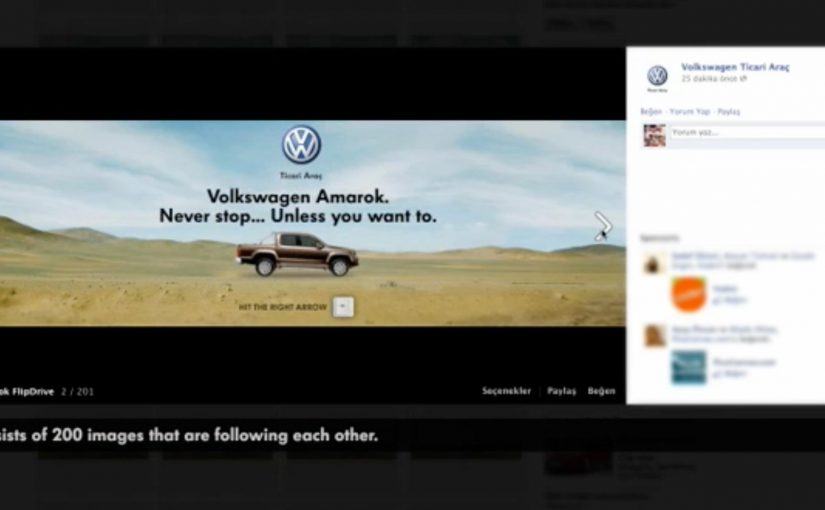
You open a Facebook photo gallery called Amarok FlipDrive, click the first image, and keep the right arrow button pressed. The photos flip fast enough to feel like a running movie. A flipbook, built out of a Facebook album.
The reference point. A “commercial” powered by a Twitter feed
In April, Mercedes Smart in Argentina created the first of its kind Tweet Commercial using its Twitter stream. Here, “Tweet Commercial” means the Twitter feed is the engine behind the spot. Now Volkswagen Amarok in Turkey has created the Facebook alternative.
The idea. An all-terrain truck that can even “drive” on Facebook
The Volkswagen Amarok is positioned as an ultimate all terrain vehicle. It can go everywhere. From the city to sand to water. With some creativity from McCann Erickson Istanbul, it can even go on Facebook.
This is the kind of platform-native execution worth copying because it treats navigation as the media layer, not just a way to browse.
How it works. 201 images in sequence
201 images that follow each other in sequence are uploaded to the Amarok FlipDrive Facebook photo gallery. Opening the first photo and keeping the right arrow button pressed makes the photos flip by fast and gives the effect of a running movie.
In global brand marketing teams looking for attention inside social feeds, this is a reminder that interface behavior can be the format.
Why it lands. Viewer control becomes playback
Because the user can hold one familiar key to control speed, the sequence feels like motion without needing a video player. The real question is whether your idea can be expressed as a repeatable gesture the platform already trains people to do.
Extractable takeaway: If a platform has a predictable navigation gesture, you can sequence stills so the gesture becomes playback and the user becomes the “play button”.
The reality check. Caching changes the experience
The flipbook experience is very jerky the first time, but once all the photos are cached (loaded locally after the first pass), it plays as seen in the video below.
What to borrow from Amarok FlipDrive
- Turn one navigation action into “play”. Upload frames in strict sequence, then let holding the right arrow key act as the playback control.
- Design for the first-run experience. Expect jerkiness until images are cached, and make sure the idea still reads even when playback is imperfect.
- Use native mechanics as the “player”. Streams, galleries, and navigation keys can carry a social commercial without introducing a separate media layer.
A few fast answers before you act
What is the Volkswagen Facebook Flipbook?
It is a Facebook photo gallery that behaves like a flipbook-style animation when you move quickly through sequential images by holding the right arrow key.
How many images does it use?
201 images, uploaded in sequence.
What does the user do to “play” it?
Open the first photo in the album and keep the right arrow key pressed to flip through the sequence fast enough to feel like motion.
Why is the first run jerky?
Because the images are not yet cached. Once the browser has loaded them once, playback becomes smoother.
What is the broader pattern?
Using native platform mechanics, such as streams, galleries, and navigation keys, as the media layer for a social commercial.