
McDonalds Hamburger Timetable

You wait for a train at Warsaw’s Central Station and check the departure board. Everything looks normal at first. Destination, track number, platform. Then you notice the twist. The wait time is not shown in minutes. It is shown in hamburgers, cokes and fries.

The idea. Make waiting feel shorter by making it measurable

McDonalds in Poland finds a creative way to make waiting for the train less agonizing for passengers and more profitable for its trainside location. The board translates delay time into a simple, food-based unit people instantly understand.

How it works at the station

In cooperation with PKP (Polish State Railways), McDonalds installs a special timetable about 50 meters from the main hub of Warsaw’s Central Train Station. It displays departure time, destination, track number, and platform information as usual. The difference is the wait and delay time, which appears as burgers, cokes and fries.

In transit retail, waiting time is one of the few moments when attention and immediate purchase intent sit in the same place.

Why this lands as a smart retail nudge

Here, a retail nudge means a light prompt that changes the next action without forcing it. The mechanic does not interrupt. It reframes the moment. The real question is how to turn dead waiting time into a branded action without making the brand feel intrusive. Because the board converts minutes into food units, grabbing food becomes the obvious way to spend the time. McDonalds is right to keep this utility first, brand second, because that is what makes the prompt feel clever rather than pushy.

Extractable takeaway: When a brand translates spare time into a simple unit tied to an immediate action, the message feels useful first and persuasive second.

What the result signals

While making the train station a more enjoyable place for waiting passengers, McDonalds sees an increase of 4,500 customers in the first month itself. The business intent is clear: convert idle station time into store traffic at the moment of highest relevance.

What to steal for retail nudges in waiting moments

  • Translate time into a brand-shaped unit. When minutes become “one burger”, the next action becomes self-evident.
  • Place the nudge exactly at the decision point. The board sits in the flow of passengers, not in a separate ad zone.
  • Keep the mechanic utility-first. It still behaves like a timetable, so people accept it instead of resisting it.
  • Make the conversion instantly readable. If it takes explanation, the moment is already gone.

A few fast answers before you act

What is the McDonalds Hamburger Timetable?

It is a train timetable that displays delay and waiting time as McDonalds menu items, like burgers, fries and Coke, instead of minutes.

Why does converting minutes into food items influence behaviour?

Because it makes the wait feel like “time you can spend” rather than “time you lose”. It also provides a natural suggestion for what to do next without using a hard call-to-action.

What makes this feel helpful instead of salesy?

It behaves like a real timetable first and a brand cue second. That utility lowers resistance because the brand message is embedded in something people already need to read.

What is the core design lesson?

Translate a boring metric into a simple, brand-linked unit that is immediately understood, and place it exactly where the decision happens.

Where else can this pattern work?

Any waiting context with nearby commerce. Transit hubs, queues, ticketing areas, and event entry points all benefit when “time to kill” becomes “time to enjoy”.

McDonald’s Reflective Billboard

You drive past a billboard during the day and see nothing. Then you pass it again at night, your headlights hit the surface, and a message appears. “Open all night.”

The idea. An ad you can only see at night

McDonald’s wanted to target people looking for a late night snack, so Cossette Vancouver created an ad that only showed itself when the audience was most likely to want it.

How reflective tape turns headlights into a reveal

Reflective tape was used to write “Open all night” on the billboard. The message was not visible during the day, but at night, with car headlights, it was revealed.

For late-night retail and roadside food brands, timed visibility like this turns the placement itself into the filter.

Why this works for late-night intent

This is behavioural targeting without data. The medium uses context instead of audience data to decide when the message becomes visible. Because the message only appears when headlights activate it, the reveal feels timely rather than intrusive.

Extractable takeaway: When the environment can decide who sees the message, the creative can stay simple and still feel precise.

What this does for late-night traffic

The real question is whether the medium can do the filtering before the copy has to. In this case, the billboard spends visibility only on people who are out at night, which makes a simple store-hours message feel more useful and more memorable.

This is a stronger OOH move than a generic night-time billboard because the medium itself makes the message feel useful.

What to steal for context-driven OOH

  • Turn an environmental condition into the trigger. Here, light does the targeting without any data.
  • Align message visibility with intent. If the audience can see it, they are already in the right moment to act.
  • Keep the proposition short and literal. The reveal is the effect, so the copy should be instantly readable at speed.
  • Design for repeat exposure. The “I saw nothing. Then I saw it” contrast is what makes it stick.

A few fast answers before you act

What is the McDonald’s Reflective Billboard concept?

It is a billboard that stays visually “blank” in daylight, but reveals the line “Open all night” when car headlights hit reflective tape after dark.

Why is night-only visibility a smart creative constraint?

Because it aligns the message with the moment of need. People out late are more likely to want a snack, so the ad appears when intent is highest.

What is the key production technique here?

Using reflective tape to create a hidden message that only becomes legible under direct light sources like headlights.

Why does this feel less intrusive than normal targeting?

Because the environment does the filtering. The ad only becomes visible in the right condition, so the timing feels useful instead of forced.

What is the broader lesson for outdoor advertising?

Let context do the targeting. When the medium responds to time, light, or location, the message can feel personalised without collecting data.

McDonald’s: Dollar Drink Days Ice Sculpture

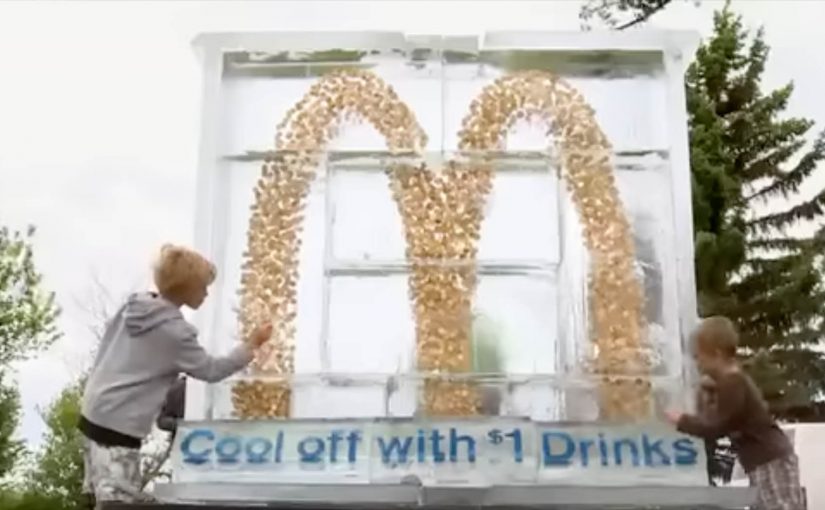
McDonald’s Canada and Cossette Vancouver brought to life one of the first interactive ice sculptures this summer on behalf of McDonald’s Restaurants in Alberta. The objective was to drive consumer interest in the company’s Dollar Drink Days campaign. Here, “interactive” means people can physically engage with the installation and change it in real time.

Hosted in the town of Sylvan Lake, the stunt saw 8,000 pounds of ice moulded into a seven-foot tall installation containing over 4,000 sparkling loonies, shaped into McDonald’s famous Golden Arches. The ice melted on a summer Saturday, and consumers chipped away at the sculpture to collect their bounty.

To attract high levels of interaction, the sculpture was strategically placed near the Sylvan Lake Pier, an area frequented by young adults and families. The day also featured a DJ, street promotional teams, hula hooping, limbo contests and giveaways.

In quick-service promotions, especially in seasonal, high-footfall leisure locations, the hard part is converting “cheap” into “must-see”.

The real question is how you turn a simple price offer into a moment people choose to chase.

Price promotions are forgettable until you give people a physical action that earns a visible payoff.

Why this activation pulls people in

The reward is visible and the deadline is unavoidable. Because the coins sit inside melting ice, the mechanism turns curiosity into action and keeps people moving from watching to participating.

Extractable takeaway: If you want a price promo to travel, make the payoff visible, put it behind one simple action, and bake in a deadline people can feel.

  • A clear, physical payoff. The value is visible and tangible, and the “win” is earned through participation.
  • Built-in urgency. Melting ice creates a natural time limit, which pushes people to act now rather than “later”.
  • Placement does the heavy lifting. Putting it at a high-traffic summer spot turns curiosity into crowds.

Reusing the melting-deadline mechanic

This is a strong example of turning a price promotion into a real-world spectacle. Instead of telling people “Dollar Drink Days is on”, the brand created a moment people wanted to be part of, and then made participation the mechanism for reward.

  • Make the payoff obvious. Put the value where people can see it before they commit.
  • Use a deadline that enforces itself. A physical countdown beats a marketing one, because it changes what people do right now.
  • Let the location supply the audience. Choose a place that already has the right crowd, then make the moment easy to join.

A few fast answers before you act

What was the Dollar Drink Days ice sculpture?

It was a seven-foot interactive ice installation in Sylvan Lake, Alberta, shaped like the Golden Arches and packed with thousands of loonies for visitors to collect as it melted.

How did people interact with it?

As the sculpture melted during the day, people physically chipped away at the ice to reach the coins inside.

Why stage it near Sylvan Lake Pier?

The location is naturally busy with young adults and families in summer, which increases footfall and keeps participation high.

What is the core pattern worth reusing?

Give people one simple action that unlocks a tangible reward. Add a natural deadline, and stage it where the right crowd already gathers.