McDonald’s Happy Table

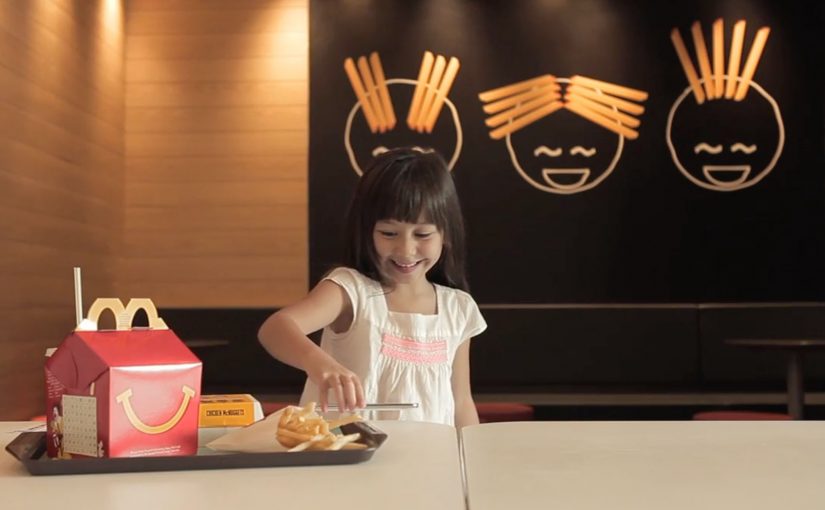
A child sits down in a McDonald’s Singapore restaurant, opens the McParty Run app on an NFC-enabled smartphone, and places the phone on a marked spot on the table. The tabletop immediately becomes the playfield. A McDonaldLand-style racing track appears around the phone, and the whole table turns into a shared game surface.

The idea. Turning a restaurant table into play

McDonald’s Singapore introduces Happy Table as an interactive dining concept that converts an ordinary in-store table into a digital playground for kids. Instead of handing out a traditional toy, the experience uses mobile technology to project a short, location-based game onto the table itself.

Here, “interactive dining” means the table is the shared surface for a short in-restaurant moment, and the phone is only the trigger.

How it works. McParty Run plus NFC

The mechanic is simple and deliberately physical:

  • Customers download the McParty Run mobile app.
  • The phone needs to be NFC-enabled.
  • The customer places the phone on a designated table inside the outlet.
  • Once the table detects the device, the tabletop becomes a virtual racing track, with animated characters and objects appearing around the surface.

Kids move around the table to control the game, racing to collect burgers and fries while avoiding familiar McDonald’s characters like the Hamburglar and Captain Crook. The table is the center of interaction, so the gameplay is naturally shared and social.

In family-oriented quick-service restaurants, the table is the shared touchpoint everyone already gathers around.

Why this is interesting in-store

Happy Table shifts the experience away from passive, individual screen time and toward a shared activity that fits the restaurant context. The game is anchored to the location and to a physical object. The table becomes the shared interface, and the phone becomes the trigger. Because the table is the interface, participation becomes social by default.

Extractable takeaway: If you want digital play to feel additive in a physical venue, make the venue the interface and keep the phone as the on-ramp.

The real question is whether you can turn waiting time into a branded group moment without making the meal feel harder for parents.

This pattern is worth copying when the interaction is optional, short, and anchored to a shared surface people already use.

What brands can take from this pattern

A few practical takeaways that translate beyond fast food:

  • Make the physical environment do the work. When the venue becomes the interface, the digital layer feels less like an add-on.
  • Design for group behavior, not solo attention. A shared surface encourages participation and reduces the “everyone disappears into their own screen” effect.
  • Keep it short and contextual. A quick, playful moment that fits waiting time is more natural than a long-form experience that competes with eating.
  • Use familiar brand assets in motion. McDonald’s characters and food cues make the experience instantly legible to kids.

Happy Table is created by the DDB Group and runs as a pilot at select outlets across Singapore.


A few fast answers before you act

What is McDonald’s Happy Table?

An interactive dining concept in McDonald’s Singapore that turns an in-store table into a digital game surface for kids.

What do you need to use it?

The McParty Run app and an NFC-enabled smartphone, placed on a designated table inside the outlet.

What is the gameplay?

A McDonaldLand-style racing experience where kids move around the table to collect burgers and fries while avoiding characters such as the Hamburglar and Captain Crook.

What makes it different from a typical mobile game?

The table is the shared interface. The experience is designed to be physical and social, centered on a real-world location and group play.

Where is it running?

As a pilot in select McDonald’s outlets across Singapore.

McDonald’s Free WiFi: Turning SSIDs into Ads

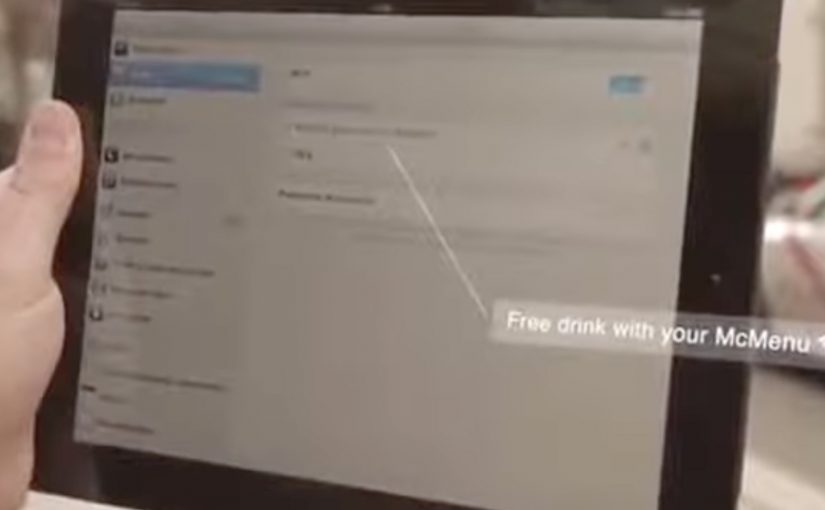
In Spain, McDonald’s offers free WiFi to all its customers. Since the WiFi signal reaches quite far, customers in surrounding restaurants also tend to use the McDonald’s network.

So McDonald’s decided to attract new customers via their own WiFi network. They simply changed the signal’s name into a message and embedded a promotion into it.

The simplest media channel you already own

This is a tiny idea with a very clear mechanism. A WiFi network name is a broadcast surface. That name is the SSID, the label devices show in the network list. It shows up exactly when people are deciding where to sit, what to order, or whether to move.

Instead of treating WiFi as utility, McDonald’s treated it as a micro-channel for demand capture.

Why the WiFi name works as advertising

In high-footfall retail settings where people scan for quick utility, the WiFi list becomes a decision interface and the SSID becomes a tiny billboard in that interface.

Extractable takeaway: When people already scan a utility list, naming inside that list can outperform bigger media because it meets intent at the moment of choice.

  • High intent moment. People looking for WiFi are already in “connect me now” mode.
  • Local reach. The signal spills into nearby venues, where potential switchers sit.
  • Zero-click visibility. You see the message before you even connect.
  • Low cost, repeatable. Updating an SSID is simple, fast, and scalable.

Where this crosses from clever to strategic

The real question is whether you treat owned infrastructure as a distribution channel, or just as a cost line.

The strategic move is not the pun. It is the use of owned infrastructure as a distribution channel. When your message sits inside a system people actively scan for, you reduce friction and increase the odds of action.

This is worth doing wherever you run guest WiFi and can keep the message instantly understandable.

It is also a reminder that not all “digital” has to be an app. Sometimes it is just naming.

What to take from this if you run retail or CX

  1. Audit your hidden touchpoints. SSIDs, receipts, kiosks, queue screens, packaging, all are media surfaces.
  2. Message at the decision point. Proximity channels work best when they align with immediate behavior.
  3. Keep the offer instantly understandable. People scan lists quickly. Clarity beats cleverness.
  4. Test and rotate. Like any channel, vary the message to learn what actually moves footfall.

A few fast answers before you act

What did McDonald’s do with its free WiFi in Spain?

It changed the WiFi network name into a message and embedded a promotional offer into the SSID to attract people nearby who could see the network on their devices.

Why does the WiFi signal matter here?

Because it reaches beyond the restaurant itself, meaning people in surrounding venues can still see and use the network, making it a local acquisition channel.

What is an SSID in this context?

It is the WiFi network name that appears in a device’s list of available networks. Changing it changes what people see before connecting.

Is this a “growth hack” or a real marketing tactic?

It is both. It is a lightweight tactic, but it is grounded in a real channel. Owned infrastructure that reaches potential customers at a high-intent moment.

What is the transferable lesson for brands?

Look for owned, ambient digital surfaces where people already scan for utility, then place a clear message there that can drive immediate action.

Track My Macca’s: Supply Chain Transparency

McDonald’s in Australia decided to use technology to tackle one of its biggest problems, the disbelief that its ingredients are fresh, locally sourced and of decent quality. So with image recognition, GPS, augmented reality and some serious integration with its supply chain, they put together a full story behind every ingredient people came across while buying food at McDonald’s.

The real challenge: trust, not awareness

This is not a campaign built to shout louder. It is built to answer the skeptical question that sits in the customer’s head at the moment of choice: “Is this actually fresh, and where did it come from?”

The real question is: how do you turn a trust objection into verifiable context at the point of purchase?

Instead of responding with claims, it responds with traceable context. Ingredient by ingredient.

Why the tech stack matters only if it is integrated

Image recognition, GPS, and augmented reality are the attention layer. The credibility layer is the supply chain integration. Here, “supply chain integration” means the experience is pulling from the same operational sourcing and logistics records the business runs on. Without that, the experience would be a glossy story. With it, the experience becomes proof.

If the experience is not tied to operational data, it becomes transparency theater rather than trust building.

  • Image recognition. Identify what the customer is looking at or buying.
  • GPS. Connect the experience to location and local sourcing claims.
  • Augmented reality. Make information feel immediate and tangible in the buying moment.
  • Supply chain integration. Ensure the “story” maps to real sourcing and logistics data.

In high-volume consumer businesses, credibility is won or lost in the buying moment, not on an “about our ingredients” page.

What makes this a strong model for brand transparency

Transparency only works when it is easy. People will not dig through PDFs or corporate sustainability pages while they are ordering lunch.

Extractable takeaway: When trust is the barrier, bring proof to the point of choice and back it with operational data that can stand up to scrutiny.

What to take from this if you run CX, MarTech, or operations

  1. Start with the objection. The customer’s doubt defines the experience.
  2. Proof beats promise. If you want trust, show traceability, not slogans.
  3. Integrate the system of record. Experiences that depend on trust must connect to operational data.
  4. Design for the moment of choice. The best transparency is delivered exactly when people need it.

Here, “system of record” means the operational data sources that govern sourcing and logistics, not a marketing layer that can drift from reality.


A few fast answers before you act

What is “Track My Macca’s”?

It is a McDonald’s Australia initiative that uses mobile technology to show a story behind ingredients, aiming to build trust in freshness, local sourcing, and quality.

Which technologies were used?

Image recognition, GPS, augmented reality, and strong integration with McDonald’s supply chain to connect the experience to real sourcing and logistics.

Why is supply chain integration the critical piece?

Because the experience depends on credibility. Without operational data behind it, the story would feel like marketing. With it, it can function as proof.

What customer problem does this solve?

It addresses disbelief about ingredient freshness and quality by making provenance and context visible at the point of purchase.

What is the transferable lesson for other brands?

If trust is your barrier, design transparency into the customer journey and connect it to your systems of record, so the experience can stand up to scrutiny.