
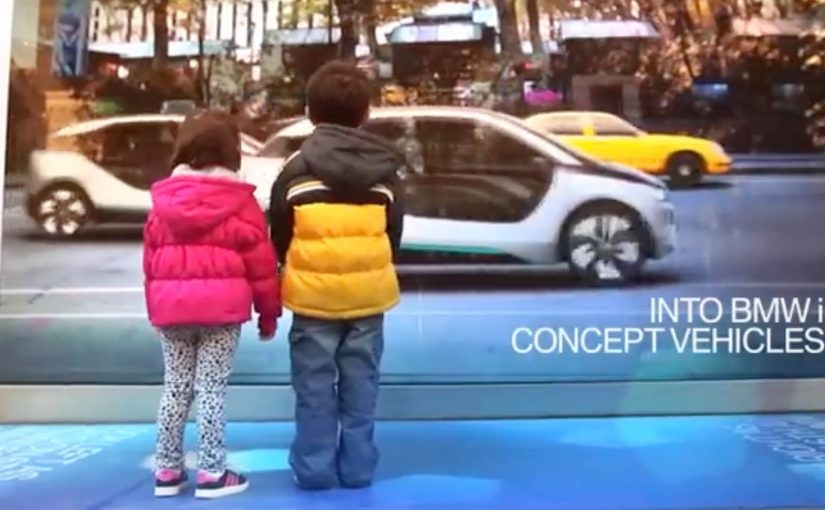
BMW i window into the near future

A street-level window in New York City behaves like a digital mirror. Here, “digital mirror” means a live street scene that can replace the cars in the image in real time. As traffic passes, the “reflection” transforms everyday cars into BMW i3 and i8 vehicles, giving passersby a glimpse into the near future.

The context. BMW i and “Born Electric”

The upcoming BMW i vehicles look distinctly futuristic and are positioned to arrive as early as late 2013. To build awareness for the BMW i Born Electric Tour in New York City, BMW reinforces a simple message. The future is closer than you think.

The real question is whether you can make a future-state product promise feel present without asking people to opt in.

This kind of work succeeds when the transformation is unmistakable from a distance and repeats for every passerby.

The execution. A live reflection that rewrites reality

BMW turns a window at the event location into a real-time “reflection” of passing traffic. The system captures what is happening on the street and swaps the vehicles in the live view for BMW i models, so the future feels present in the exact moment people walk by.

In public spaces, low-friction interactive experiences win when they are legible from a distance and require no download or instruction.

Why this works. Low friction, high surprise

The interaction requires no download, no instruction, and no commitment. It is immediate, legible from a distance, and designed for public curiosity. Because the swap happens in the same sightline people already have, surprise arrives before skepticism. The value is the reveal. A familiar street scene. Then a future version of that same scene.

Extractable takeaway: If you want people to believe “the future is close,” show the future inside a familiar frame, in real time, with one unmistakable before-and-after.

Make the promise feel present

  • Borrow a default behavior. Use a frame people already check, like a reflection or a window, so attention is automatic.
  • Make the change binary. One clear swap that anyone can spot, even in motion.
  • Let repetition do the work. Design it so the reveal happens again and again for new passersby, without setup.

A few fast answers before you act

What is BMW i Window Into the Near Future?

A street-level installation that turns a window into a live digital “reflection,” transforming passing traffic into BMW i3 and i8 vehicles.

What is it promoting?

Awareness for the BMW i Born Electric Tour in New York City, and the idea that the future is closer than you think.

What is the main user behavior?

Walk by, notice the window, and experience the surprise as the street scene is transformed in real time.

Why is the window format effective?

It uses a natural behavior, looking at reflections, then subverts it with a future-state overlay.

What is the transferable pattern?

Place the experience where attention already exists, then deliver one high-clarity transformation that makes the product promise tangible.
Sprint: Unlimited Love Billboard in Times Square

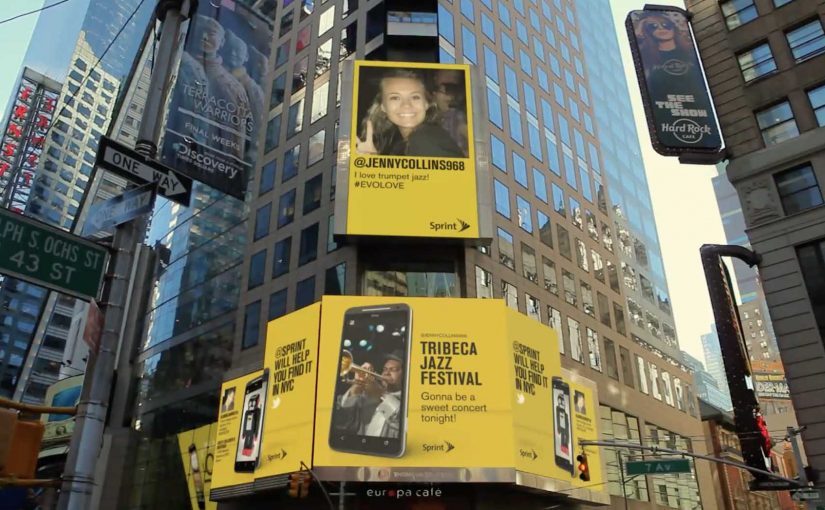
You are in Times Square and a billboard asks a simple question. What do you love. You tweet your answer with #EVOLOVE to @sprint, and the screen answers back with places in New York City where you can find it.

Sprint in the USA created an integrated advertising campaign for the launch of the HTC EVO 4G LTE phone on their network. To launch EVO in New York City they set up an interactive billboard in Times Square that encouraged visitors to tweet things they love with #EVOLOVE to @sprint. Then, with the help of local experts, the billboard re-tweeted locations of where these things of love could be discovered in New York City.

Why the mechanic works

The mechanism is a clean exchange. You give the brand a public signal. A tweet about something you love. The brand gives you an immediate, useful response. A location you can act on right now. That “reply with value” is what turns a hashtag prompt into participation.

Extractable takeaway: Interactive OOH works best when the public input reliably triggers a fast, specific reply that helps someone decide what to do next.

It also creates a visible social proof layer. The billboard is not only showing Sprint’s message. It is showing other people’s messages, which makes the campaign feel alive and current while you are standing there.

In consumer technology launches and telco marketing, a social-to-DOOH loop, where a social post immediately changes what the screen shows, turns a landmark screen into a real-time recommendation engine that people can influence from their own phones.

What Sprint is really buying

This is a launch tactic that behaves like service. It positions the EVO as a device you use to discover the city, not just a phone with specs. At the same time, it lets Sprint demonstrate “unlimited” as a lived experience. Always on, always connected, always responding in real time.

The real question is whether you can keep the reply layer fast, relevant, and brand-safe in public.

If you cannot operationalize that reliably, a simpler DOOH idea will outperform an “interactive” one that feels slow or generic.

Steal this reply-with-value billboard pattern

  • Make the input obvious. One hashtag. One handle. One sentence prompt.
  • Return something concrete. Maps, directions, a nearby place, a clear next action.
  • Curate the response layer. “Local expert” guidance beats generic automation for relevance and trust.
  • Design for the crowd and the clip. The street moment should be fun to watch. The video should still work without being there.

A few fast answers before you act

What is the Sprint #EVOLOVE Times Square billboard?

A digital billboard that invites people to tweet what they love with #EVOLOVE to @sprint, then responds by showing where in New York City they can find that thing.

Why connect Twitter to a billboard instead of running a normal DOOH spot?

Because participation becomes the content. The screen stays fresh, people feel seen, and the interaction creates a public spectacle that attracts more participants.

What is the “value exchange” in this campaign?

The user provides a public message and attention. The brand provides a timely, useful recommendation and makes the user visible on a high-profile screen.

What makes this different from simply displaying tweets on a screen?

The reply layer. The billboard does not only mirror tweets. It answers them with specific places and directions, which turns social chatter into utility.

What is the biggest execution risk?

If the responses feel slow, generic, or off-topic, people stop playing. The campaign only works when the replies feel genuinely relevant in the moment.

Popcorn Indiana: The Popinator

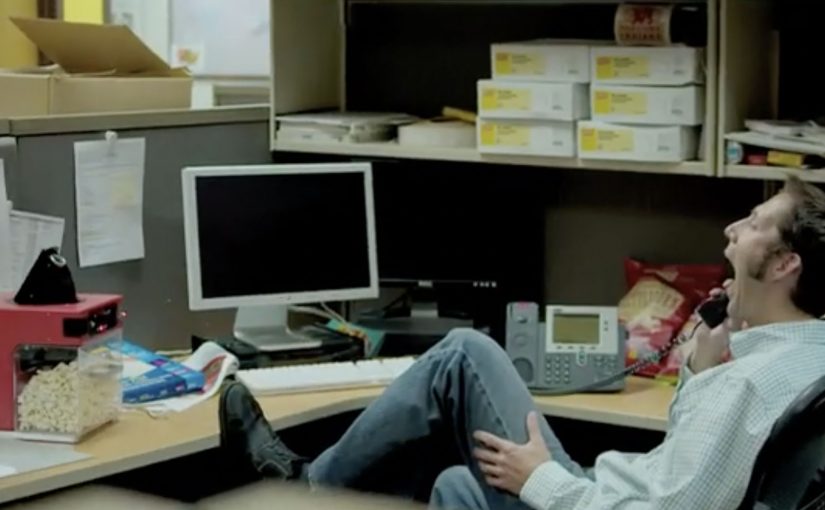
You say “pop”. A machine swings toward you and launches a single piece of popcorn into your mouth.

Thinkmodo created “The Popinator”, a gadget built as a playful piece of brand content. It is presented as a voice-triggered system that can pinpoint where the spoken word originated in a room, then fire popcorn in that direction. Popcorn is described as being shootable up to 15 feet, and the device is described as intended for indoor use.

How the gag is engineered

The mechanism is deliberately simple to explain. A keyword prompt. Direction finding. A rotating launcher. One kernel per “command”. The build turns a familiar snack habit into a mini spectacle that feels like a “future gadget”, even if you never plan to own one.

In consumer marketing where product messages blur quickly, a physical prop that demonstrates one absurdly clear benefit can generate more talk than another round of feature claims.

Why it lands

It works because it compresses the whole story into a single, repeatable moment. Say the word. Watch the machine react. See the payoff. The format is built for office viewing, quick sharing, and the social proof of “we tried it and it actually did something”.

Extractable takeaway: If you want earned reach fast, create a one-line premise people can test in their heads instantly, then design the payoff so it reads clearly on camera without explanation.

What the brand is really buying

This is not only about popcorn. It is about attention and imagination. The Popinator reframes an everyday product as something playful and engineered, then lets the internet do the distribution work by debating whether the gadget is “real” and how it works. The real question is whether one absurd, repeatable demo can make a commodity snack feel worth talking about. The stronger brand move here is making the behavior memorable, not pretending the hardware is the story.

What to borrow from The Popinator

  • Build a single, legible “demo moment”. One trigger. One reaction. One payoff.
  • Make the prop do the talking. The less narration required, the more shareable the clip becomes.
  • Design for repeat attempts. Repetition is content when the mechanism is satisfying to watch.
  • Let curiosity drive comments. “Is it real” is a distribution engine when handled responsibly.

A few fast answers before you act

What is The Popinator?

A popcorn-launching machine created as brand content, presented as firing kernels toward whoever says the word “pop”.

What is the core mechanism?

A keyword prompt triggers direction-finding, then a rotating launcher fires one kernel toward the sound source.

Was it a real product you could buy?

It is presented as a prototype-style gadget for content. Some coverage from the time frames it as a marketing stunt rather than a commercial device.

Why do “fantasy gadget” videos travel so well?

They borrow the credibility of product demos while delivering entertainment. Viewers share them as a mix of “I want this” and “no way this is real”.

What is the safest reusable lesson for brands?

Turn a mundane product habit into a surprising, visual demonstration that can be explained in one sentence and enjoyed in under a minute.