
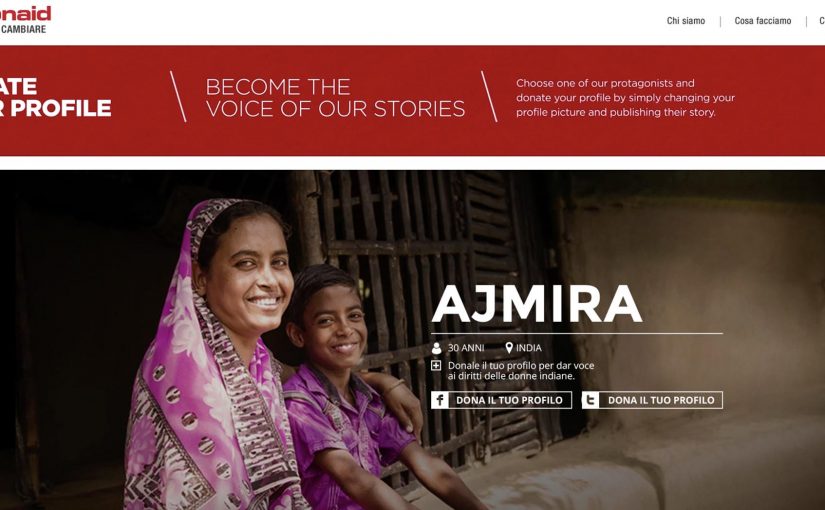
ActionAid: Donate Your Profile

ActionAid is an organisation committed to many projects, like fighting hunger and poverty. But in Italy it is known primarily for sponsoring children.

To communicate the broader work of ActionAid with a small media and production budget, DLV BBDO created “Donate Your Profile”. Participants donated their Facebook and Twitter profile pictures so that awareness could be generated for the stories of people ActionAid helped.

How “Donate Your Profile” worked

The mechanism is a simple identity swap. People hand over the most visible square in their social presence. Their profile photo. In return, they display a campaign image tied to a real person’s story, so every comment, like, and share carries that story into everyday social traffic.

Support from Radio 105, Radio Deejay, La Stampa, Marc Marquez and other Italian celebrities and brands helps normalise the behaviour. Once well-known accounts participate, the “donate your picture” action looks safe, easy, and socially endorsed.

In Italian cause marketing, borrowing social identity can outperform paid media when budgets are tight, because it turns personal networks into distribution.

The real question is how to turn a low-budget act of support into something people carry through their normal social behaviour.

Why the profile swap spreads

This works because it converts passive support into a visible, persistent signal. A profile picture is not a post that disappears in a feed. It is a durable badge that travels wherever you show up online, and it prompts questions that naturally lead to explanation and sharing.

Extractable takeaway: If you need earned reach without heavy spend, move the call to action from “share a post” to “change a default”. When people change a default surface, the campaign rides along with their normal behaviour.

The reported impact

The project was described as becoming the 5th most trending topic on Twitter and generating over 79 million media impressions, with more people joining in as the support network grew.

What to borrow from the profile-swap pattern

  • Pick a high-frequency surface. Defaults like profile photos travel more than one-off posts.
  • Make the action reversible. People participate faster when the commitment feels temporary.
  • Seed with credible partners. Media brands and recognisable faces reduce hesitation.
  • Turn participation into a conversation starter. The best mechanics invite questions, not just clicks.

A few fast answers before you act

What is “Donate Your Profile”?

It is a campaign where people replace their Facebook and Twitter profile pictures with a campaign image, so ActionAid stories gain awareness through everyday social interactions.

Why use profile pictures instead of posts?

A profile picture is persistent and high-visibility. It shows up repeatedly across comments and interactions, so the message travels without requiring constant re-posting.

How did the campaign scale beyond early participants?

Reportedly through support from media brands and celebrities, which makes the behaviour feel normal and increases follow-on participation.

What results were reported?

Reported results included reaching the 5th most trending topic on Twitter and generating over 79 million media impressions.

What is the main risk with this pattern?

Trust. If people are unclear about what is being changed, for how long, and what they are authorising, participation drops. The exchange must be transparent and easy to undo.

Obra do Berço: The SOS SMS

Street children begging for food and money near busy traffic stops are a common sight in metropolitan cities like Rio de Janeiro. Accustomed and tired of this routine, drivers often shut their car windows to ignore the children and avoid any contact.

To raise awareness and trigger more donations, “Obra do Berço”, a day care for underprivileged children in Brazil, found a way to make the children’s voices heard through those closed windows.

Bluetooth antennas were hidden near traffic signals where large groups of children tended to gather. When drivers stopped at the lights, the antennas sent an SOS SMS to nearby phones.

A message that slips past the closed window

The mechanism is a proximity-triggered interruption. Drivers can shut out the street by rolling the glass up, but they still carry one open channel with them. Their phone. The campaign uses that channel to deliver a short, unavoidable nudge at the exact moment the social problem is physically present.

In dense urban commuter settings, the hardest part of fundraising is breaking habitual avoidance without escalating the intrusion.

The real question is how you interrupt a learned act of avoidance without making the intervention feel more invasive than the problem itself.

Why this lands

This works because it reframes the “ignore” reflex. The driver’s default action is to reduce discomfort by closing the window. The SMS reopens the reality in a different place, and it does it at a moment when the person has time. Waiting at the red light. That works because the channel change breaks the driver’s avoidance pattern without forcing face-to-face contact. The intervention is also personal. It arrives one-to-one, not as a public shaming message blasted at everyone.

Extractable takeaway: If your audience has learned to tune out a problem in a specific physical context, move the prompt to a channel they still keep open in that context, and time it to a pause moment where action is possible.

What the campaign is really doing

It is converting location into relevance. Instead of asking for empathy “in general,” it triggers the ask at the exact place where indifference usually happens. That makes the message harder to dismiss as abstract, and it gives the NGO a fighting chance to turn a routine stop into a micro-decision to help.

This is smart low-budget fundraising because it uses context and timing to create relevance instead of relying on guilt alone.

What to steal from this roadside trigger

  • Target a repeatable micro-moment. Red lights create predictable dwell time.
  • Use a channel people already carry. You do not need new hardware in the user’s hands.
  • Keep the prompt short. The first goal is attention, not a long explanation.
  • Link the ask to immediate context. Relevance beats persuasion when budgets are small.

A few fast answers before you act

What is “The SOS SMS”?

It is a charity activation where hidden Bluetooth antennas near traffic lights sent an SOS SMS to drivers’ phones to raise awareness and prompt donations.

Why use traffic lights as the media placement?

Because drivers are stopped, attention is idle, and the social issue is physically present in the same moment, making the message feel relevant.

What problem does this solve versus traditional street fundraising?

It bypasses the closed-window barrier and reduces the face-to-face avoidance loop by moving the first contact into a private phone message.

Is this more effective than posters or billboards?

It can be, because it is timely and personal. The message arrives when the audience is already in the situation, not hours later.

What’s the main risk with proximity-triggered messaging?

If it feels spammy or unclear why the message arrived, people may react negatively. The copy and consent expectations need to feel respectful and transparent.