
IKEA Beröra

To launch the iPad version of the IKEA catalogue in Norway, ad agency SMFB created a brand new IKEA product called “Beröra”.

“Beröra” is a sewing kit with a special conductive thread that you sew into the index finger of your favourite gloves. Once the operation is done, the gloves work on a touch screen.

The idea in one clean sentence: Beröra turns any winter glove into a touchscreen glove, so the IKEA catalogue app fits the reality of how people live and move.

A launch mechanic that feels like a product, not a campaign

The smart move is that the “ad” looks and behaves like an IKEA item. A needle, instructions, and conductive thread. Simple enough to DIY (do it yourself), tangible enough to talk about, and useful enough to keep around after the novelty fades.

Extractable takeaway: When a digital launch depends on in-the-moment behavior, ship a small physical fix that removes the biggest usage friction so trial becomes effortless.

Conductive thread matters because most touch screens register conductive contact. So the kit essentially makes a glove fingertip “readable” to the device without forcing people to buy specialised tech gloves. By solving the glove-on touchscreen problem up front, the kit makes the first app interaction frictionless, which is what turns curiosity into downloads.

In cold-climate retail markets, the fastest way to accelerate digital adoption is to remove the tiny physical frictions that stop people trying it in the moment.

The real question is whether your launch removes the first real-world barrier to trial, or just asks people to work around it.

Solve the barrier first, then market the now-easier behavior.

Results and recognition

The promotion generated a lot of interest. As reported at the time, 12,000 kits went in roughly two weeks, and the IKEA Norway iPad catalogue app broke download records.

The work later picked up awards-circuit recognition, including a One Show merit award, and gold at the Festival of Media in Montreux in the Best Launch Campaign category.

What to steal for your next app launch

  • Turn the barrier into the giveaway. Do not “explain” the friction. Remove it with something people can hold.
  • Make the object shareable offline. A physical product travels through homes, offices, and friend groups faster than a banner ever will.
  • Keep the installation simple. If the user needs a tutorial longer than a minute, the drop-off kills word of mouth.
  • Let the product demonstrate the promise. When the benefit is self-evident, belief comes for free.

A few fast answers before you act

What is Beröra, in plain terms?

Beröra is a DIY conductive-thread sewing kit created for IKEA Norway. You sew the thread into a glove fingertip so it works on touchscreen devices, supporting the launch of IKEA’s iPad catalogue.

Why does a physical kit help launch a digital catalogue?

Because it removes a real-world usage barrier. If people cannot comfortably use a phone or tablet in winter conditions, they will not build the habit. The kit makes the app feel practical, not theoretical.

What makes this a strong “earned media” idea?

It creates a story that is easy to repeat. IKEA made a product that solves a modern annoyance, and it is tied directly to the app being promoted. That combination tends to travel well as earned media, meaning unpaid coverage and sharing.

What is the key mechanism that drives engagement here?

Utility creates trial. Trial creates talk. Talk creates downloads. The kit is the trigger that makes the catalogue experience easier, then social sharing does the distribution work.

What should you measure if you do something similar?

Track speed of redemption, install lift during the distribution window, and repeat usage of the app. If you have it, add branded search lift and share-of-voice during the launch period.
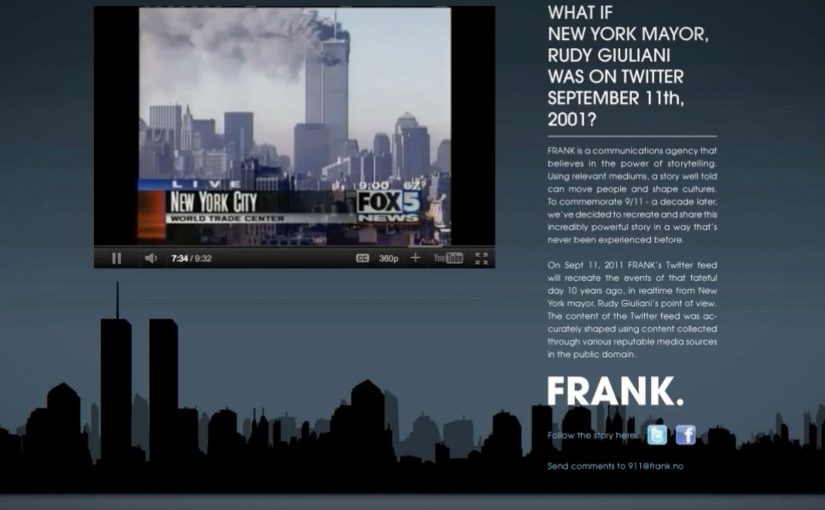
FRANK Oslo: Giuliani 9/11 Tweets

You follow a Twitter feed as if it is happening now. Updates arrive minute by minute, building confusion into urgency, then urgency into shock. The feed is written from New York mayor Rudy Giuliani’s point of view, and it recreates September 11, 2001 in real time.

FRANK is a communications agency from Oslo that wants to demonstrate the power of storytelling through the right medium. To commemorate 9/11 a decade later, they recreate and share the day as a live social stream experience.

On September 11, 2011, FRANK’s Twitter feed recreated the events of that day ten years earlier in real time from Giuliani’s point of view. The feed is described as being shaped using content collected from reputable public-domain media sources.

Real-time remembrance as a platform-native documentary

The mechanism is simple and specific. A single account publishes a paced sequence of posts that map to the original timeline, written in a constrained perspective, so the audience experiences the narrative in the same format they use for breaking news.

Here, platform-native means the story is built for the feed itself, not merely promoted through it.

In crisis and remembrance communications, real-time formats can make historical events feel immediate without changing the facts.

Why it lands

The power is in the temporal constraint. Real-time pacing prevents the viewer from jumping to the ending, which recreates uncertainty and heightens attention. The Giuliani viewpoint acts as a narrative spine, giving the stream a human decision-maker and a consistent voice, rather than a collage of headlines. It is a reminder that storytelling is not only what you tell, but also how you sequence it and where you let people experience it.

Extractable takeaway: If you want audiences to feel the weight of a known story, constrain the format. Pick one viewpoint, match the original timeline, and let pacing do what exposition cannot.

What the campaign is really doing

This is a proof of medium choice. The real question is whether the medium can carry remembrance with the same urgency as the original news cycle. Twitter is not used as a promotion channel. It is used as the container for the story. The campaign demonstrates that a platform-native structure can increase empathy and attention for complex events, while staying grounded in documented reporting.

What to steal from this real-time storytelling pattern

  • Choose one perspective. A single viewpoint makes large events navigable and coherent.
  • Use timing as a creative constraint. Real-time sequencing creates tension and attention without additional production.
  • Build credibility into the sourcing. If you rely on archival material, describe your source discipline clearly.
  • Match story to medium. The most persuasive channel is sometimes the format people already trust for “live” information.

A few fast answers before you act

What is FRANK Oslo’s “Giuliani 9/11” idea?

A real-time Twitter reconstruction of September 11, 2001 from Rudy Giuliani’s viewpoint, published ten years later to let audiences experience the timeline through a live-feed format.

Why use Twitter instead of a film or article?

Because the platform format is the point. A feed is how people experience unfolding events, so the campaign uses that native behavior to recreate pacing and uncertainty.

How does the single viewpoint help?

It creates narrative continuity. Viewers follow one decision-making perspective rather than switching between fragmented sources.

What is the main credibility requirement for this pattern?

Source discipline. If you claim accuracy, you need a clear method for selecting, verifying, and sequencing archival material.

When should you use real-time reconstruction?

When the goal is remembrance, education, or empathy, and when pacing and sequence are essential to understanding the human experience of the event.

Volkswagen: BlueMotion Roulette

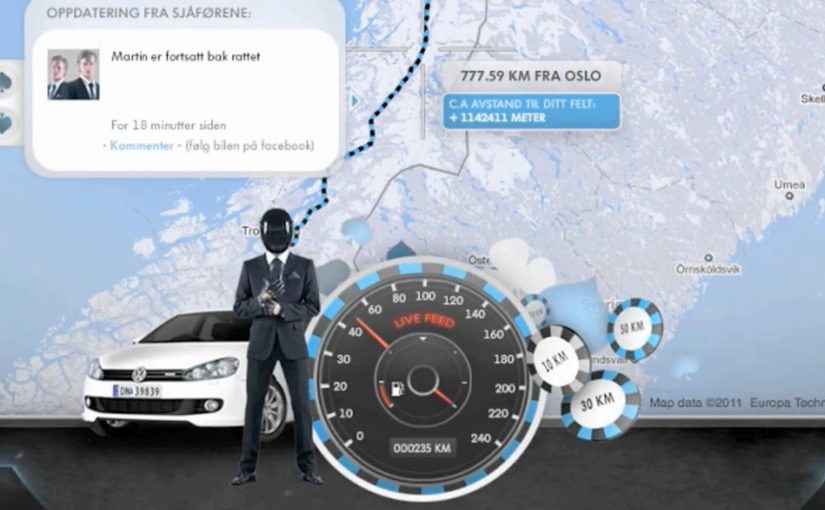
Volkswagen has turned the E6, often described as the Norwegian equivalent to Route 66, into a real-time online game of roulette using Google Maps and Street View.

TRY/Apt from Oslo devised the game to highlight the main feature of the new Golf BlueMotion, its low fuel consumption, in a meaningful and memorable way.

By “roulette”, Volkswagen literally meant dividing the E6 into thousands of map “slots” and asking people to bet on the exact spot where a fully tanked Golf BlueMotion would finally run out of fuel. Each person could place only one guess. If the car stopped on your chosen spot, you would win it.

Why the mechanic forces learning

The one-guess rule is the underrated design choice. If you only get one bet, you do not throw it away casually. You start researching. How efficient is the car, really. How far could it realistically go. What kind of driving conditions matter. The game turns “I saw an MPG claim” into “I tried to estimate a real outcome.”

The real question is how far it will go in real conditions when you only get one chance to be right.

This is a smart way to market efficiency because it turns a fuel-consumption spec into a public, falsifiable outcome people can debate, predict, and verify.

That is the brand win. You are not pushing information at people. You are pulling them into the proof.

In automotive efficiency marketing, a technical number only becomes persuasive when people can translate it into distance, time, and a story they want to test.

What made it stick beyond the stunt

Published campaign results describe close to 50,000 people placing bets, with roughly the same number visiting the site on the day of the drive. The car reportedly kept going for 27 hours and came to a halt about 1,570 km north of Oslo, turning a fuel-consumption spec into a distance people can picture. Even better. There was a real winner. The reporting names Knud Hillers as the person who picked the precise spot where the car finally stopped.

Extractable takeaway: If you want a spec to travel, turn it into a single, answerable public question, then design one constraint that forces participants to estimate, not just watch.

Steal this from BlueMotion Roulette

  • Convert a spec into a prediction. People remember what they estimate, not what they are told.
  • Limit participation to raise intent. One guess makes research feel rational.
  • Make the proof public. A live run creates shared tension and shared conversation.
  • Build the story around a single question. “How far can it really go” is the whole campaign.

A few fast answers before you act

What is BlueMotion Roulette?

BlueMotion Roulette is an interactive Volkswagen campaign that turns a real highway into a map-based betting game. People guess where a Golf BlueMotion will run out of fuel on one tank. If they guess correctly, they win the car.

Why use Google Maps and Street View for this?

Because it makes the “distance” claim tangible. The map gives precision, context, and credibility, and it lets people choose an exact location rather than a vague number.

What makes the one-guess rule so effective?

It increases commitment. If you only get one bet, you are more likely to look up facts and make a reasoned estimate, which forces deeper engagement with the product story.

What is the biggest risk with a live proof mechanic?

If the outcome is unclear or disputed, the proof collapses. The run, the rules, and the documentation of the final stopping point all need to be transparent and easy to understand.

What should you measure for a campaign like this?

Participation volume, repeat visitation on “event day”, social conversation during the live window, and whether people can correctly retell the mechanic and the proof outcome afterward.