

S-Oil: HERE Balloons

Seoul is often described as having one of the world’s highest levels of gasoline consumption, and parking space is scarce. The everyday cost is not just frustration. It is fuel burned while circling for a spot. One widely cited estimate frames it as roughly 15km a month driven just to find parking, which can add up to about a litre of fuel wasted per driver.

To reduce that waste, South Korean oil brand S-Oil teamed up with Cheil Worldwide and tried a simple visibility hack. In practice, that means turning hidden parking availability into a physical signal drivers can read from a distance. Bright yellow HERE balloons were set up for each parking space. When a car parked, the balloon dropped. When the car left, it rose again. Drivers could spot the balloons from far away and head straight to open spaces without wandering.

A parking signal you can see from across the lot

The mechanism is low-tech but precise. Each space gets a tall, arrow-shaped balloon tethered so that occupancy physically pulls it down. Availability lets it float up. The whole system turns a hidden status. “Is this space free?” into a visible skyline of yes and no.

In dense Asian megacities where time, congestion, and emissions compound daily, the best “smart city” ideas are often the ones that remove searching rather than adding instructions.

The real question is how quickly you can make a hidden status visible enough to remove wasted movement at scale.

Why it lands

This works because it attacks a behaviour, not an attitude. Drivers do not need to be persuaded to care about fuel. They just need the environment to stop making them waste it. The balloons cut decision time, reduce aimless loops, and make the correct action obvious without signs, apps, or learning curves.

Extractable takeaway: When your outcome depends on reducing “search”, do not ask people to change intent. Change visibility. Make the correct option legible from far away, and the behaviour shifts on its own.

What the results are described to show

Campaign reporting describes the one-day test as saving about 23 litres of fuel across roughly 700 cars. The same reporting frames the real opportunity as scale. If you replicate a small efficiency across many lots and many days, the cumulative savings become meaningful.

What parking and place teams can steal

  • Turn status into a skyline. If availability is the problem, make it visible at distance.
  • Prefer passive systems over active ones. No app installs, no user training, no instructions needed.
  • Design for the first two seconds. The idea must be understood instantly from a moving car.
  • Measure the behavioural delta. Track circling reduction, time-to-park, and fuel impact, not just “awareness”.

A few fast answers before you act

What are S-Oil “HERE” balloons?

They are arrow-shaped balloons installed above parking spaces that rise when a space is free and drop when a car occupies it, so drivers can spot availability from a distance.

What problem does the idea solve?

It reduces fuel and time wasted while drivers circle looking for a space by making empty spots immediately visible.

Why use balloons instead of an app?

Balloons work for everyone instantly, without installs, connectivity, or attention on a screen. The signal is in the environment where the decision happens.

What results were reported?

Campaign reporting describes a one-day test where roughly 700 cars saved about 23 litres of fuel, with larger savings possible if scaled.

How can a city or brand adapt this approach?

Pick a “hidden” status that causes wasted movement, then create a physical signal that is readable at distance and updates automatically with the real-world state.
Molson Canadian: The Beer Fridge

First various brands created campaigns with red buttons, then came one with a pink phone, and now Molson, a Canadian beer brand, revolves a whole campaign around bright red refrigerators.

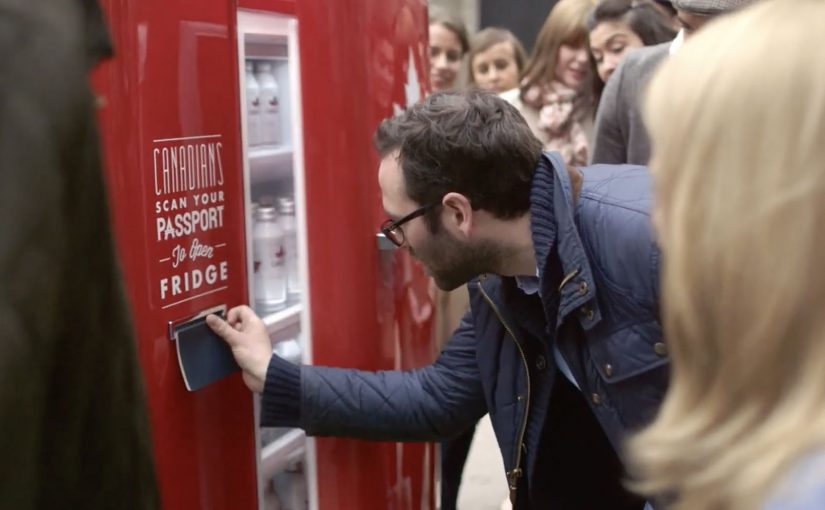
These eye-catching fridges were filled with Molson Canadian beer and strategically placed across a variety of European locations to attract crowds. The catch is simple. The fridge can be opened only by scanning a Canadian passport.

The campaign was created by Rethink Canada to bring back the classic tagline, “I Am Canadian.” The footage collected from the different locations was then cut into a longer online film and a shorter TV ad, described as running during the Stanley Cup Finals.

A gate that turns identity into a moment

The mechanism is a physical “access rule” everyone understands. Here, the access rule is simple: only a scanned Canadian passport opens the fridge. A fridge full of free beer is a magnet. The passport scan turns that magnet into a social filter, because the only way anyone drinks is if a Canadian is present and willing to open it. In one move, the crowd goes from spectators to collaborators.

In multinational brand building, national identity can easily become abstract. This makes it concrete in public, in seconds, with a prop people instinctively gather around.

Why it lands

It works because the restriction creates a mini-drama with a friendly payoff. People try. People fail. Then the “right” person arrives, the door opens, and the whole crowd benefits. The brand gets an emotional signature without needing to over-explain heritage, or wave flags on screen.

Extractable takeaway: If you want a brand idea to travel, design a simple rule that forces strangers to interact. Make the rule easy to understand, visibly enforced, and rewarding for everyone, not only the “qualified” participant.

What Molson is really reviving

The fridge is the stunt, but the strategic job is memory refresh. “I Am Canadian” is not a new line. The activation re-earns the right to say it by staging a situation where being Canadian is the key that unlocks a shared experience.

The real question is whether a legacy national tagline can earn fresh relevance without sounding like a rerun. Molson gets this right because the stunt turns identity from a slogan into a shared public reward.

What brand teams can take from it

  • Use a physical object as a social trigger. Fridges, doors, vending machines, and switches pull people in because they promise an outcome.
  • Let the rule do the storytelling. One constraint can communicate positioning faster than a paragraph of copy.
  • Make the payoff collective. If only one person wins, the crowd turns cynical. If everyone wins, the crowd turns into distribution.
  • Film what the rule creates. The best “campaign video” is documentation of real behavior the mechanic generates.

A few fast answers before you act

What is Molson Canadian’s “Beer Fridge” campaign?

It is an activation built around bright red fridges placed in public locations. The fridge opens only when a Canadian passport is scanned, turning identity into the key that unlocks free beer.

Why require a Canadian passport?

The passport requirement creates instant tension and a clear story. It forces a social moment where Canadians become the enablers, and everyone around them shares the reward.

What does this have to do with “I Am Canadian”?

The mechanic makes “Canadian-ness” functional rather than symbolic. The tagline lands as a conclusion the crowd just witnessed, not a claim the ad simply states.

Why place the fridges in Europe?

Because it creates contrast and visibility. A Canadian-only key in a non-Canadian setting produces curiosity, crowds, and a stronger “identity unlocks access” narrative.

How can another brand apply this pattern?

Choose one brand truth, translate it into an access rule, and attach a collective payoff. Then design the experience so the resulting human interactions are worth filming.

Rajec: Frozen Art to Sell Water in Winter

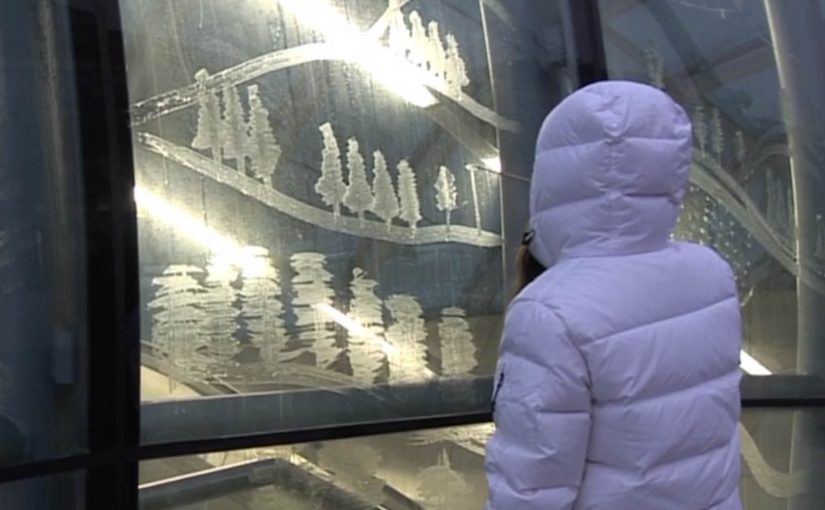
Rajec wants people to buy spring water even when it is cold outside, so the brand turns its own product into the medium. Artists use Rajec water to create frosty artworks overnight in high-footfall locations, so the next morning the city wakes up to “Patented by Nature” made visible.

The mechanic is simple and budget-smart. Pick specific public locations, give artists permission to work within the constraints of freezing weather, and let the cold do the production. The result is temporary ice art that looks native to winter, but still unmistakably tied to water.

In Central European FMCG categories, winter is where habitual consumption drops. So a physical, weather-native installation can reframe the product as seasonally relevant instead of seasonally optional.

Why frozen artwork is a strong “Patented by Nature” proof

It makes the positioning literal. The environment “patents” the result, because the cold is doing real work. That gives the campaign an authenticity cue that polished advertising often struggles to achieve, especially for a product as familiar as water.

Extractable takeaway: When your brand promise depends on “naturalness”, build a proof that requires nature to complete it. Then place that proof where people can stumble on it without opting in.

What the campaign is really optimizing for

The real question is how to make bottled water feel worth noticing in the season when people are least inclined to buy it. This is a smart seasonal demand play because it turns winter from a sales headwind into the proof itself.

This is designed to create winter salience with minimal spend. Here, winter salience means staying mentally available in the season when bottled water is easiest to ignore. The installations function as local talk triggers, photo moments, and brand reminders, without needing long media flights. You get attention because it is unexpected and temporary, and you get relevance because the execution only exists in winter conditions.

What to steal for your own seasonal demand problem

  • Exploit the season instead of fighting it. Use weather and constraints as production tools.
  • Make the product physically present. When the product is the material, the brand tie is harder to miss.
  • Design for ephemerality. Temporary work creates urgency and increases the chance people share it.
  • Choose “commuter proof” locations. Busy, repeat-traffic spots do the frequency building for you.

A few fast answers before you act

What is the core idea of Rajec Frozen Artwork?

Use Rajec water to create ice artworks overnight in frequented public places, so winter itself becomes the production method and the brand proof.

Why does this help sell water in winter?

It restores relevance by linking the product to the season people least associate with water buying, and it does so with a physical cue people notice without trying.

What makes the execution feel credible rather than “advertising”?

The cold does real work. The result looks like something the environment caused, which supports the “Patented by Nature” idea.

What kind of location makes this work best?

High-footfall public locations work best because repeat exposure turns a temporary installation into a stronger memory cue without requiring paid media weight.

What is the main risk in copying this approach?

If the brand link is too subtle, it becomes “nice street art” with weak recall. The product-to-art connection needs to be unmistakable.