
Corona Extra: Luna Corona

Corona Extra and their ad agency Cramer-Krasselt worked with astronomers, planetariums, and universities in the USA to calculate the positioning of the moon, aiming to capture a moment where it would align perfectly with an image of a Corona Extra beer.

The moment was timed so the billboard’s “missing lime” is completed by the moon’s crescent alignment on the nights of June 14 and 15.

When the sky completes the creative

The mechanism is engineered perspective plus a fixed window in time. The billboard artwork is designed so that from a specific viewing position, the crescent moon appears exactly where a lime wedge would normally sit on a Corona bottle. The media placement then turns into a scheduled viewing, because the “full ad” only exists when the moon cooperates.

In out-of-home advertising, aligning a message with a real-world phenomenon can turn a static placement into a time-limited event people actively seek out.

Why it lands

This works because it makes a familiar brand ritual feel discovered rather than advertised. The payoff is not a new claim. It is a real-world moment that feels improbably perfect, which gives people a reason to stop, watch, and tell someone else where and when it happened. The real question is how far a brand can make the physical world do the storytelling for it. The stronger move here is using the moon to deliver the brand cue instead of adding more message.

Extractable takeaway: If you can make the environment complete your creative, you turn passive exposure into participation. That participation becomes the distribution.

What to steal from Luna Corona

  • Design for one unmistakable illusion: one clean visual trick beats multiple clever details.
  • Use time as a feature: a narrow viewing window creates urgency without discounts or gimmicks.
  • Make the “rule” explainable: people should be able to describe it in one sentence.
  • Choose a ritual people already associate with you: the lime wedge is an instantly legible brand cue.
  • Capture proof: the video is not decoration. It is how the idea travels beyond the street corner.

A few fast answers before you act

What is “Luna Corona”?

It is an out-of-home idea where a Corona billboard is positioned and designed so the crescent moon visually becomes the lime wedge on the bottle during a specific time window.

Why involve astronomers and universities?

Because the illusion depends on precise timing and angle. You need accurate lunar position predictions to know when the crescent will “land” in the right spot from the viewer’s perspective.

Is this interactive?

Not in the device sense. The interaction is physical. People move into position, wait for the right moment, and witness the alignment as it happens.

What makes it more than a clever billboard?

The scarcity. It only “works” at certain times, so it behaves like an event, not just media inventory.

What’s the biggest risk with ideas like this?

Fragility. If weather, timing, sightlines, or location details are off, the reveal fails. The planning and production tolerance must be treated like a live event.
Benefit Cosmetics: Temptation Telephone

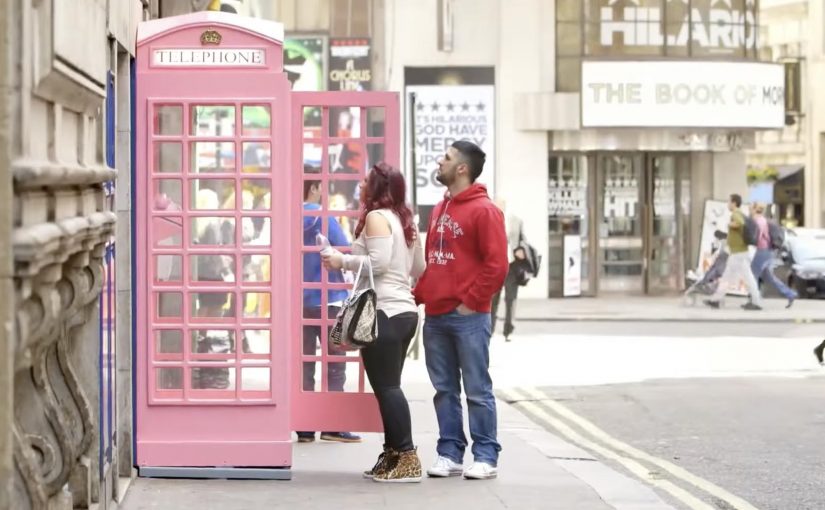
‘Ring ring…’ A pink telephone starts ringing in the middle of London. The question is simple. Do you pick it up.

Benefit Cosmetics places a pink phone booth on a busy street for a day and turns the call into a dare. If you answer, you are pulled into a pop-up “celebrity moment”. A quick makeover, then a trip to Café de Paris where you are pushed onto the stage to sing Whitney Houston’s “I Wanna Dance With Somebody” with a live band in front of a packed room.

The temptation mechanic

The mechanism is built around a single micro-decision, meaning one small public choice with immediate consequences. Answering a ringing phone in public. The payoff is immediate escalation. You are not given a flyer or a discount. You are given a story you will retell. The booth, the ring, the dare, the stage. The whole thing is designed to transform a passerby into the headline.

In beauty retail and experiential marketing, the fastest way to earn attention is to convert curiosity into a socially shareable moment that makes the participant feel chosen.

Why it lands

This works because it exploits a universal impulse. Most people want to know what happens if they answer. The booth creates theatre, the ringing creates urgency, and the venue creates legitimacy. That sequence works because the first action feels harmless, while the public payoff turns a passing impulse into a memorable story. The participant does not feel like they “took part in advertising”. They feel like they got a once-only experience, which is exactly what makes the footage feel authentic and replayable.

Extractable takeaway: When you can own a clear “dare”, design it around a tiny public action with a big, fast reward, then stage the reward somewhere iconic so the story carries your brand without further explanation.

What Benefit Cosmetics is really selling

The real question is whether Benefit can make confidence feel like something you step into, not something you buy. Benefit is not really selling makeup here. It is selling permission to be bold. The makeover is a prop. The real product is the feeling of stepping into the spotlight for ten minutes.

What to steal from Benefit’s temptation loop

  • Engineer a single, obvious trigger. One action. One choice. Answer or walk past.
  • Pay off immediately. Curiosity dies fast. Reward it fast.
  • Borrow an iconic container. A recognizable venue turns a stunt into “a real event”.
  • Make the participant the content. Their nerves and laughter do more than scripted copy ever will.

A few fast answers before you act

What is Benefit’s “Temptation Telephone”?

A one-day street activation where a ringing pink phone booth lures passersby into answering, then escalates into a makeover and a live on-stage performance at Café de Paris.

Why does the ringing phone work as a trigger?

Because it creates an unavoidable question. Who is calling. What happens if I answer. That curiosity produces voluntary engagement.

What role does Café de Paris play in the idea?

It supplies instant credibility and spectacle. The venue makes the payoff feel like a “real night out”, not a brand demo.

What makes this feel shareable rather than staged?

The participant’s reaction arc. Hesitation, commitment, then performance. Viewers watch to see whether the person goes through with it.

When is this pattern a good fit?

When your brand can credibly promise confidence, fun, or transformation, and you can deliver a fast, memorable payoff tied to a single public decision.

Secret Diary of a Call Girl: The Window Opposite Radio

A window performance built for radio

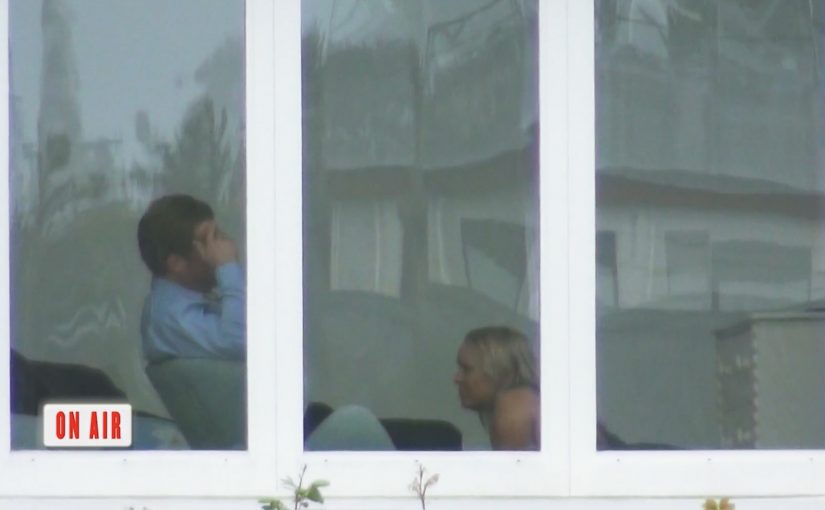
To launch the British TV drama Secret Diary of a Call Girl in New Zealand, DraftFCB staged a simple provocation. An “actress” displayed call girl-like behavior in a house window directly opposite a top radio station for three successive nights.

As expected, the scene caught the attention of the local DJ, who began broadcasting his observations on air. Other DJs around the country reportedly picked up the story, keeping it in circulation for roughly 72 hours. On the final night, with public interest at its peak, the actress closed the blinds to reveal the show message and the reason for the spectacle.

The mechanic: hijacking live commentary as distribution

The campaign is engineered to be “irresistible to narrate.” Put a curiosity trigger within line-of-sight of people whose job is filling airtime with observations, then let their real-time commentary do the heavy lifting. The multi-night schedule matters because it turns a one-off sighting into an unfolding story that listeners can return to, and that other shows can reference without needing new material.

In entertainment launches, live conversation often outperforms polished promos because the audience feels like they are overhearing something that is happening, not being sold something.

In broadcast-led markets, earned attention compounds fastest when the story is physically proximate to a microphone and structured to renew itself across multiple days.

Why it lands

It uses a classic public curiosity loop. People see something ambiguous, hear someone validate it on air, then share it socially to compare interpretations. Because the DJs are reacting in the moment, the “is this real?” tension stays alive long enough to travel, and the final-night reveal provides closure that feels like a payoff rather than a disclosure.

Extractable takeaway: If you want sustained buzz, design a repeatable public trigger that creates daily new angles for commentators, then hold the brand reveal until attention has clearly peaked.

What the launch is really optimizing for

The goal is not just reach. It is talk time, repetition, and social spillover. A premiere wins when it becomes the thing people reference without being prompted, and when the message arrives as the resolution of a story people have already been following.

The real question is whether the setup can turn observation into repeated on-air narration before the reveal arrives.

What to steal from this radio-first stunt

  • Choose a “natural broadcaster.” Put the trigger near people whose incentive is to describe what they see.
  • Make it episodic. Multi-night structure creates freshness and gives people a reason to check back.
  • Design ambiguity, then control the release. Let curiosity build, but ensure the reveal is clean and unmistakable.
  • Plan the social overflow. Seed a format that is easy to retell in one line, so listeners can amplify it without context.

A few fast answers before you act

What did DraftFCB do to promote Secret Diary of a Call Girl in New Zealand?

They staged an actress behaving like a call girl in a bedroom window opposite a radio station for three nights, prompting DJs to discuss it on air until a final-night reveal connected it to the TV premiere.

Why does placing the stunt opposite a radio studio matter?

Because DJs are paid to narrate interesting observations. Physical proximity to the studio turns the environment into live content.

What is the core distribution mechanic?

Earned media through live commentary. The stunt creates something discussable, and the on-air conversation becomes the ad.

Why run it across multiple nights?

Repeat nights transform a sighting into a story arc, increase the chance of pickup across stations, and create a natural moment for a final reveal.

What is the biggest risk with this kind of tactic?

If the reveal is unclear or the tone feels exploitative, the conversation can flip. The payoff must land cleanly and fast.