
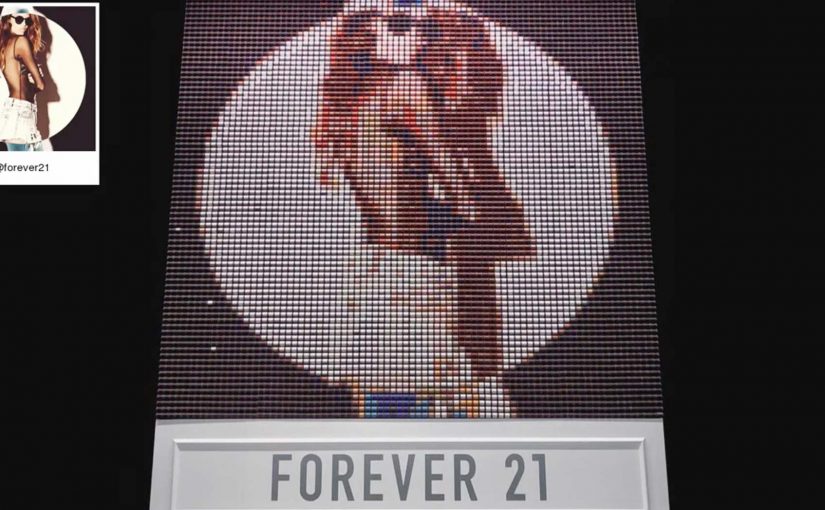
Instagram Powered Thread Screen by Forever 21

Instagram Powered Thread Screen by Forever 21

The F21 Thread Screen is a 2,000 pound machine that uses 6,400 mechanical spools of thread to display Instagrams hashtagged with #F21ThreadScreen. Melding fashion and technology, the Thread Screen is truly beautiful and unique. Hashtag an Instagram of you and your friends and see yourselves in a way unlike anything you’ve seen before…

Why this installation is so compelling

The idea is simple. Post with a hashtag. But the output is unexpected. Instead of a screen showing pixels, you get a physical, mechanical interpretation that feels handcrafted, even though it is powered by a heavy machine.

Extractable takeaway: When a familiar action produces a materially different output, people stop, watch, and share the surprise.

Because the installation turns a normal Instagram post into a moving, thread-based image, the same content earns attention as an in-store spectacle.

  • Digital input, physical output. A social post becomes a tangible display.
  • Participation is effortless. The only requirement is a hashtag, which fits existing behavior.
  • It creates a new kind of “share”. People share twice. First on Instagram. Then again when the installation shows them back in a surprising format.

In retail environments, where foot traffic is finite and attention is fragmented, turning social participation into a physical moment can convert passers-by into participants.

How to reuse the Thread Screen pattern

The real question is how you take a familiar social mechanic and make the payoff feel materially different in the real world.

Retail and fashion brands should not just “display social” in-store. They should translate participation into a physical moment people want to watch and capture.

  • Change the medium of the reward. Keep the action familiar (a hashtag), but make the output unexpected enough to feel handcrafted.
  • Design for dwell time. Here, dwell time means the extra time people stay near the installation to see themselves appear and change.
  • Build in the second share. Give people a reason to post again, because the physical result looks nothing like a normal screen.

A few fast answers before you act

What is the Forever 21 Thread Screen?

It is a large-scale mechanical installation that uses thousands of thread spools to display Instagram posts tagged with #F21ThreadScreen as a physical, moving thread-based image.

How does a visitor participate?

They post an Instagram photo with the hashtag #F21ThreadScreen, which the installation then pulls into the display.

Why is this effective for retail and fashion brands?

It turns social participation into an in-store spectacle, giving people a reason to engage, watch, and share again from the physical experience.

What is the key takeaway?

Do not just “display social”. Transform it. The more unexpected the medium, the more memorable the experience becomes.
The Adaptive Storefront: BLE Retail Display

The Adaptive Storefront: BLE Retail Display

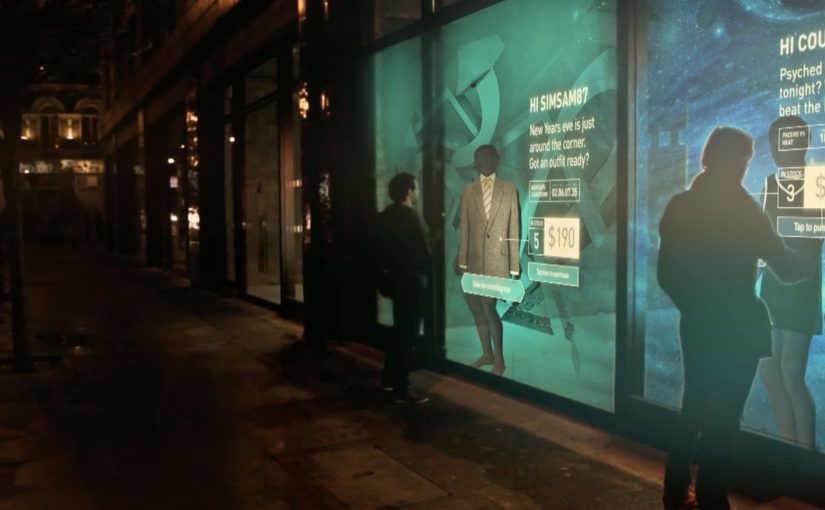
Shop windows, billboards, bus stops, and car showrooms do not have to be passive experiences. In the video below, a prototype interactive digital display adapts to whoever stands in front of it.

The display identifies shoppers using Bluetooth Low Energy (BLE) and reacts to personal data stored on the shopper’s mobile device, such as shopping habits and preferences. Shoppers can swipe through personalised content, place items in a virtual shopping cart, and purchase straight from the display.

When glass turns into a shoppable interface

This “adaptive storefront” concept takes a familiar retail surface and makes it behave like a storefront UI. Here, “adaptive storefront” means the window can recognise a nearby device via BLE and change what it shows based on data available on that device. Not a poster. Not a looped video. A live interface that changes per person and lets you complete an action while you are still in that high-intent moment of attention.

How the prototype behaves in front of a shopper

  • Detect. BLE proximity is used to recognise that a specific shopper is present.
  • Adapt. The display adjusts what it shows based on data available on the shopper’s phone.
  • Let the shopper drive. Swiping changes what is on screen, rather than forcing a fixed sequence.
  • Close the loop. Items can be added to a cart and purchased directly from the display.

In physical retail environments, the storefront is the first high-attention interface a brand controls before a shopper reaches the shelf.

Why it lands

Because the display can recognise a nearby device and accept input on the surface, it compresses discovery, consideration, and purchase into one interaction. The value is not the novelty of a “smart window”. It is the reduction of steps between interest and action, while the shopper’s intent is still fresh. The real question is whether you can do that with clear permission and control, not silent personalisation.

Extractable takeaway: A surface becomes valuable when it combines context with immediate action. Personalisation only earns its keep when it removes friction and helps a shopper decide faster, not when it merely looks clever.

What it is really trying to unlock for brands

Behind the demo is a clear ambition. Turn high-footfall surfaces into conversion surfaces. If the experience is permissioned and useful, it can bridge the gap between physical browsing and digital checkout without forcing a shopper to open an app, search, and start over.

That also hints at a measurement upgrade. A storefront that can be interacted with can be instrumented. What people swipe. What they ignore. What they add. Where they drop. That is a very different feedback loop than counting impressions.

Practical takeaways for adaptive storefronts

  • Start with one job-to-be-done. For example, “help me shortlist”, “show me what is in stock”, or “let me buy in two taps”.
  • Make control obvious. If swiping is the interaction, design the UI so people understand it in one second.
  • Keep data minimal and on-device. Use only what is needed to improve relevance, and avoid making the experience feel intrusive.
  • Design for the environment. Glare, distance, dwell time, and group behaviour change everything compared to mobile UX.
  • Plan the opt-in moment. The experience works best when the shopper understands why the screen adapts and what they get in return.

A few fast answers before you act

What is an “adaptive storefront” in plain terms?

It is a storefront display that changes what it shows based on who is standing in front of it, and lets the shopper interact and buy directly on the surface.

Why use BLE for this type of experience?

BLE enables low-power proximity detection, so a display can recognise a nearby device and trigger the right experience without requiring scanning a code each time.

What data is needed to personalise the display?

Only enough to improve relevance. For example, stated preferences, browsing history, or saved items, ideally kept on the shopper’s phone and shared with clear permission.

What makes this feel useful instead of creepy?

Permission, transparency, and value. The shopper should understand what is happening, control it, and get something meaningfully better than a generic screen.

What should you measure in a pilot?

Opt-in rate, interaction rate, add-to-cart rate, conversion rate, and whether the experience reduces time-to-decision without increasing drop-off.

S-Oil: HERE Balloons

S-Oil: HERE Balloons

Seoul is often described as having one of the world’s highest levels of gasoline consumption, and parking space is scarce. The everyday cost is not just frustration. It is fuel burned while circling for a spot. One widely cited estimate frames it as roughly 15km a month driven just to find parking, which can add up to about a litre of fuel wasted per driver.

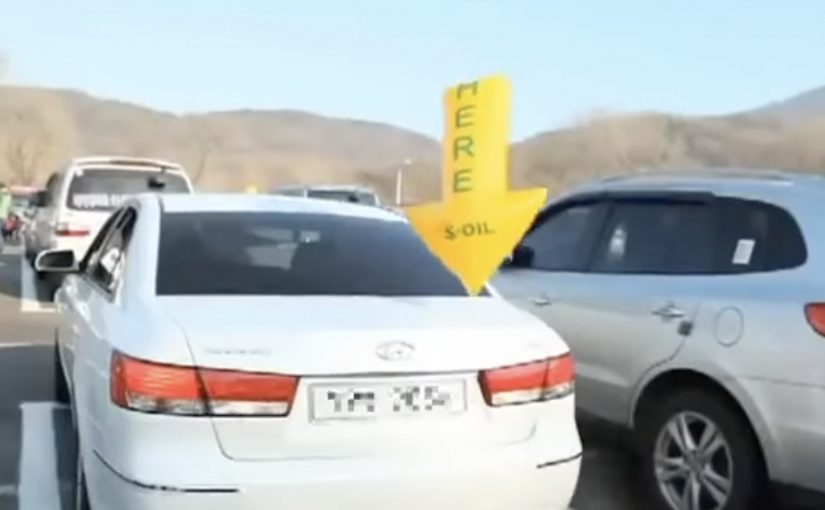
To reduce that waste, South Korean oil brand S-Oil teamed up with Cheil Worldwide and tried a simple visibility hack. In practice, that means turning hidden parking availability into a physical signal drivers can read from a distance. Bright yellow HERE balloons were set up for each parking space. When a car parked, the balloon dropped. When the car left, it rose again. Drivers could spot the balloons from far away and head straight to open spaces without wandering.

A parking signal you can see from across the lot

The mechanism is low-tech but precise. Each space gets a tall, arrow-shaped balloon tethered so that occupancy physically pulls it down. Availability lets it float up. The whole system turns a hidden status. “Is this space free?” into a visible skyline of yes and no.

In dense Asian megacities where time, congestion, and emissions compound daily, the best “smart city” ideas are often the ones that remove searching rather than adding instructions.

The real question is how quickly you can make a hidden status visible enough to remove wasted movement at scale.

Why it lands

This works because it attacks a behaviour, not an attitude. Drivers do not need to be persuaded to care about fuel. They just need the environment to stop making them waste it. The balloons cut decision time, reduce aimless loops, and make the correct action obvious without signs, apps, or learning curves.

Extractable takeaway: When your outcome depends on reducing “search”, do not ask people to change intent. Change visibility. Make the correct option legible from far away, and the behaviour shifts on its own.

What the results are described to show

Campaign reporting describes the one-day test as saving about 23 litres of fuel across roughly 700 cars. The same reporting frames the real opportunity as scale. If you replicate a small efficiency across many lots and many days, the cumulative savings become meaningful.

What parking and place teams can steal

  • Turn status into a skyline. If availability is the problem, make it visible at distance.
  • Prefer passive systems over active ones. No app installs, no user training, no instructions needed.
  • Design for the first two seconds. The idea must be understood instantly from a moving car.
  • Measure the behavioural delta. Track circling reduction, time-to-park, and fuel impact, not just “awareness”.

A few fast answers before you act

What are S-Oil “HERE” balloons?

They are arrow-shaped balloons installed above parking spaces that rise when a space is free and drop when a car occupies it, so drivers can spot availability from a distance.

What problem does the idea solve?

It reduces fuel and time wasted while drivers circle looking for a space by making empty spots immediately visible.

Why use balloons instead of an app?

Balloons work for everyone instantly, without installs, connectivity, or attention on a screen. The signal is in the environment where the decision happens.

What results were reported?

Campaign reporting describes a one-day test where roughly 700 cars saved about 23 litres of fuel, with larger savings possible if scaled.

How can a city or brand adapt this approach?

Pick a “hidden” status that causes wasted movement, then create a physical signal that is readable at distance and updates automatically with the real-world state.