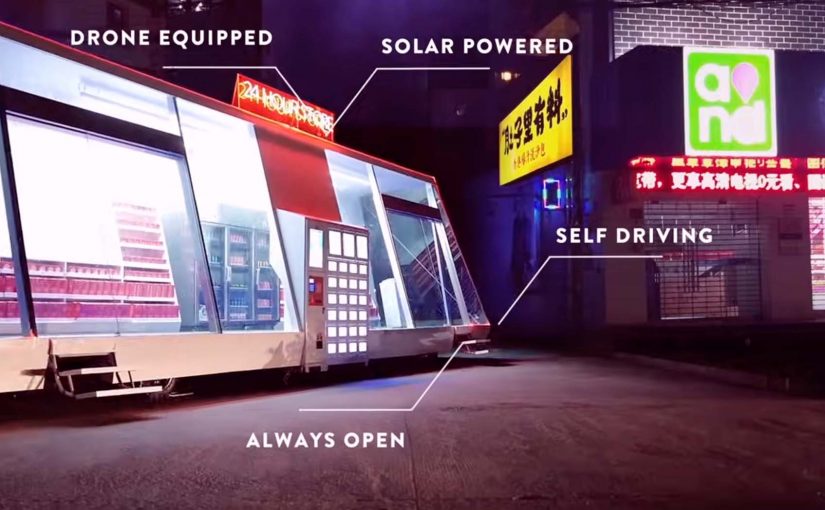
Every parking space becomes a 24-hour store. The Moby Mart is designed to turn ordinary parking spots into always-on retail. Roughly the size of a small bus, it carries everyday products such as snacks, meals, basic groceries, and even shoes. To use it, you download an app, register as a customer, and use your smartphone to unlock the doors. Here, “always-on” means open around the clock without staff on site.
The idea is in trial mode. The store is undergoing trials in Shanghai through a collaboration between Swedish startup Wheelys Inc and China’s Hefei University. For now, the trial prototype is stationary, based permanently in a car park. But the company says it is working with technology partners to develop the self-driving capability, as shown in the video.
The mechanism behind the parking-space store
The mechanism is app-gated access plus self-service. Entry, selection, payment, exit. When that first unlock step feels safe and effortless, an unattended unit starts to feel like normal retail, not a gimmick.
In urban convenience retail, reducing the distance and time between intent and purchase is often the real differentiator.
The real question is whether you can move retail to the moment of demand without breaking trust, support, and replenishment.
If the access and “this worked” confirmation are not rock-solid, mobility and novelty will not save the experience.
What this concept makes tangible
This lands because it reframes “location” as something you can deploy and operate, not just something you lease and staff. The store becomes infrastructure, and the app becomes the front door.
Extractable takeaway: When you make access the first experience, trust and operations become part of the product, not back-office details.
Retail flips from “go to store” to “store comes to you”
The provocation is simple. If the unit can be deployed anywhere, then proximity becomes a variable you can design, not a constraint you accept.
Friction reduction becomes the product
The app unlock and self-service flow compresses the journey. Entry, selection, payment, exit. Less waiting, less staffing, less handoff.
Mobility creates new placement logic
A store on wheels changes what “location strategy” means. Instead of long-term leases, the unit can be positioned where demand spikes, or where fixed retail is uneconomical.
What to copy from Moby Mart
- Start with a familiar format. People immediately understand a convenience store. That lowers cognitive load.
- Make access the first experience. App unlock is the “moment of truth.” If that step is seamless, everything downstream feels modern.
- Design for unattended trust. Clear rules, clear prompts, and a clear “this worked” confirmation prevent anxiety in a staffless space.
- Prototype the operating model early. Mobility, restocking, and support are not secondary. They are the offering.
A few fast answers before you act
What is the Moby Mart?
A bus-sized, staffless, mobile convenience store concept that aims to turn parking spaces into 24-hour retail, accessed via a smartphone app.
How do customers use it?
They download an app, register, and unlock the doors with their phone to shop inside.
Where is it being tested?
It is undergoing trials in Shanghai through a collaboration between Wheelys Inc and China’s Hefei University.
Is it already self-driving?
The trial prototype is stationary in a car park. The company says it is working with partners on self-driving capability.
What is the core lesson for marketers and innovators?
Move the experience to the moment and place of demand. Then design the access, trust, and operations as the real product.