
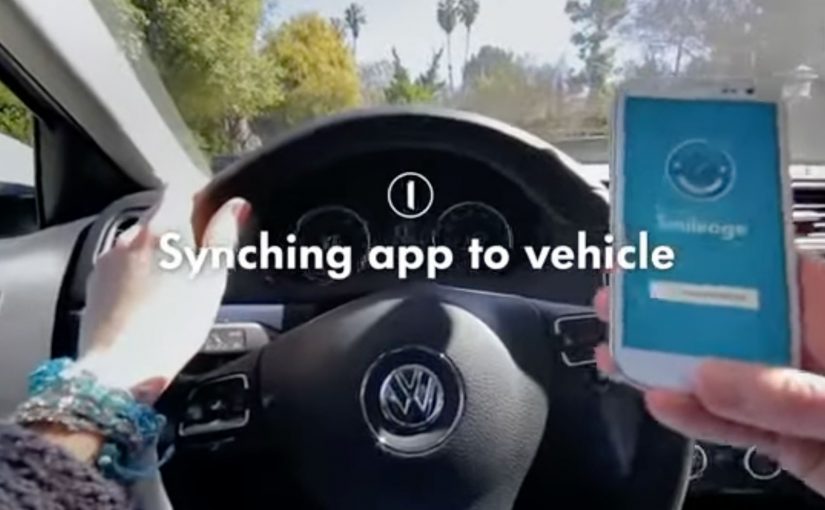
Volkswagen Smileage: Road Trips with Google

With the Volkswagen Smileage app, road trips are never going to be the same again. Smileage is the in-app points system you earn from trip activity and social participation. Powered by Google the app is set to socialise road trips world over.

To start earning Smileage you have to pair the app with your car and sign in with your Google account. Once synced, the app automatically connects each time you go for a ride.

Friends can then watch and comment on your journey in real time while you earn Smileage through shared photos, kilometers, checkins, comments, likes and punches, the app’s name for quick in-app interactions from other nearby Volkswagens.

The car becomes a social object

The concept here is not just “tracking”. It is making the trip legible and interactive for people who are not in the car. Because spectators can react and contribute in real time, the drive becomes more shareable and more repeatable than a private commute.

  • Automatic connection. Pair once, then the app connects when you drive.
  • Live participation. Friends can watch and comment in real time.
  • Gamified reward loop. Points are earned through trip activity and social interactions.

Why the Google sign-in matters

In global automotive and mobility brands, the growth lever is turning driving time into something other people can see and join in.

The real question is whether your product turns real-world activity into something other people can participate in, not just something you can track.

Signing in with a Google account signals that this is more than a standalone app. It is built to plug into existing identity, location, and potentially mapping behavior. That is what enables a smoother experience and a more connected ecosystem around the trip. This is the right trade when you want engagement to extend beyond the driver.

Gamification that is tied to behavior

The points system is not abstract. It is linked directly to what happens on a trip. Photos, kilometers, check-ins, comments, likes, and even “punches” from nearby Volkswagens. The incentives are designed to encourage both movement and sharing.

Extractable takeaway: When rewards map to real-world actions and make those actions socially visible, the loop feels earned and keeps paying out after the trip ends.

  1. Drive. Kilometers and check-ins create baseline progress.
  2. Share. Photos create moments worth reacting to.
  3. Engage. Comments and likes add social energy.
  4. Connect. Nearby Volkswagens add community and surprise.

In connected consumer products, engagement grows fastest when real-world activity, identity, and social participation are designed as one loop.

What to take from this if you build connected experiences

  1. Reduce setup friction. Pair once. Auto-connect later.
  2. Design for spectators. The audience is part of the experience, not just the driver.
  3. Reward real activity. Gamification works best when points map to meaningful behavior.
  4. Use social to extend usage. Trips become more memorable when others can join in.

A few fast answers before you act

What is Volkswagen Smileage?

It is an app that pairs with your Volkswagen and Google account to make road trips social, letting friends follow and comment live while you earn points for trip activity and engagement.

How do you start earning Smileage?

You pair the app with your car and sign in with your Google account. Once synced, it connects automatically each time you go for a ride.

How do you earn points in the app?

Through shared photos, kilometers, check-ins, comments, likes, and “punches” from other nearby Volkswagens.

What is the main experience benefit for users?

Road trips become shareable in real time, turning the drive into a live story that friends can react to and participate in.

What is the transferable lesson for connected products?

If you combine automatic sensing with social participation and rewards tied to real behavior, you can turn routine usage into a repeatable engagement loop.

American Express “Twitter Sync”

You sync your American Express card to Twitter, retweet an offer with a specific hashtag, and the reward loads to your card without printing a coupon. For example, tweeting #AmexWholeFoods loads a $20 statement credit that applies when you spend $75 or more at Whole Foods.

A statement credit is a credit applied to your card account after a qualifying purchase.

The foundation. Couponless offers via Facebook

In July last year, American Express launched a first of its kind application on Facebook called “Link, Like, Love” that allowed card members to link their cards to the app and receive deals based on the likes, interests and social connections of the card members and their Facebook friends.

Members who used this service did not have to print coupons to redeem at a store. Instead, they loaded deals onto their AmEx account by hitting an online button in the app, and the reward was given when they swiped the card at the time of purchase.

The latest move. Sync your card with Twitter

Now, in its latest social venture, American Express allows card members to sync their cards with their Twitter account at sync.americanexpress.com/twitter. After the sync, card members follow @AmericanExpress and re-tweet its special offers that come with exclusive hashtags. The re-tweet loads the card with a couponless reward.

In US consumer retail programs, card-linked offers live or die on how little friction sits between discovery, activation, and redemption.

The real question is whether you can make offer activation feel like normal feed behavior while keeping redemption invisible at checkout.

Why this lands. Activation becomes a social reflex

The mechanism is the point. The retweet is the activation event, and the statement credit is the reward. That matters because activation moves into a habit people already perform in the feed, while redemption stays automatic at swipe. This is a strong pattern when you want offers to be used without asking people to print, clip, or remember anything.

Extractable takeaway: If redemption happens at the point of payment, your biggest lever is activation friction. Make activation feel like ordinary behavior, not like work.

The constraint. Availability by market

The Facebook and Twitter sync work only for US card holders.

What to copy. Couponless offer mechanics

  • Trigger in the moment of attention: Use a lightweight action people already do in the channel as the activation step.
  • Redeem where trust is highest: Deliver the benefit at purchase via the existing payment instrument, not via a separate coupon ritual.
  • Make the rule explicit: Tie every offer to one clear condition and one clear reward so it is easy to repeat and explain.

A few fast answers before you act

What is American Express Twitter Sync?

A program that lets card members sync an AmEx card to Twitter and load couponless offers by retweeting hashtagged deals.

What does a retweet actually do?

It activates an offer and loads the reward to the synced card, so redemption happens automatically when the card is used.

What is a concrete example of an offer?

Tweeting #AmexWholeFoods loads a $20 statement credit that applies when a purchase of $75 or more at Whole Foods is made.

What do you need to do after syncing?

Follow @AmericanExpress and retweet its special offers that include the required hashtag.

Who can use it?

It is positioned for US card holders.

Foursquaropoly: Real-World Monopoly via Foursquare

Can you imagine playing a real-world version of Monopoly wherever you go, 24/7. A bunch of students decide to explore exactly that, and the result is a concept video that mashes up Foursquare-style check-ins with classic Monopoly rules.

Mechanic in plain terms: your location becomes the board. You “move” by going places, you “claim” by checking in, and ownership plus rewards become part of everyday movement through a city.

In mobile-first consumer experiences, location-based play works best when it turns routine movement into a simple loop of progression, competition, and collectible status.

Why it lands

It takes an abstract board game and makes it instantly legible in the real world. Because the check-in becomes both the move and the proof, the player gets status feedback without learning new controls. The joy comes from recognition. Streets become properties, venues become squares, and everyday decisions get a light layer of consequence. The real question is whether you can keep the loop fair and legible once real places and real rewards enter the rules.

Extractable takeaway: When you translate a familiar game into a real-world experience, keep the rules understandable in one sentence and the feedback immediate. The faster a player can see “what I did” and “what it unlocked,” the longer the concept stays sticky.

What this hints at for brands

The intriguing angle is not just “Monopoly in the streets.” It is the reward layer. By “reward layer,” I mean a simple, visible benefit attached to a check-in. Brands could join in by sponsoring virtual rewards that are redeemable for real-world objects, using check-ins as the trigger and redemption as the payoff. Done carefully, the value exchange is clear: attention and footfall in return for something tangible. This works best as an opt-in, time-boxed layer, not a permanent loyalty system.

Steal these mechanics for location activations

  • Turn geography into progress. Make “being somewhere” the action, so participation feels effortless.
  • Use scarcity that maps to reality. Limited locations, limited time windows, and visible ownership are more compelling than generic points.
  • Reward the behavior you actually want. If you want visits, reward arrivals. If you want repeat, reward streaks and routes.
  • Keep the redemption simple. The moment the payoff is confusing, the game stops being a game and becomes admin.

A few fast answers before you act

What is Foursquaropoly?

A concept for turning Monopoly into a 24/7, location-based game where check-ins and real-world movement replace dice rolls and board squares.

Why is Monopoly a good fit for a real-world location game?

Because it already maps cleanly to places, ownership, and rivalry. Those ideas translate naturally into neighborhoods, venues, and repeat visits.

What makes a location-based game loop feel sticky?

It feels sticky when each check-in produces immediate feedback, such as status or ownership, and the rules stay understandable without a manual.

How could brands participate without breaking the experience?

By sponsoring rewards that feel additive, such as limited-time bonuses at specific locations, and keeping the rules consistent so the game still feels fair.

What is the biggest risk in making this real?

Player fatigue and confusion. If the rules are too complex or the rewards feel arbitrary, people stop understanding what to do next and the loop collapses.