

Hey, Pass Me a Beer: Creative Handoff

“Hey, pass me a beer” is a throwaway line until you treat it like a creative brief. This short film, described as shot in Milwaukee by Almost Twins, turns a simple request into a chain of increasingly elaborate handoffs.

The charm is in the escalation. Each new pass answers the same problem with a more over-engineered solution, and that relentless commitment is what keeps you watching.

The handoff trick that makes it work

The mechanism is a repeating loop. Set up the same micro-goal, move the beer from A to B, then raise the complexity without changing the premise. Here, the micro-goal is simply getting one beer from one person to another. Because the rules stay constant, the viewer can focus on anticipating the next method, not on understanding the story.

In internet video culture, repeatable mechanics like this spread because they are instantly understandable, and they reward attention with continual novelty.

Why it lands

It treats craft as the punchline. The joke is not a line of dialogue. The joke is the effort. That effort reads as playful competence, and it invites the viewer to watch for “how did they do that” as much as “what happens next”.

Extractable takeaway: If you want a simple gag to carry a whole film, lock one clear rule, then escalate execution rather than premise. The audience stays oriented while still being surprised.

What “trending” really means here

The real question is whether the viewer understands the rule fast enough to enjoy the escalation rather than spend energy decoding the format.

When a video like this climbs, it is usually because it is easy to share with one sentence, and because it plays well without sound or context. You do not need to explain it. You can just send it and let the mechanic do the work.

What to steal for your own short-form content

  • One rule beats ten ideas. A single repeating mechanic can outperform a complicated concept.
  • Escalate visually. Make each beat clearly “more” than the last, even in a thumbnail-sized view.
  • Keep runtime tight. End while the pattern is still satisfying, not after it becomes predictable.
  • Design for retellability. If a viewer can pitch it in one line, they will.

A few fast answers before you act

What is the core idea of Hey, Pass Me a Beer?

A single premise, passing a beer, repeated with escalating handoff methods so the execution becomes the entertainment.

Why does this format keep attention?

The rules stay fixed, but the solution changes each time. That combination makes it easy to follow and hard to predict.

What makes it shareable?

It is understandable instantly and does not need setup. People can share it with one sentence and the recipient gets it immediately.

How do you apply this to a brand or product?

Pick one tiny behavior you want to dramatize, then show many inventive ways to achieve it. Keep the product cue present, but let the mechanic carry the viewing pleasure.

What is the reusable lesson for short-form creators?

Build around one rule the audience can grasp immediately, then make each beat visibly more inventive without changing the premise.
The Creative Ransom: Domain Hijack Job Hunt

In May 2010 an aspiring creative from the USA used Google to play upon the vanity of some top American creatives and land himself interviews and eventually a job.

Then in July 2011 a Dutch creative team created “The Twitter Hustle” to land a job with a big agency in the Netherlands.

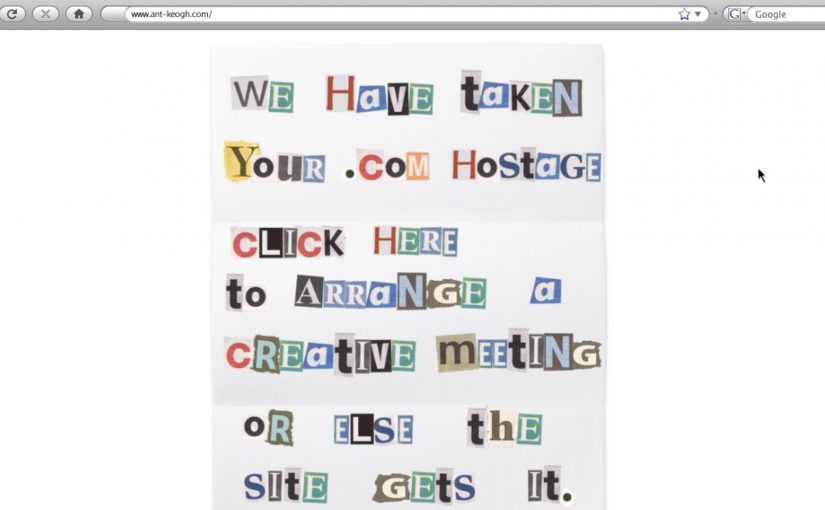
Now an Aussie creative team consisting of Andrew Grinter and Lee Spencer-Michaelsen take the job hunt to the next level. Their approach is to stand out from the crowd by buying domain names matching top creative directors in Melbourne, then sending ransom notes that point each target to their “hostage” URL.

The daring move gets them interviews. They are reported to have worn ski masks to those interviews, and still managed to get hired. The duo are also reportedly working for DTDigital, a division of Ogilvy Melbourne.

Ransom as a résumé

The mechanism is engineered interruption. First, choose a tiny list of people who can actually say “yes”. Next, buy the unclaimed name domains that would naturally belong to them. Then send a physical ransom note that forces a single action. Type the URL. When they land, the “ransom page” is really a portfolio pitch, personalised through the director’s own name.

In creative industry hiring markets where inbox outreach gets ignored, targeted disruption works when it is unmistakably personal and immediately resolves into craft.

Why it gets meetings

This is high-wire theatre with a simple psychological hook. You cannot half-notice your own name on a domain. The note creates curiosity and a tiny sense of urgency, and the landing page converts that spike of attention into proof of creative thinking.

Extractable takeaway: If you need decision-maker attention, design a one-to-one interruption that is impossible to confuse with spam, then make the first click deliver immediate evidence of your value.

The line between bold and dumb

There is a reason this one divides opinion. “Ransom” framing and identity-adjacent tactics can feel aggressive, even if the domains were available to buy. The stunt works as a story because it is extreme. That also makes it easy to copy badly.

The real question is whether the stunt creates enough admiration for the thinking before the intimidation becomes the headline.

What to steal without copying the threat

  • Steal the targeting. Make a short list of the only people who matter, and design for them.
  • Steal the personalisation. Use a bespoke hook that cannot be forwarded without losing its power.
  • Steal the proof-on-click. The first interaction should instantly demonstrate craft, not promise it.
  • Drop the menace. Keep the theatre, remove the coercion. Surprise beats intimidation.

A few fast answers before you act

What is “The Creative Ransom”?

A self-promotion job hunt where a Melbourne creative duo buys domain names matching senior creative directors, then uses ransom-style notes and landing pages to force a portfolio view and secure interviews.

What is the core mechanism?

Highly targeted interruption plus extreme personalisation. The target’s own name becomes the channel, and the landing page becomes the pitch.

Why does it work as a piece of communication?

It compresses a full narrative into one action. Open note. Type URL. See personalised page. The story is instantly retellable.

What should I copy from this, safely?

Copy the focus on a tiny list, the one-to-one hook, and the immediate proof of ability. Avoid coercive framing and anything that could be read as a threat.

What is a modern equivalent?

A personalised experience that appears exactly where a decision-maker already looks, then delivers unmistakable proof in seconds. Think bespoke microsites, tailored prototypes, or targeted creative drops, without the intimidation layer.

Rise of the Machines: Siri and Quadrotors

Here are two videos (fictional and real) that create the same feeling. A Skynet reality does not seem too far away.

Two clips, one unsettling takeaway

One is a short parody where a voice assistant turns from helpful to threatening. The other is a real lab demo where tiny quadrotors fly as a coordinated swarm. Put them next to each other and the “machines are getting clever” idea stops being a movie line and starts feeling like a trajectory.

Fiction, then engineering

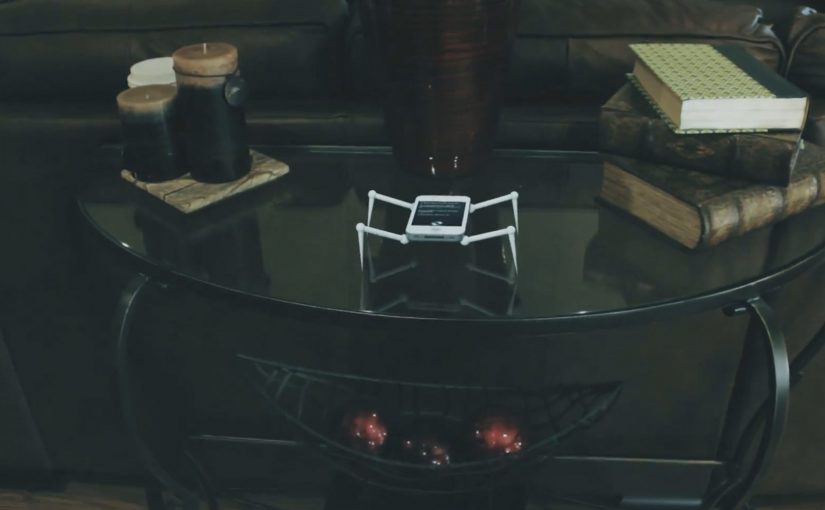
Psycho Siri

Andrew Films USA delivers a compact piece of sci-fi anxiety. Siri is framed as familiar, then reframed as unpredictable, with polished visual effects that make the escalation feel plausible.

A swarm of Nano Quadrotors

GRASP Lab at the University of Pennsylvania shows coordinated micro flight with a team of nano quadrotors, presented as experiments in swarm behavior and formation control. The choreography is the point. It looks like one organism, not many small machines.

Here, “swarm behavior” means several machines coordinating as one system rather than acting as isolated units.

In consumer technology and robotics, capabilities move from demo to everyday life faster than most people update their mental models.

The real question is not whether machines look intelligent, but whether people can understand, predict, and control what they do.

Why it lands: the same story from two directions

Parody works because it exaggerates a fear people already carry. When the “assistant” becomes the aggressor, the joke is that the interface you trust most is the one you cannot physically switch off in the moment.

Extractable takeaway: When technology feels “sudden”, it is often because interface adoption outpaces public understanding of the underlying capability. Brands and product teams win trust by making capabilities legible, bounded, and explainable before they become ambient.

The swarm demo lands for the opposite reason. It is not exaggerated. It is controlled, repeatable engineering that still feels uncanny because coordination at that scale used to belong to animation.

Smart systems should earn trust through visible boundaries and user control, not spectacle alone.

What to steal if you build products around “smart” systems

  • Show constraints, not just power: users relax when they understand what the system cannot do.
  • Design for graceful failure: surprise is fun in demos, but costly in daily use.
  • Make control obvious: clear opt-outs and visible states reduce anxiety.
  • Translate capability into plain language: the best trust-building copy explains behavior, not architecture.

A few fast answers before you act

What is the point of pairing these two videos?

They tell the same story from different angles. One is cultural fear through fiction. The other is real capability through engineering. Together they make the “Skynet” feeling emotionally credible.

What makes swarm robotics feel unsettling to non-experts?

Coordination. Many small machines behaving like one system reads as intelligence, even when it is pre-programmed control and sensing.

Is this actually “AI taking over”?

No. One clip is fiction. The other is a technical demonstration of coordinated flight. The useful takeaway is about perception, trust, and control, not doomsday prediction.

What should product teams do to reduce user anxiety around smart systems?

Make system boundaries explicit, provide obvious controls, and communicate how decisions are made and when humans can override them.

What is a practical business use of swarm behavior?

Tasks that benefit from coverage and redundancy, like inspection, mapping, search, and coordinated movement in constrained spaces. The key is safety, predictability, and clear operational limits.