
Zappos Thanksgiving Baggage Claim

Zappos Thanksgiving Baggage Claim

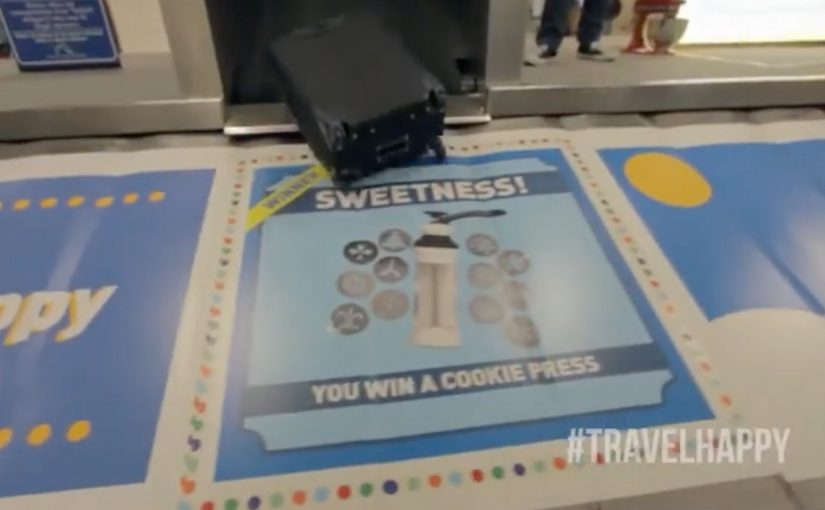
Thanksgiving Eve is one of the most stressful days to travel. So Zappos shows up in a place most people associate with impatience. The baggage claim carousel.

At Houston’s George Bush Intercontinental Airport, Zappos turns sections of a baggage carousel into a roulette-style game. Parts of the moving belt are marked with prizes and slogans. When your suitcase arrives and lands on a prize square, you win what it lands on. That can be a product prize or a gift card. Suddenly, the worst part of the journey becomes the most watchable part.

Why the idea works

The real question is how you turn captive waiting into a brand moment without adding any extra steps. The activation flips the emotional context. Baggage claim is pure friction. Zappos turns it into anticipation. Here, “activation” means a brand experience that reworks an existing touchpoint rather than creating a new destination. People are already looking at the carousel. They are already waiting. By making the outcome visible and immediate, the same waiting behavior becomes suspense. This is smart experience design because it changes the feeling of the wait without adding friction.

Extractable takeaway: When attention is guaranteed, you do not need more messaging. You need a simple mechanic that changes what the same behavior feels like.

The CX mechanics are simple by design

  • No app. No instructions. You just wait as usual.
  • Instant feedback. Your bag lands. You know if you win.
  • Social energy. People around you start watching your outcome too, because it is a shared moment.

In enterprise retail and travel environments, the biggest CX wins often come from redesigning unavoidable waiting, not adding steps.

Design moves worth copying

  • Pick a real pain point where attention is already guaranteed, then redesign the emotion of that moment.
  • Make participation automatic. If people must opt in, you lose most of the crowd.
  • Use a reward that is immediate and credible, so the surprise feels real, not promotional.

A few fast answers before you act

What is the Zappos Thanksgiving baggage claim activation?

A roulette-style baggage carousel game at an airport on Thanksgiving Eve where travelers win prizes based on where their luggage lands.

Why is baggage claim such a strong place for this?

It is a high-friction moment with captive attention. Everyone is already watching the belt and waiting.

What is the core experience design principle?

Reduce friction by changing the emotion of the same behaviour. Waiting stays the same, but it becomes suspense and delight instead of irritation.

How does it work without an app or instructions?

Participation is automatic. You wait for your bag as usual, and the belt markings tell you instantly whether you won.

What is the minimum you need to replicate the pattern?

A captive-wait moment, a visible game mechanic, instant feedback, and an immediate, credible reward.
Jimmy Kimmel: Halloween Candy Prank 2013

Jimmy Kimmel: Halloween Candy Prank 2013

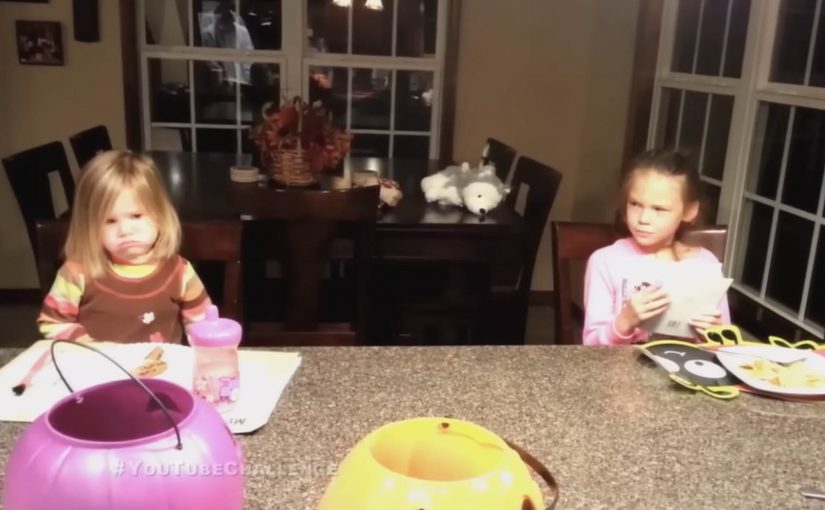
For the third consecutive year, talk show host Jimmy Kimmel challenges the parents of America to prank their kids and pretend that they ate all of their Halloween candy.

As always, parents oblige by the hundreds, and the results of this year’s Halloween Candy YouTube Challenge are compiled into a best-of reel.

A prank designed for mass participation

The mechanism is almost nothing. One line delivered at the worst possible moment, with a camera rolling. The show prompts the setup, parents run it at home, and YouTube becomes the route for collecting clips at scale.

That works because the prompt is so simple that families can recreate it instantly, while the show keeps editorial control by curating the best reactions into one polished reel.

In US pop-culture marketing, repeatable audience-participation formats win because they are easy to copy and still feel personal every time.

The real question is how a one-line prank becomes a yearly entertainment asset people keep recreating for free.

Why this lands

This is a smart participation format, not just a late-night gag. The emotions are instant and unedited. You get a mix of outrage, heartbreak, negotiation, and unexpected maturity, and that variety keeps the compilation watchable. It also feels like a yearly ritual, which helps the segment spread even among people who do not watch the show regularly.

Extractable takeaway: If you want repeatable virality, give people a one-sentence script, a clear capture instruction, and a predictable calendar moment, then let the audience supply infinite variation.

The previous challenge videos can be seen here: 2011 and 2012.

What repeatable participation marketers should steal

  • Make the prompt copyable. One sentence beats a complex brief.
  • Design for home production. If the content requires no special tools, submissions multiply.
  • Compile the chaos. A best-of edit turns scattered clips into a single shareable asset.
  • Repeat annually. Familiar format plus new reactions gives people a reason to come back each year.

A few fast answers before you act

What is the “I ate your Halloween candy” challenge?

Parents tell their kids they ate all the Halloween candy, film the reaction, and submit the clip for a compilation segment.

Why does this format keep working year after year?

The setup stays identical, but the reactions are endlessly different, which creates fresh entertainment without changing the mechanic.

What makes the compilation more shareable than single clips?

A best-of edit increases pace and variety, so viewers stay longer and are more likely to pass it on as a single link.

What is the core growth driver?

Low friction participation. One simple script, one simple recording, and a familiar upload behavior.

What should brands learn from this without copying the cruelty?

Use a repeatable prompt that invites audience variation, and build a clear “submit, then compile” distribution loop around it.

Corona Extra: Luna Corona

Corona Extra: Luna Corona

Corona Extra and their ad agency Cramer-Krasselt worked with astronomers, planetariums, and universities in the USA to calculate the positioning of the moon, aiming to capture a moment where it would align perfectly with an image of a Corona Extra beer.

The moment was timed so the billboard’s “missing lime” is completed by the moon’s crescent alignment on the nights of June 14 and 15.

When the sky completes the creative

The mechanism is engineered perspective plus a fixed window in time. The billboard artwork is designed so that from a specific viewing position, the crescent moon appears exactly where a lime wedge would normally sit on a Corona bottle. The media placement then turns into a scheduled viewing, because the “full ad” only exists when the moon cooperates.

In out-of-home advertising, aligning a message with a real-world phenomenon can turn a static placement into a time-limited event people actively seek out.

Why it lands

This works because it makes a familiar brand ritual feel discovered rather than advertised. The payoff is not a new claim. It is a real-world moment that feels improbably perfect, which gives people a reason to stop, watch, and tell someone else where and when it happened. The real question is how far a brand can make the physical world do the storytelling for it. The stronger move here is using the moon to deliver the brand cue instead of adding more message.

Extractable takeaway: If you can make the environment complete your creative, you turn passive exposure into participation. That participation becomes the distribution.

What to steal from Luna Corona

  • Design for one unmistakable illusion: one clean visual trick beats multiple clever details.
  • Use time as a feature: a narrow viewing window creates urgency without discounts or gimmicks.
  • Make the “rule” explainable: people should be able to describe it in one sentence.
  • Choose a ritual people already associate with you: the lime wedge is an instantly legible brand cue.
  • Capture proof: the video is not decoration. It is how the idea travels beyond the street corner.

A few fast answers before you act

What is “Luna Corona”?

It is an out-of-home idea where a Corona billboard is positioned and designed so the crescent moon visually becomes the lime wedge on the bottle during a specific time window.

Why involve astronomers and universities?

Because the illusion depends on precise timing and angle. You need accurate lunar position predictions to know when the crescent will “land” in the right spot from the viewer’s perspective.

Is this interactive?

Not in the device sense. The interaction is physical. People move into position, wait for the right moment, and witness the alignment as it happens.

What makes it more than a clever billboard?

The scarcity. It only “works” at certain times, so it behaves like an event, not just media inventory.

What’s the biggest risk with ideas like this?

Fragility. If weather, timing, sightlines, or location details are off, the reveal fails. The planning and production tolerance must be treated like a live event.