
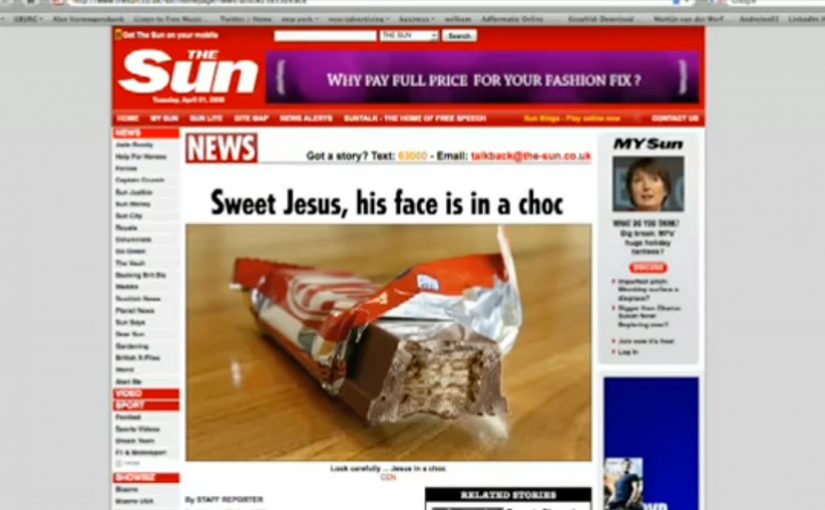
Kit Kat: Jesus Loves Kit Kat

When a bite turns into a “sighting”

Every so often the internet latches onto a “miracle” story. This one starts with a simple, everyday moment. Someone takes a bite of a Kit Kat, and suddenly the bite pattern is framed as a face. Cue the inevitable question. Is it real, or is it just our brains doing what they always do with patterns?

Either way, the punchline lands immediately because the brand line is already waiting for it. Jesus loves Kit Kat. Have a break. Have a Kit Kat.

The stunt behind the headline

The mechanism is a simple one. Take a familiar cultural pattern. The “miraculous sighting” story. Then attach it to an everyday object and let curiosity do the distribution work.

In European FMCG marketing, low-budget PR seeding, meaning you plant the story with a few publishers to trigger pickup, can outperform paid media when the story is easy to retell and the brand cue, the unmistakable product signal inside the joke, is inescapable.

In this case, the campaign is described as being kick-started by sending a tip to major Dutch news sites about a “Jesus face” discovered in a bitten Kit Kat, complete with “proof” photos. Once the story lands, the audience spreads it for free, partly to react, partly to mock, and partly to forward the joke. That works because the audience is invited to judge the “realness” and repeat the brand line while they do it.

Why it lands: the audience writes the punchline

It works because the viewer instantly knows what to do with it. “Is it real” is the hook. “Obviously not” is the release. Then the slogan becomes the comment section fuel, because “Have a break” and “Give me a break” are ready-made responses that keep repeating the brand.

Extractable takeaway: If you use a familiar “sighting” format, design the sharing loop so people repeat the brand line as they debate whether it is “real”.

What the brand is really buying

The real question is whether the stunt forces a repeatable brand line, not whether anyone believes the “sighting”.

This is not persuasion. It is memory and talk value, meaning the worth of being talked about. The goal is to force a moment of attention in a low-involvement category, then lock the attention to a slogan people already know well enough to quote without effort.

Steal the “sighting” shape for earned reach

  • Use a story shape people already recognise. Familiar formats travel faster than “new idea” explanations.
  • Make the brand cue inseparable from the joke. If the gag works without the product, you are funding entertainment, not brand recall.
  • Design for repeatable phrasing. The best hooks come with a built-in line people will type in their own words.
  • Know the risk. Hoax-style PR, where you let people briefly wonder if it is real, can backfire if your category depends on trust, seriousness, or institutional credibility.

A few fast answers before you act

What is happening in “Jesus Loves Kit Kat”?

A playful “sighting” style story frames a bitten Kit Kat as if it reveals a face, and the curiosity and debate around it drives sharing.

What is the core mechanism?

PR seeding plus a familiar meme-like story format. People click to judge it, then share to react, mock, or pass along the joke.

Why does this kind of story travel fast?

Because it is easy to retell and invites opinion. The audience becomes the distributor by arguing about whether it is “real”.

What is the brand risk to watch?

Hoax-style hooks can backfire in categories where trust and seriousness matter. The technique needs category-fit and tone discipline.

What is the most transferable takeaway?

If you use a cultural format people already recognise, make sure the brand cue is inseparable from the punchline, otherwise the joke outlives the brand.


Mazda2: Smooth Parking

A woman pulls up in her Mazda2 and faces a classic “you’ll never fit in there” moment. Two road workers have effectively turned a parking bay into a narrow trap, and the smirk on their faces says the punchline is supposed to be on her.

Then the ad flips the frame. Instead of forcing the expected struggle, she reverses, lines up, and uses the planks like ramps, smoothly climbing over the obstacle and landing the car where it needs to be. The joke is still there, but the target changes.

How the trick is staged

The execution is built as a micro-story with one clear constraint. A “too-small” space, onlookers who provide the social pressure, and a single move that resolves the tension in an unexpected way. The product benefit is not explained. It is demonstrated.

In consumer marketing for everyday mobility products, the fastest way to prove a benefit is to stage it in an instantly understood micro-situation.

The real question is whether your benefit can be proven in a single, instantly legible move.

Why it lands

It borrows a familiar stereotype as bait, then cashes out with a clean reversal. The audience is guided to predict failure, so the successful outcome feels sharper, funnier, and more shareable than a standard capability demo.

Extractable takeaway: If your category is full of “feature talk”, build a single-scene proof that forces a prediction, then overturn it with one unmistakable visual action. When the viewer can explain the benefit in one sentence without pausing the video, you have a story that travels.

What Mazda is really selling here

This is not a parking tutorial. It is a personality claim delivered through performance. “Small car agility” becomes a social moment. The driver keeps composure under judgement, and the car becomes the quiet accomplice that makes the comeback possible.

Steal the one-scene proof technique

  • Engineer a single constraint. Make the situation legible in two seconds, so the viewer immediately forms a prediction.
  • Let the crowd voice the tension. Onlookers, comments, or disbelief create stakes without exposition.
  • Resolve with one clear move. One action that visually “proves” the benefit beats a stack of claims.
  • Make the twist retellable. If someone can summarise it in a line, it is easier to forward.

A few fast answers before you act

What is “Smooth Parking” in this context?

It is a short Mazda2 film that sets up an apparently impossible parking space and then resolves it with a surprising manoeuvre that makes the car’s agility feel real rather than advertised.

Why use a stereotype at all?

Because it accelerates comprehension. The risk is obvious. You need the payoff to clearly reverse the target, otherwise you reinforce the stereotype instead of undermining it.

What makes this “viral-ready”?

A tight setup, a fast twist, and a visual finish that does not require language or brand knowledge to understand. People share it as a punchline, and the product benefit comes along for free.

How do you apply this outside automotive?

Choose one everyday friction point your audience recognises instantly. Add a single constraint that feels unfair. Then show your product resolving it with one unmistakable action, not a list of features.

How do you avoid the twist feeling like a gimmick?

Make the setup and constraint honest, then let the resolution be a single action that cleanly proves the benefit, not extra explanation.

Erdinger: Drinking and Driving, the 0% Twist

A car rolls through the city. A police stop follows. The officers lean in, looking for the usual “roadside donation” and the driver plays along, calmly offering a beer.

Then comes the punchline. The beer is positioned as 0% alcohol, so the “gotcha” is not that the driver outsmarts the law, it is that the product truth flips the entire situation into a clean reveal.

The prank is the plot, the product truth is the twist

This is staged like a short documentary. A mockumentary, meaning it borrows the signals of documentary realism to make a scripted idea feel “found” instead of “made.” The setting is described as a downtown South American city where traffic stops double as bribe fishing.

In consumer marketing, the fastest path to shareable attention is often a single product truth turned into a public situation people can retell.

How it works: build tension, then release it safely

The mechanism is simple and replicable:

  • High-stakes setup: alcohol control and a police stop.
  • Social friction: the uncomfortable “what will they do” moment.
  • Unexpected compliance: the product is positioned as 0%, so the driver is not “escaping,” he is “within the rules.”
  • Clean release: viewers get to laugh without carrying guilt, because the punchline is anchored in the product claim, not reckless behavior.

In regulated categories and global consumer marketing, this kind of “responsible twist” lets you stage tension without training the audience to celebrate harm.

The real question is whether your product truth can carry the punchline without turning the audience into accomplices.

Why it spreads: it gives viewers a story, not a slogan

People do not forward “great taste” claims. They forward a scene they can summarize in one line. “These guys offer beer at a breath test, and it is fine because it is 0%.” That is the whole viral unit. It also lands because the audience recognizes the broader trope of roadside authority and awkward power, then the brand resolves it with a disarming, responsible reframing.

Extractable takeaway: Build the retell first, then design the twist so it resolves on a defensible truth that gives the audience a guilt-free reason to share.

What the brand is really selling

The visible message is “0% alcohol.” The deeper intent is permission. This is the right move because it makes responsibility the payoff, not a disclaimer.

It positions the beer as a choice that fits social moments where you want the ritual, not the alcohol.

That matters because “non-alcoholic” is not only a functional attribute. It is a situational benefit: it lets the product show up in contexts where a normal beer is a bad idea.

Steal the 0% twist structure

  • Start from a product truth that can survive scrutiny, not a vague brand value.
  • Choose a situation with instant stakes so the first five seconds do the work.
  • Design a moral “safe landing” where the audience can enjoy the twist without endorsing harm.
  • Make the retell obvious by ensuring the story fits in one sentence.

A few fast answers before you act

Is this encouraging drunk driving?

No. The joke is engineered to resolve on “0% alcohol,” so the brand can claim compliance rather than celebrate recklessness.

What is the core creative mechanic here?

It converts a product attribute into a plot device. The “0%” is not a line at the end, it is the hinge that changes what the scene means.

Why does the documentary style matter?

Mock-documentary cues create believability quickly. Viewers process it as “something that happened,” which increases watch-through and sharing.

What makes the idea portable to other categories?

The structure is generic: tension, social friction, twist, relief. Any brand with a defensible “safety” or “permission” truth can map onto that arc.

What is the biggest risk when copying this approach?

If the “safe landing” is weak, the audience reads it as promoting harmful behavior. The twist must clearly reframe the situation as responsible, not as a workaround.