
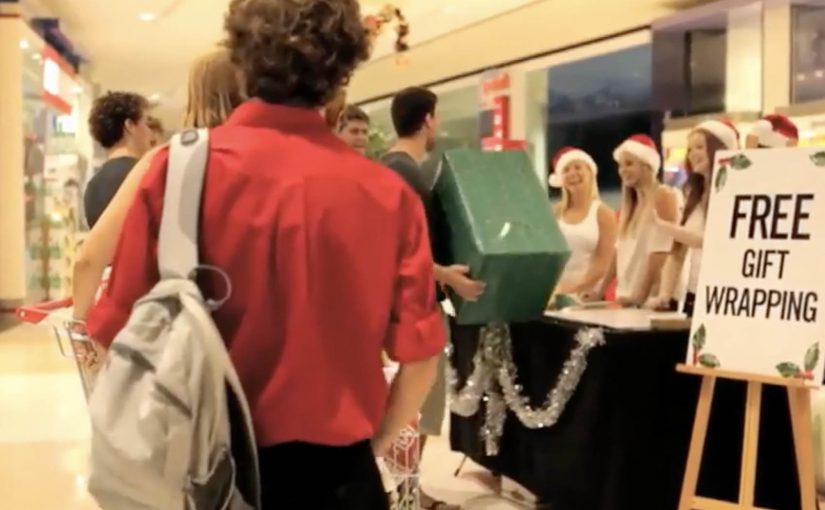
Hyundai A-League: Gift Wrapping Swindle

Getting people into a stadium rarely starts with sport. It starts with habit. Lowe in Sydney uses the pre-Christmas rush to put a match invitation into a moment people already care about, without needing another ticket ad.

A Christmas “service” that flips into promotion

The activation doesn’t fight for attention in a new media slot. It borrows an existing ritual, getting gifts ready, when people are already in a generous, social mindset and open to small surprises.

The smart part is the order of operations. It feels like help first, marketing second, which lowers resistance and makes the message easier to carry into conversation afterwards.

The reveal is the media

Once people opt in, the experience pivots. What looks like a straightforward offer becomes a playful con, and that pivot is the part people remember and retell.

That retelling is the distribution engine. It converts passive reach into a personal anecdote, and personal anecdotes are what move a friend group from “I saw something” to “we should go.”

In crowded sports and entertainment markets, attendance is often won at the everyday decision points where people choose what they will do with their next free evening.

The real question is whether you can turn an attendance ask into a story people want to retell, not just a message they notice.

Why the idea lands so well

The “swindle” framing does two jobs at once. Here, “swindle” simply means a playful bait-and-switch, the wrapping offer flips into a match invite. It creates tension and emotion in the moment, and it makes the participant feel involved, not targeted. The reaction is the content, and the retelling is the distribution.

Extractable takeaway: If you can attach your message to a real-world ritual that people already care about, you don’t need to “earn attention” from scratch. You simply redirect it, then give people a story they can repeat without you.

This is also listed in Effie Awards Australia reporting as a winner in the “Most Original Thinking” category, which fits the design: a small behavioural hack, not a big media buy.

What the league is really buying

The hidden win is not just awareness. It’s habit disruption. You take a non-football moment and reframe it as football-adjacent, then you push the idea of attending into a context where people are already planning social time around the holidays.

A ritual-first activation like this beats incremental ticket messaging because it recruits people’s social planning habits, not just their attention.

That’s how you move from “I saw an ad” to “we should go”. The campaign manufactures a nudge that feels organic because it is embedded inside a familiar activity.

Ritual-based attendance nudges to copy

  • Pick a ritual with built-in foot traffic: shopping, commuting, queues, checkouts, waiting rooms.
  • Make the reveal the message: the twist should be the reason people talk, not an extra layer you explain after.
  • Design for retelling: if the story can be repeated in one sentence, it will travel further than the experience itself.
  • Keep the CTA implicit: the best outcome is that people decide to act while they are still talking about what happened.

A few fast answers before you act

What is “The Great Christmas Gift Wrapping Swindle”?

It’s a holiday-season activation that turns gift wrapping into a surprise promotional stunt, engineered to spark conversation and drive attendance.

Why is gift wrapping a smart channel for sports marketing?

Because it’s a ritual people willingly engage with. The message travels physically with the gift, and the moment is social by default.

What makes this more effective than a standard ticket ad?

The participant becomes the messenger. A prank-style reveal produces a story, and stories outperform slogans when it comes to getting people to act.

What’s the main risk with prank mechanics?

If the reveal feels mean-spirited or wastes people’s time, you get backlash without benefit. The tone has to stay playful, and the participant has to feel “in on it” quickly.

How do you adapt the pattern outside sports?

Attach your offer to a real-world ritual in your category. Then design one clear twist that transforms the ritual into a story people want to repeat.

Microsoft Office Project 2007: Mega Woosh

Microsoft created a viral featuring Bruno Kammerl, described as building the biggest waterslide on earth. The test run was more than successful, and the film leans into that “did I just see that” energy from the first second.

A stunt film that behaves like a project story

The mechanism is classic viral bait. A bigger-than-life engineering build. A simple premise. A single high-risk moment. Then just enough mystery around “who is this” and “why does this exist” to make people share it while they debate whether it is real.

In enterprise project-management software marketing, a bold proof-like narrative can communicate “we make impossible plans doable” faster than feature lists ever will.

Why it lands

It uses constraint and payoff. The build feels specific enough to be plausible, and the jump delivers an instant, physical climax. Even if viewers suspect it is staged, the film still works because the emotion is the product. Surprise, disbelief, and the urge to forward it.

Extractable takeaway: If you want a product that sells “capability” to feel memorable, show one exaggerated outcome, then let the audience connect the dots back to the promise.

What this says about the brand

The strategic intent is to borrow the energy of ambitious personal projects and map it onto a tool used for complex planning. The viral creates a mental shortcut. Big plan. Bold execution. Managed outcome.

The real question is whether this kind of spectacle makes enterprise planning feel ambitious enough to remember. It does, because the campaign turns project management into a visible, shareable outcome instead of a software demo.

What to steal from Mega Woosh

  • Make the promise physical. If your product sells “capability”, dramatize it with a single, extreme outcome people can picture instantly.
  • Lock one simple story rule. Big build. One test. One payoff. The simpler the rule, the easier the share.
  • Use specificity to create plausibility. Named protagonist, concrete build details, and a clear “test run” moment make the film feel real enough to debate.
  • Let the audience connect the metaphor. Do not over-explain the product. Give them the leap from “impossible project” to “project management”.
  • Design the talk trigger. The best virals are built around a single question people argue about. “Is this real” is a distribution engine.
  • Keep the brand cue clean and minimal. Too much branding breaks the spell. Too little branding loses the credit.

A few fast answers before you act

What is Mega Woosh in one line?

A viral stunt film built around an oversized waterslide jump, used to signal “anything is possible” as a metaphor for managing big projects.

Why does this work as marketing for project software?

Because it dramatizes planning and execution as a single, bold narrative. The story does the positioning work without needing specs.

What makes it so shareable?

One premise, one payoff, and a high-disbelief moment that triggers debate and forwarding.

What is the risk of this approach?

If the audience feels tricked rather than entertained, trust can take a hit. The framing needs to stay playful, not deceptive.

What should marketers copy from this format?

Use one extreme, easy-to-explain outcome to embody the promise, then keep the branding light enough for the spectacle to travel.

The Sun spoofs Apple’s iPhone ads

It looks like an Apple iPhone ad at first. Then the tone flips. Glue London plays on the fascination with digital technology and the iPhone. It lands as a cheeky spoof for The Sun.

The punchline. “v 4.0, since 1969”

The film finishes with the words “v 4.0, since 1969”. It is a nod to The Sun’s 40th birthday anniversary this year, delivered in the visual language of tech versioning.

The real question is whether your audience already knows the borrowed format well enough that you can spend your seconds on the twist.

Borrowing a trusted format is a smart shortcut, as long as the punchline is unmistakably yours.

Why this works. Borrow a format people already trust

The execution borrows the look and rhythm of a category-defining ad format and uses it as a shortcut. Here, “format” means the pacing, typography, and product-shot grammar viewers associate with Apple’s iPhone ads. By borrowing that grammar, the film earns instant comprehension, which makes the flip to The Sun feel sharper and the end line hit harder.

Extractable takeaway: When you borrow a dominant format, the audience does the decoding for you. That lets your creative spend its energy on the twist, not on explaining the frame.

In mass-market media brands, borrowing big-tech visual codes can be a fast way to signal modernity because audiences already carry the reference.

How to reuse this spoof move

  • Match the “real” format first. If the opening does not feel authentic, the parody reads as a try-hard imitation.
  • Keep the twist to one line. A single, version-number style punchline gives people something quotable to repeat.
  • Make the last card do the branding. Let the borrowed grammar set expectations, then let your end line pay it off for your brand.

A few fast answers before you act

What is this ad?

A spoof of Apple’s iPhone advertising style for The Sun, created by Glue London.

What does “v 4.0, since 1969” refer to?

A reference to The Sun’s 40th birthday anniversary, expressed like a software version update.

What is the core creative tactic?

Use a familiar tech-ad format as a recognizable frame, then subvert it with a brand-specific punchline.

Why does it travel as a viral?

It is short, culturally legible, and built on a format people immediately recognize.