
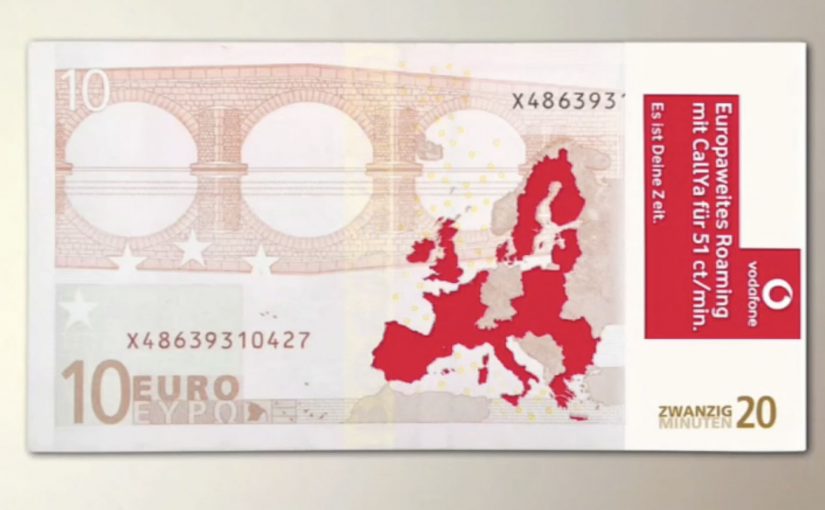
Vodafone: Banknote Sticker for Roaming

To promote Vodafone’s cheap roaming tariff for Europe, Scholz & Friends chose a medium that does not compete for attention. They modified banknotes with stickers, so the message reaches people in a very specific place, their wallet.

The idea is as low-tech as it is disruptive. Instead of asking travellers to notice another poster, banner, or leaflet, the campaign piggybacks on something they already handle repeatedly while travelling.

Roaming costs are a practical irritation. The sticker works because it shows up when travellers are already handling money.

Why a sticker on cash beats a billboard

Most media fights for a glance. A banknote already has “permission” to be looked at, checked, counted, and passed along. Adding a sticker turns that routine behavior into repeated exposure, without needing a second of extra attention budget.

Extractable takeaway: If the offer is about saving money or reducing travel friction, place it inside a ritual people already repeat, not in a channel that asks for attention first.

It is also inherently portable. Cash moves through hands, venues, and neighborhoods, which gives the idea a built-in distribution logic that feels organic rather than broadcast.

For price-led travel offers, wallet insertion beats billboard spend because it shows up at decision time.

What the mechanic is really doing

  • Context targeting: travellers touch cash, exchange cash, and pay in unfamiliar places.
  • Frequency: one note can generate dozens of impressions across multiple days.
  • Zero clutter: the message lives where ads rarely live, inside the payment ritual.

That is the core “clutter breaking” move. It replaces interruption with insertion.

For European travellers moving across borders, wallet-level touchpoints cut through because they appear at the exact moment people are thinking about money and connectivity.

The real question is whether you can attach your promise to a repeated behavior, instead of paying to interrupt one.

Business intent under the simplicity

The immediate goal is recall for “cheap EU roaming” at the moment a traveller is likely to make a connectivity decision. The deeper goal is brand association with practical travel confidence, meaning Vodafone as the network that makes cross-border usage feel less stressful.

Wallet-level touchpoints to borrow

  • Choose a touchpoint people already trust, then add a light layer of message.
  • Exploit repeated rituals, paying, checking, stamping, validating, not one-off exposure.
  • Keep the promise instantly legible, one benefit, one reading, no decoding.
  • Design for pass-along, so distribution is a property of the medium, not a separate plan.

A few fast answers before you act

What makes this “ambient” instead of traditional advertising?

The message is placed inside an everyday object people already use, rather than in a dedicated ad space that competes for attention.

Why is the wallet a powerful media channel for travel offers?

Because it is handled frequently during travel, and it naturally frames the offer around cost and practicality.

What is the main risk with banknote-based ideas?

Control and coverage. You cannot fully control who receives the notes, and scale depends on distribution logistics and how widely the notes circulate.

How do you measure impact when the medium is not digital?

Use proxies like search lift for the tariff term, store inquiries, roaming plan activations, and time-boxed correlation against the distribution window.

What is the transferable lesson beyond telecom roaming?

If your promise is about saving money or reducing travel friction, placing it inside a payment or travel ritual can outperform louder media because it arrives in-context.

Vodafone: Power to You

A telco ad built around a painfully human moment

This spot does not try to impress you with technology. It starts with a situation that feels familiar, that split-second where you finally get what you want and then do not quite know what to do with it.

The mechanic: make the service invisible, make the feeling unforgettable

The mechanism is classic restraint. The product sits in the background as the enabler, while the story puts all the weight on a single emotional beat and a clean punchline.

That works because people remember the awkward human payoff more easily than they remember another service claim.

In global telco advertising, the fastest way to make connectivity feel valuable is to tie it to a moment people recognize from real life.

Why this lands

Because it refuses to oversell. The humor comes from recognition, not exaggeration, and the brand benefit lands as a by-product of the scene rather than a claim you are asked to believe.

Extractable takeaway: When you sell an invisible utility, stop explaining the utility. Show the human outcome in one tight scene, and let the audience supply the meaning.

What Vodafone is really doing here

The real question is how a utility brand makes an invisible service feel personally valuable without falling into feature talk.

It is not a feature demo. It is permission. The brand frames itself as the thing that gives you the ability to act, even if you still have to handle the awkwardness of being human once the connection is made.

That is the right strategic choice for a telco brand.

What to borrow from Vodafone’s restraint

  • Pick one emotion and commit. A single relatable moment beats a list of capabilities.
  • Keep the product in the background. Let the story deliver the proof indirectly.
  • Write for instant recognition. If people can say “that is me”, you have the ad.
  • End on a clean beat. One punchline. One memory.

A few fast answers before you act

What is this “Power to You” spot trying to achieve?

It makes Vodafone’s promise feel human by anchoring the brand to a recognizable emotional moment rather than to technical claims.

Why does the low-feature approach work for a telecom brand?

Because the service is largely invisible when it works. The best proof is often the outcome it enables, not the infrastructure behind it.

What is the core creative pattern here?

Understatement plus recognition. Build the story around a real-life feeling, then let the brand show up as the quiet enabler.

Why use humor instead of product proof?

Because recognition lowers resistance. When people see themselves in the scene, the brand benefit feels inferred rather than imposed.

What is the transferable principle?

If your product is a utility, sell the human moment it unlocks. The clearer the moment, the less you need to explain.

Vodafone NZ: 1000 phones, 53 ringtones, 1 song

When “viral” requires real engineering

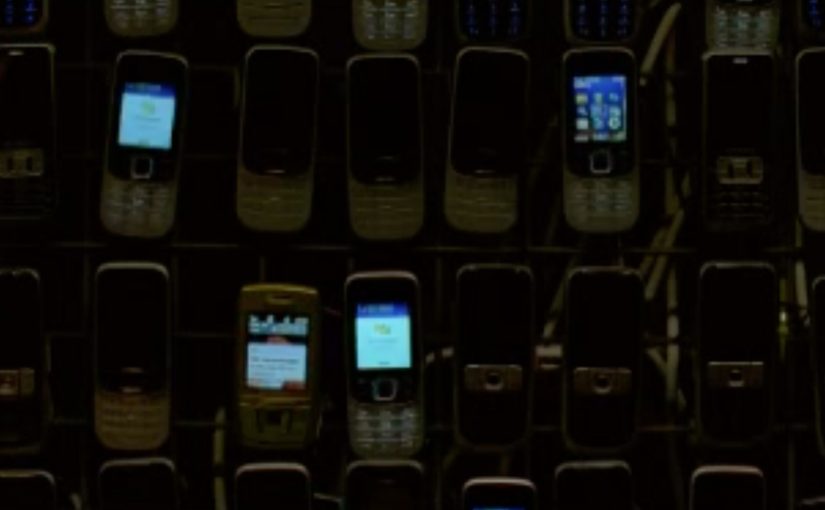
To create a viral video these days, you need to do something great and unique. Vodafone NZ hired a production team to orchestrate cellphones into “playing” Tchaikovsky’s 1812 Overture.

This was done using 1000 phones and 53 different ringtone alerts, synchronized to recreate the classical piece.

How 1000 phones became an orchestra

The mechanism was constraint-driven composition.

Instead of instruments, the “sound palette” was a fixed set of ringtone alerts. The team then arranged phones like sections in an orchestra and synchronized their playback so the combined output recreated the music.

What makes this work on camera is that you can see the system. Rows of devices. Repetition at scale. A human-built machine producing a familiar piece.

In global telecom marketing, the most shareable films often work because the effort is visible.

Why the idea lands with viewers

It lands because it is both absurd and precise, and the visible synchronization lets the viewer sense the complexity without needing the full production process.

Extractable takeaway: When the constraint is instantly legible and the build is visibly real, the craft becomes the hook that earns attention and sharing.

It also bridges cultures. Highbrow music meets everyday tech, creating an unexpected contrast that feels fresh instead of forced.

The business intent behind the ringtone orchestra

The intent was to associate Vodafone with coordination, scale, and modern connectivity, without having to say those words.

The real question is whether your “viral” idea would still be interesting if the camera had to capture a real system doing the work.

This is the right kind of brand film for a telco. It shows coordination and connectivity instead of claiming it.

Steal this pattern from the ringtone orchestra

  • Make effort visible. When the craft can be seen, viewers reward it with attention and sharing.
  • Use a constraint as the hook. “Only ringtones” creates a clear challenge people instantly understand.
  • Engineer a spectacle that reads in one frame. Scale should be obvious without explanation.
  • Let the metaphor do the branding. Show coordination and connectivity instead of claiming it.

If you like the resulting tune, you can download it to your computer, as well as the 53 ringtones used to create it, from www.vodafone.co.nz/symphonia.


A few fast answers before you act

What did Vodafone NZ create?

A film where 1000 mobile phones, using 53 different ringtone alerts, were synchronized to perform Tchaikovsky’s 1812 Overture.

What is the core mechanism?

Constraint-driven composition. A fixed set of ringtone sounds becomes the “instrument set”, and synchronization plus physical arrangement makes the system readable on camera.

Why does it work as shareable content?

The effort is visible. The scale reads instantly, and the contrast between classical music and ringtones creates a surprising but coherent hook.

What business goal does this support for a telco brand?

It turns “connectivity at scale” into a watchable metaphor. Many devices acting as one becomes an entertaining proof of coordination and network promise.

What is the most transferable takeaway?

If you can make the constraint and the craft legible in one frame, the build itself becomes the reason people share.