
Coca-Cola Light: The Return of Love in Brazil

A relaunch built on memory. And a ritual

In 2009 Coca-Cola Light was taken out of the Brazilian market. But even after its five year absence, 99% of Brazilians still had the brand in their minds.

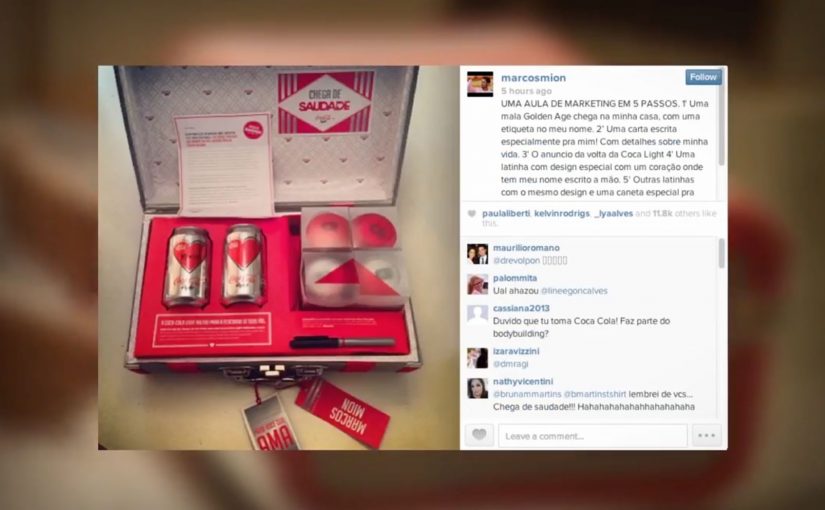
So for their 2014 relaunch they identified 150 influencers that were also real Coca-Cola Light lovers. Then a special handmade suitcase was delivered to each one of them. The suitcase contained a personal letter with the relaunch news and a ritual to send Coca-Cola Light cans to special friends with their names handwritten on it. The results:

The move: turn influencers into messengers, not media

The suitcase is not “merch.” It is a delivery mechanism for a story and a behavior. The influencer receives the relaunch news. Then immediately passes it on, name-by-name, to people who matter to them.

Why this feels like love, not marketing

Handwritten names shift the tone. You are not forwarding an ad. You are sending a personal gift with someone’s identity on it. That makes the relaunch feel earned and human, especially after a long absence.

The relaunch job-to-be-done

Restart conversation and consumption fast by activating people who already love the brand, and giving them a simple way to recruit other “special friends” into the comeback.

Steal this play

  • When a brand returns, start with believers. Then give them a repeatable sharing ritual.
  • Use personalization as the transmission fuel. Names beat slogans.
  • Package the behavior, not just the product. The “how to share” should be inside the box.

A few fast answers before you act

What did Coca-Cola Light do for the 2014 relaunch in Brazil?

They identified 150 influencers who were genuine Coca-Cola Light lovers and delivered handmade suitcases containing a personal letter and a sharing ritual.

What was inside the suitcase?

A personal letter announcing the relaunch and a ritual for sending Coca-Cola Light cans to special friends with names handwritten on the cans.

Why use handwritten names?

It turns distribution into a personal gesture. The relaunch message travels as a named gift rather than a generic announcement.

What is the core mechanic behind the campaign?

Activate true fans first, then convert them into one-to-one distributors by giving them a simple ritual to pass the product on to friends.
Kia Lie Detector

Most people in Belgium know that Kia gives a 7-year warranty on all its models. That is a good thing. But a lot of them also think 7 years sounds too good to be true, and that there must be a catch. That is a problem. If people do not believe your advertising message, regular advertising is insufficient.

So LDV United built a campaign designed to prove one simple point. Although it sounds unbelievable, the 7-year warranty is described as 100% true, with no catch.

Proof beats repetition

To prove the warranty was genuine, the campaign used a lie detector. Legal Connections, described as an official lie detector company, hooked up the CEO of Kia Motors to a polygraph. Consumers then asked him questions about the 7-year warranty during a live online session.

In European automotive markets, long warranties are a major purchase heuristic, and credibility becomes the real bottleneck when the claim feels “too good”.

Here is the key marketing idea in one line. When your promise is extraordinary, you need a proof ritual that feels public, simple, and hard to fake.

How the stunt travels

The lie detector was not the whole campaign. It was the anchor. The stunt was communicated through newspaper ads, banners and a press release announcing that an actual CEO would undergo a live lie detector test. That structure is what turns a proof moment into earned media and word of mouth, meaning peer-to-peer sharing both online and offline.

Because a polygraph is a culturally understood symbol of truth-testing, it reframed the warranty from “marketing claim” into “something we are willing to be challenged on, live”.

Recognition and reported impact

The work later picked up Cannes Lions recognition, listed as a Direct Bronze Lion for “Lie Detector”.

The campaign’s impact was reported via independent media company Scripta as:

  • Brand recognition: 42% (instead of 32% sector average)
  • Attribution: 73% (instead of 62% sector average)
  • Resulting in an Effectiveness Rating of 31% (instead of 20% sector average)
  • And last but not least: An impressive credibility of 80%

What to steal for your next “credibility gap” claim

  • Identify the credibility gap early. If the promise sounds implausible, spend on proof, not frequency.
  • Choose a proof mechanic people already understand. Polygraph. Lab test. Public demo. Anything that signals “hard to fake”.
  • Make the proof interactive. Live questions beat scripted endorsements when trust is the objective.
  • Package the moment for pickup. Announce it like an event, so press and blogs have a clean story to carry.

A few fast answers before you act

What problem does the Kia lie detector idea solve?

It solves a credibility problem. When a benefit sounds too good to be true, people assume a hidden condition. The campaign is designed to remove that doubt by staging proof in public.

Why use a lie detector in advertising?

A polygraph is a widely understood truth ritual. Even if people do not treat it as perfect science, it signals confidence and willingness to be challenged in front of an audience.

What makes this more than a stunt?

The stunt is structured as a live, interactive Q&A, and it is distributed through paid announcements and PR. That combination turns a single moment into a story that can travel.

When should brands avoid “proof theatre” like this?

If the claim cannot withstand scrutiny, or if the proof method is likely to be seen as misleading or unsafe, the stunt will backfire. Proof mechanics only work when the underlying promise is clean.

What are better success metrics than views for credibility campaigns?

Measure belief and consideration shifts. Brand trust, message credibility, attribution to the correct benefit, and downstream intent signals are usually more meaningful than raw reach.

Kit Kat: Jesus Loves Kit Kat

When a bite turns into a “sighting”

Every so often the internet latches onto a “miracle” story. This one starts with a simple, everyday moment. Someone takes a bite of a Kit Kat, and suddenly the bite pattern is framed as a face. Cue the inevitable question. Is it real, or is it just our brains doing what they always do with patterns?

Either way, the punchline lands immediately because the brand line is already waiting for it. Jesus loves Kit Kat. Have a break. Have a Kit Kat.

The stunt behind the headline

The mechanism is a simple one. Take a familiar cultural pattern. The “miraculous sighting” story. Then attach it to an everyday object and let curiosity do the distribution work.

In European FMCG marketing, low-budget PR seeding can outperform paid media when the story is easy to retell and the brand cue is unmistakable.

In this case, the campaign is described as being kick-started by sending a tip to major Dutch news sites about a “Jesus face” discovered in a bitten Kit Kat, complete with “proof” photos. Once the story lands, the audience spreads it for free, partly to react, partly to mock, and partly to forward the joke.

Why it lands: the audience writes the punchline

It works because the viewer instantly knows what to do with it. “Is it real” is the hook. “Obviously not” is the release. Then the slogan becomes the comment section fuel, because “Have a break” and “Give me a break” are ready-made responses that keep repeating the brand.

What the brand is really buying

This is not persuasion. It is memory and talk value. The goal is to force a moment of attention in a low-involvement category, then lock the attention to a slogan people already know well enough to quote without effort.

What to steal if you want earned reach without begging for it

  • Use a story shape people already recognise. Familiar formats travel faster than “new idea” explanations.
  • Make the brand cue inseparable from the joke. If the gag works without the product, you are funding entertainment, not brand recall.
  • Design for repeatable phrasing. The best hooks come with a built-in line people will type in their own words.
  • Know the risk. Hoax-style PR can backfire if your category depends on trust, seriousness, or institutional credibility.

A few fast answers before you act

What is happening in “Jesus Loves Kit Kat”?

A playful “sighting” style story frames a bitten Kit Kat as if it reveals a face, and the curiosity and debate around it drives sharing.

What is the core mechanism?

PR seeding plus a familiar meme-like story format. People click to judge it, then share to react, mock, or pass along the joke.

Why does this kind of story travel fast?

Because it is easy to retell and invites opinion. The audience becomes the distributor by arguing about whether it is “real”.

What is the brand risk to watch?

Hoax-style hooks can backfire in categories where trust and seriousness matter. The technique needs category-fit and tone discipline.

What is the most transferable takeaway?

If you use a cultural format people already recognise, make sure the brand cue is inseparable from the punchline, otherwise the joke outlives the brand.