
Viajes Galeón: Twitpoker

Viajes Galeón: Twitpoker

A poker table. Five of Colombia’s best-known Twitter personalities. Except the chips are not money. They are followers.

Viajes Galeón, a Colombian travel agency, and Y&R Colombia create Twitpoker, a poker game where players bet their Twitter followers instead of cash. The match is streamed live to audiences via web cams, pulling spectators into the tension of every hand because every raise has a visible social cost.

As described, the live format scaled beyond the five invited players. More than 27,000 people played together on a single table experience, and a brand with little or no prior social footprint used the stunt to kick-start its Twitter presence.

Followers as currency

The mechanism is a value swap. Twitter followers become the stake, which instantly reframes poker from private risk to public reputation. Every decision is legible to the audience and personally meaningful to the players, because the loss is social proof, not cash.

In social-led brand building, the most persuasive “launch” is a mechanic that makes your audience feel they are participating in the growth, not merely watching an ad about it.

Why it lands

The idea works because it turns a platform metric into a story engine. Most follower counts sit idle as vanity. Twitpoker makes the number consequential, and consequence creates attention. The live stream adds immediacy, and the five invited players supply recognizable personalities, so the audience is watching real identities collide with real incentives.

Extractable takeaway: If you want social growth fast, design a mechanic where the platform’s native currency is genuinely at stake, then stage it live so spectators feel the outcome unfolding in real time.

What the travel brand is really buying

The real question is how a low-awareness travel brand gives people a reason to follow right now.

Viajes Galeón is not buying “engagement” as a buzzword. It is buying a credible reason for people to follow, talk, and keep watching. The campaign converts a travel agency into a social event host, which is a stronger role for a brand with low awareness than trying to shout offers into a quiet feed.

What to steal from Twitpoker

  • Make the platform metric matter. Treat followers, likes, time, or access as something that can be risked or earned.
  • Use live to create urgency. Live formats compress attention and increase sharing because people do not want to miss the outcome.
  • Cast with credibility. Recognizable participants provide narrative without needing heavy scripting.
  • Let the audience feel included. Scale participation beyond the core cast so it becomes a shared event, not a private stunt.

A few fast answers before you act

What is Twitpoker?

A live-streamed poker game where participants bet their Twitter followers instead of money, built to generate attention and grow a brand’s social presence.

Why does “betting followers” work as a mechanic?

Because it converts a familiar social metric into a real stake, making every play emotionally legible and socially consequential.

What role does the live stream play?

It creates immediacy and shared tension, which increases participation, sharing, and real-time commentary.

What is the key requirement for this to feel credible?

The stakes must be real and visible, and the participants need an audience that cares about their reputations.

When should a brand use a stunt like this?

When the goal is to bootstrap social attention quickly, and when you can translate platform-native value into a simple game with a clear win and loss.

Yellow Pages: Location Based Banner

Yellow Pages: Location Based Banner

Here is the next generation of interactive web banners. Tel Aviv agency Shalmor Avnon Amichay/Y&R promoted the Yellow Pages augmented reality location-based app by creating a banner that does the same thing. Here “location-based” means it surfaces nearby businesses based on where you are.

The banner opens your webcam and lets you see the businesses around you. Wave your hand to switch between businesses. Click a business to jump straight to its Yellow Pages listing.

A banner that behaves like the product

The clever part is that this is not “interactive” for decoration. It is a working demo of the core value proposition. If the app helps you find what is near you, the banner proves that promise immediately, inside the placement, without asking you to imagine anything. Utility products should be advertised by demonstrating usefulness, not by describing features.

The mechanic: webcam as context, hand wave as UI

The flow is intentionally simple. Turn on the camera. Overlay nearby business options. Use a wave to move through results. Use a click to convert curiosity into action via the listing page.

In local discovery experiences, the strongest persuasion is a live, context-matched preview of usefulness rather than a feature claim.

Why it lands: it removes the “so what” gap

Most directory and local-search advertising dies in the space between promise and proof. The real question is whether your ad can turn a promise into proof without leaving the page. This banner collapses that gap, because it starts with your own context, then shows results, then lets you act. The interaction is the explanation.

Extractable takeaway: The fastest way to make a utility app feel essential is to let people experience the “aha” moment before they ever leave the page they are on.

What Yellow Pages is really trying to achieve

The business intent is to reposition Yellow Pages as modern, digital, and situationally useful, not just a legacy directory brand. The banner also creates a clear performance path. Engagement inside the unit, then click-out to a listing that can drive calls, visits, or follow-on app consideration.

Steal the demo-first local discovery pattern

  • Mirror the product in the ad. If the product is a tool, make the ad behave like the tool.
  • Use one gesture people understand. A wave as “next” is instantly legible. No tutorial needed.
  • Keep the ladder of commitment short. Preview. Browse. Click through. No extra steps.
  • Make the experience readable for bystanders. Obvious motion plus clear on-screen change sells the mechanic in shared environments.
  • Watch privacy optics. If you turn on a camera, be explicit that it is for interaction and context, not identification.

A few fast answers before you act

What is a “location based banner”?

It is a banner ad that adapts its content to the user’s situation, typically location or environment cues, so the ad can show relevant nearby options instead of generic messaging.

How does this Yellow Pages banner work?

It opens a webcam view, overlays nearby business options, lets you wave to cycle through businesses, and lets you click a result to open the corresponding Yellow Pages listing.

Why use a webcam at all?

Because it makes the experience feel immediate and personal. The ad becomes a live “finder” interface rather than a static claim about finding things.

What makes gesture-controlled banners risky?

Friction and variability. If the gesture detection fails or is unclear, users assume the ad is broken. The interaction must be forgiving and the feedback must be instant.

What is the safest way to replicate the idea today?

Keep the mechanic to one simple input, provide clear on-screen feedback, and ensure the user can still get value even if they do not enable the camera.

Caixa and Benfica: Pitch Invasion

Caixa and Benfica: Pitch Invasion

A sponsorship story told on the pitch

The hardest part of football sponsorships is making a partnership feel like more than a logo. Caixa and Benfica used a live stadium moment to do exactly that.

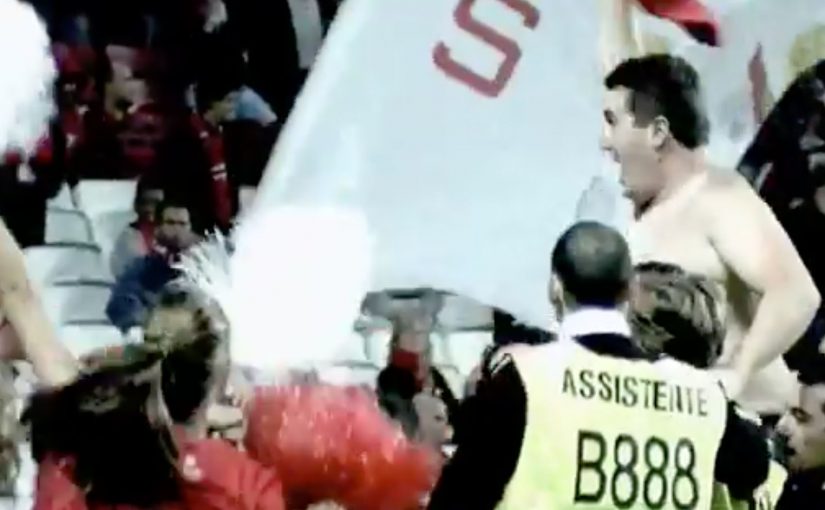
Here is a video case study of a first-of-its-kind football pitch invasion created to promote the partnership between the biggest Portuguese bank, Caixa, and Portugal’s biggest football club, Benfica.

The real question is how a sponsor earns emotional legitimacy inside a club culture.

How the pitch invasion became the activation

The mechanism was direct. Take something normally forbidden and tightly controlled. A pitch invasion. Then redesign it as a planned experience connected to the partnership.

Here, an “activation” is the on-site experience that turns a sponsorship into something fans can participate in.

That shift matters because it turns the “unthinkable” into a sanctioned moment. The pitch itself becomes the media channel, and the stadium becomes a stage the audience remembers.

In European football stadium culture, the pitch is the hardest boundary to cross, so sanctioned access reads as a rare privilege.

Why it lands in a football context

Football already runs on emotion, tribal identity, and the feeling of being part of something bigger than yourself. Letting people cross the boundary from stands to pitch collapses distance between fans and club. It creates belonging, and it produces a story worth retelling because it looks and feels like a once-in-a-lifetime exception.

Extractable takeaway: When a culture has a protected boundary, designing a safe, sanctioned way to cross it creates instant belonging and a story people repeat.

The business intent behind the spectacle

The intent was to make the Caixa and Benfica partnership feel lived, not announced.

Sponsorships stick when the brand is seen enabling something fans care about, not just buying visibility.

A bank does not naturally belong in the middle of football culture. This activation borrowed the club’s emotional intensity and translated sponsorship into an experience that fans would associate with the partnership itself.

A sponsor activation playbook to copy

  • Turn the asset into an experience. If you sponsor something, find a way to let people physically engage with it.
  • Use controlled rule-breaking. A “forbidden” behavior becomes powerful when it is safely redesigned and permitted.
  • Build a moment that photographs itself. Stadium-scale actions create natural documentation and sharing.
  • Make the brand the enabler. The partnership should feel like it unlocked access, not like it bought attention.

A few fast answers before you act

What was the Caixa and Benfica activation?

A planned football pitch invasion designed as a promotional moment to support the Caixa and Benfica partnership, documented in a video case study.

What was the core mechanism?

Reframe a normally prohibited act. Entering the pitch. As a controlled, brand-enabled experience tied to the partnership.

Why does this idea work particularly well in football?

Because football is built on belonging and emotion. Letting fans step onto the pitch creates a memorable boundary-crossing moment.

What sponsorship goal did this support?

Making the partnership feel culturally meaningful and fan-relevant, not just visually present through branding.

What is the main takeaway for sponsors?

Create access and participation that feels exceptional. If fans feel the partnership unlocked something real, the brand association sticks.