
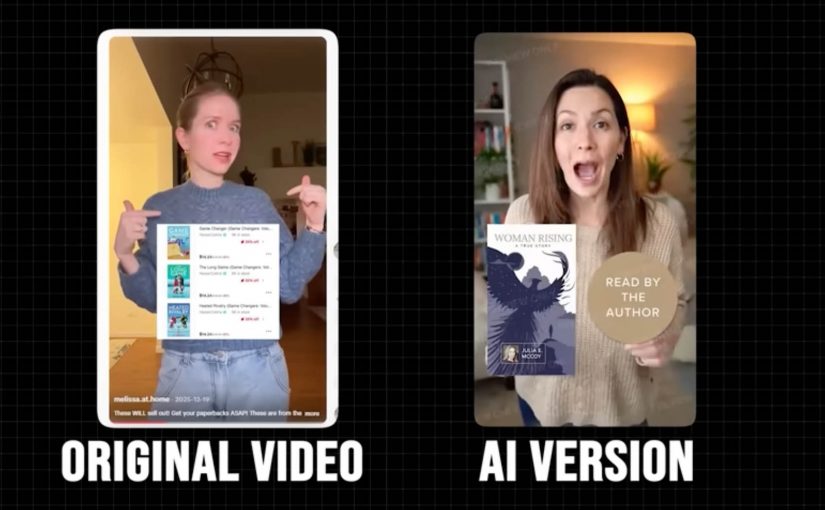
Viral Content: Clone Winning Ads in Minutes

Viral video creation just changed with Topview AI.

For years, short-form performance video lived in two modes. Manual production that is slow and expensive. Or template-based generators that are faster, but still force you into lots of manual re-work.

Now a third mode is emerging: AI Video Agents, meaning systems that take a short brief plus a few inputs and generate a complete multi-shot draft you can iterate on.

The shift is simple. Instead of editing frame-by-frame, you brief the outcome. Optionally provide a reference viral video. The agent then recreates the concept, pacing, and structure for your product in minutes. Your job becomes direction, constraints, and iteration. Not timelines.

Meet the AI Video Agent “three inputs” workflow

Topview’s core promise is “clone what works” for short-form marketing.

Upload your product image and/or URL so the system extracts what it needs. Share a reference viral video so it learns the shots and pacing. Get a complete multi-shot video that matches the reference style, rebuilt for your product.

That is the operational unlock. You stop asking a team to invent from scratch every time. You start generating variants of formats that already perform, then iterate based on outcomes.

In performance marketing organizations, tools that “clone” winning ads mainly shift the bottleneck from production to briefing quality, governance, and iteration discipline.

What “cloning winning ads” really means

This is not about copying someone’s assets. It is about cloning a repeatable pattern.

Extractable takeaway: When a workflow can reliably regenerate a proven creative structure, the bottleneck shifts from making assets to choosing angles, proof, and guardrails that improve one test at a time.

High-performing short-form ads tend to share the same backbone. A strong opening. A clear value moment. Proof. A simple call-to-action. The variable is the angle and execution. Not the structure.

AI video agents are optimized to reproduce that backbone at speed, then let you steer the angle. Because the agent reuses a proven structure, you can spend your time on angles and proof, which increases iteration velocity. That is why they matter for performance teams. The advantage is iteration velocity. The risk is sameness if you do not bring differentiation in offer, proof, and brand voice.

What to evaluate beyond the AI Video Agent headline

I would not judge any platform by a single review video. I would judge it by whether it covers the tasks that constantly slow teams down.

From the “creative tools” surface, Topview positions a broader toolbox around the agent, including: AI Avatar and Product Avatar workflows (plus “Design my Avatar”). LipSync. Text-to-Image and AI Image Edit. Product Photography. Face Swap and character swap workflows. Image-to-Video and Text-to-Video. AI Video Edit.

This matters because real creative operations are never “one tool.” They are a chain. The more of that chain you can keep inside one workflow, the faster your test-and-learn loop becomes.

Topview alternatives. Choose by use case, not by hype.

If you are building a modern AI powered creative tech stack, ensure you match the AI tools to the job.

HeyGen

HeyGen positions itself around highly realistic avatars, voice cloning, and strong lip-syncing, plus broad language support and AI video translation. It also supports uploading brand elements to keep outputs consistent across projects. Compared to Topview’s short-form ad focus and beginner-friendly “quick publish” style workflow, HeyGen is often the stronger fit when avatar-led and multilingual presenter content is your primary format.

Synthesia

Synthesia is typically strongest for presenter-led videos, especially training, internal communications, and more “corporate-grade” marketing explainers. Compared to Topview’s short product ad focus, Synthesia is often the cleaner fit when a human-style presenter is the core format.

Fliki

Fliki stands out when your workflow starts from existing assets and needs scale. Blogs, slides, product inputs, and team updates converted into videos with avatars and voiceovers, plus a large set of voice and translation options. Use Fliki when you want breadth and flexibility in avatar and voiceover production. Otherwise, use Topview AI when your priority is easily creating short videos from links, images, or footage with minimal workflow friction.

Operating moves to steal with AI video agents

The real question is whether your team can turn minutes-long production into a disciplined iteration system without losing distinctiveness.

Viral content is no longer a production problem. It is becoming an iteration problem.

  • Brief for outcomes, not assets. Define the hook, value moment, proof, and CTA before you generate variants.
  • Constrain sameness early. Put brand voice, offer boundaries, and “do not do” rules into the brief so speed does not turn into remix culture.
  • Run a ruthless learning loop. Test fewer, better variants. Kill quickly. Scale only what proves incremental lift.

Which viral video would you recreate first. And what would you change so it is unmistakably yours, not just a remix.


A few fast answers before you act

What does “clone winning ads” actually mean?

It usually means generating new variants that reuse the structure of high-performing creatives. The goal is to speed up iteration, not to copy a single ad one-to-one.

Is this ethical?

It depends on what is being “cloned.” Reusing your own learnings is normal. Copying another brand’s distinctive IP, characters, or protected assets crosses a line. Governance and review matter.

What will still differentiate brands if everyone can produce fast?

Strategy, customer insight, and taste. If production becomes cheap, the competitive edge moves to positioning clarity, creative direction, and the quality of testing and learning loops.

How should teams use this without flooding channels with slop?

Use strict briefs, clear brand guardrails, and a limited hypothesis set. Test fewer, better variants. Kill quickly. Scale only what proves incremental lift.

What is the biggest risk?

Over-optimizing for short-term clicks at the expense of brand meaning, trust, and distinctiveness. High-volume iteration can become noise if the work stops saying something specific.

Mirakl Santa Quits

A Christmas brand film made with generative AI

Mirakl, the ecommerce software and marketplace platform provider, has launched a Christmas campaign built around a 60-second brand film titled “Santa Quits”. The creative twist is not the plot. It is the production method.

The film was created with AiCandy Australia. Mirakl describes every character and scene as AI-generated, then shaped into a finished narrative through human creative direction and filmmaking craft.

Santa quits, the world panics, and an elf restarts operations

In the film, Santa resigns under modern seasonal pressure, triggering worldwide protests as people demand Christmas be saved. The resolution is deliberately on-theme. An elf restarts the operation using “agentic commerce” powered by Mirakl Nexus, restoring gift delivery in time for Christmas Eve.

Here, “agentic commerce” means software-driven agents that can search, decide, and execute commerce workflows across systems under defined guardrails, with humans setting policy and handling exceptions.

When the plot is the product truth

The real question is how a B2B commerce platform proves it is built for an agent-driven future without hiding behind abstract slides and buzzwords. This film answers by turning the operating model into the story: seasonal demand overwhelms legacy operations, then an agentic system orchestrates recovery.

By using generative AI to produce the film while telling a story about AI-powered commerce, Mirakl makes the medium itself part of the evidence, which is why “agentic commerce” lands as an operating model rather than a feature label.

In global B2B ecommerce infrastructure categories, credibility comes from showing how your system holds together when pressure spikes and timelines are non-negotiable.

Why this lands as B2B marketing

For marketers, the move is not “AI-made ad”. It is alignment. Message and medium point to the same idea: when expectations become impossible, throwing more people and more dashboards at the problem stops working. You need infrastructure designed for AI-assisted execution, not just human effort at higher speed.

Extractable takeaway: A B2B brand film earns attention when it behaves like a systems demo, showing what breaks under stress, what orchestrates the fix, and what customers can reliably expect.

The production lesson: AI changes the economics of craft

AiCandy’s claim is not that AI makes creativity optional. It is that AI filmmaking can deliver cinematic work faster and on tighter budgets, as long as human direction stays in charge of narrative, tone, and finishing. That mirrors Mirakl’s product posture: automation scales execution, while humans define intent and manage exceptions.

What to steal from this campaign

This is a smart B2B move because it turns a future-facing concept into a concrete failure mode and a concrete recovery path. If you reduce it to “AI-made brand film”, you miss the strategic structure.

The film works because it connects three things into one coherent story:

  • A familiar cultural moment (Christmas pressure).
  • A clear operational failure mode (the system cannot scale).
  • A product truth (agentic commerce needs infrastructure).

Copy the system, not the gimmick. Make your narrative demonstrate the future you are selling. Then make the medium reinforce the message.


A few fast answers before you act

What is “Mirakl Santa Quits”?

“Santa Quits” is a Mirakl Christmas campaign built around a 60-second brand film. Mirakl positions it as a story about seasonal commerce pressure and how agentic commerce can restore operations at scale.

Who created the film and how was it produced?

The film was created with AiCandy Australia. Mirakl states that characters and scenes were produced via generative AI, then shaped into a finished narrative through human creative direction and filmmaking craft.

What does “agentic commerce” mean in this context?

In this story, agentic commerce refers to software-driven agents that can execute commerce operations with a degree of autonomy, such as coordinating tasks and workflows to restart and run delivery operations under defined guardrails. In the film’s narrative, an elf uses agentic commerce powered by Mirakl Nexus to restore gift delivery.

Why is this campaign notable for marketers?

Mirakl uses AI to tell a story about AI-powered commerce, aligning message and medium. It is also a concrete example of generative AI being used for a brand film, paired with human creative direction, to reach a cinematic outcome under real constraints.

What’s the real business point behind the “Santa Quits” story?

The plot frames seasonal demand as an operational stress test. The resolution suggests that automation and agentic systems can restart and scale commerce operations quickly, restoring reliability when timelines are non-negotiable.

What is a practical way to apply this idea without making “AI theatre”?

Start with one high-frequency content format and define clear quality criteria and approval checkpoints. Then measure cycle-time, cost, and consistency. If you cannot show repeatable outcomes, you are experimenting, not building a scalable capability.

Burger King Burn that Ad

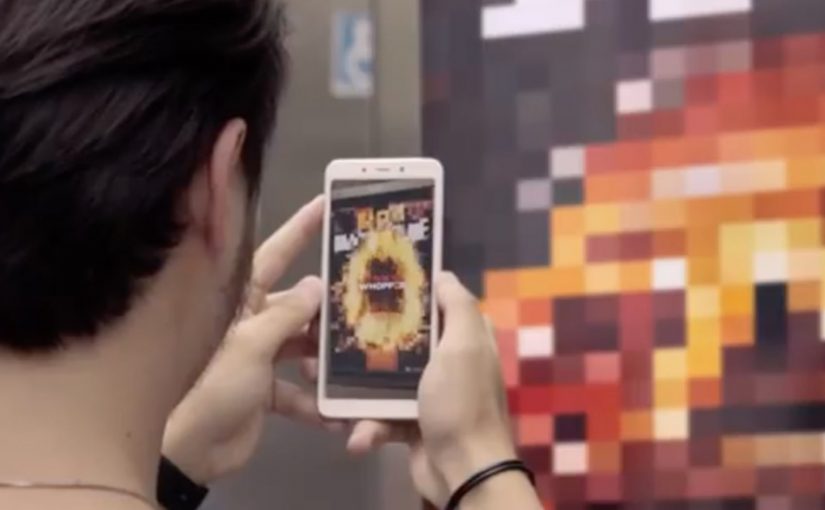
In Brazil, Burger King and ad agency David SP use augmented reality to “burn” competitors’ ads through consumers’ mobile phones. The reward is simple and immediate. Participate, and you earn a free Whopper.

Burger King expects to give away 500,000 Whoppers through the promotion, pushing more people to use Burger King Express, the service that lets customers pre-order food for pickup.

How “Burn that Ad” works

The mechanic turns rival advertising into a trigger. Here, the mechanic is one simple action that immediately returns a coupon reward. You point your phone at a competitor’s ad, the experience “burns” it in AR, and the payoff is a Whopper coupon. It is a direct, product-first incentive tied to a single action.

In quick-service restaurants, where choice is made in seconds, immediate incentives can shift behaviour faster than storytelling.

Why the reward is the strategy

This is not a brand-film play. It is a behavioural exchange. The AR effect is decoration. The engine is the immediate product reward tied to one action. The real question is whether your mechanic creates an immediate, low-friction exchange that makes a new behaviour worth trying. Because the reward is immediate and tied to one action, the AR burn becomes a conversion trigger rather than a gimmick. The customer does something specific in the moment, and Burger King pays them back with something they value immediately. That makes participation scalable beyond the novelty of AR.

Extractable takeaway: If you want people to adopt a new operational path, design a one-step exchange where the reward is immediate, tangible, and triggered by a single action.

The operational goal: Burger King Express

The giveaway is not only about footfall. It is designed to drive adoption of pre-order pickup via Burger King Express. The campaign builds a reason to try the service, not just the product.

What to steal

  • Make competitors the trigger: Turn a competitor’s presence into your acquisition trigger, without relying on complicated steps.
  • Keep it low-friction: Keep the action simple and the reward tangible.
  • Scale an operational behaviour: Link the incentive to an operational behaviour you want to scale, such as pickup pre-order adoption.

A few fast answers before you act

What is “Burn that Ad”?

A Burger King Brazil promotion that uses augmented reality to “burn” competitors’ ads on mobile phones and reward participants with a free Whopper.

What is the incentive?

A free Whopper, delivered via the promotion’s reward mechanic.

How many Whoppers does Burger King plan to give away?

500,000.

What is Burger King Express?

A Burger King service that lets customers pre-order food for pickup.

What business behaviour does it push beyond the giveaway?

Using Burger King Express to pre-order food for pickup.