
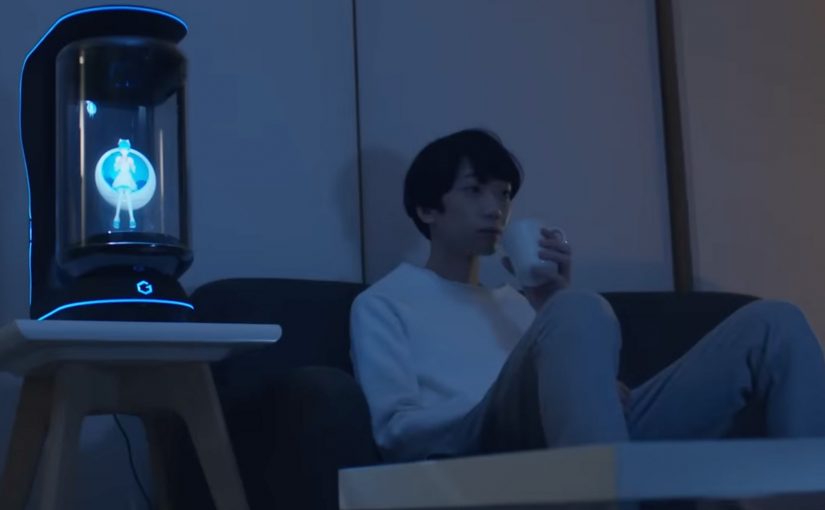
Gatebox: The Virtual Home Robot

You come home after work and someone is waiting for you. Not a speaker. Not a disembodied voice. A character in a glass tube that looks up, recognizes you, and says “welcome back.” She can wake you up in the morning, remind you what you need to do today, and act as a simple control layer for your smart home.

That is the proposition behind Gatebox. It positions itself as a virtual home robot, built around a fully interactive holographic character called Azuma Hikari. The pitch is not only automation. It is companionship plus utility. Face recognition. Voice recognition. Daily routines. Home control. A “presence” that turns a smart home from commands into a relationship.

What makes Gatebox different from Alexa, Siri, and Cortana

Gatebox competes on a different axis than mainstream voice assistants.

Voice assistants typically behave like tools. You ask. They answer. You command. They execute.

Gatebox leans into a different model:

  • Character-first interface. A persistent persona you interact with, not just a voice endpoint.
  • Ambient companionship. It is designed to greet you, nudge you, and keep you company, not only respond on demand.
  • Smart home control as a baseline. Home automation is part of the offer, not the story.

The result is a product that feels less like a speaker and more like a “someone” in the room.

Why the “holographic companion” framing matters

A lot of smart home innovation focuses on features. Gatebox focuses on behavior.

It is designed around everyday moments:

  • waking you up
  • reminding you what to remember
  • welcoming you home
  • keeping a simple loop of interaction alive across the day

That is not just novelty. It is a design bet that people want technology to feel relational, not transactional.

What the product is, in practical terms

At its most basic, Gatebox:

  • controls smart home equipment
  • recognizes your face and your voice
  • runs lightweight daily-life interactions through the Azuma Hikari character

It is currently available for pre-order for Japanese-speaking customers in Japan and the USA, at around $2,600 per unit. For more details, visit gatebox.ai.

The bigger signal for interface design

Gatebox is also a clean case study in where interfaces can go next.

Instead of:

  • screens everywhere
  • apps for everything
  • menus and settings

It bets on:

  • a single persistent companion interface
  • a character that anchors interaction
  • a device that makes “home AI” feel present, not hidden in the cloud

That is an important shift for anyone building consumer interaction models. The interface is not the UI. The interface is the relationship.


A few fast answers before you act

Q: What is Gatebox in one sentence?
A virtual home robot that combines smart home control with a holographic companion character, designed for everyday interaction.

Q: Who is Azuma Hikari?
Gatebox’s first character. A fully interactive holographic girl that acts as the interface for utility and companionship.

Q: What can it do at a basic level?
Control smart home equipment, recognize face and voice, run daily routines like wake-up, reminders, and greetings.

Q: Why compare it to Alexa, Siri, and Cortana?
Because it is positioned as more than a voice assistant. It is a character-first, companion-style interface.

Q: What is the commercial status?
Available for pre-order for Japanese-speaking customers in Japan and the USA, at around $2,600 per unit.
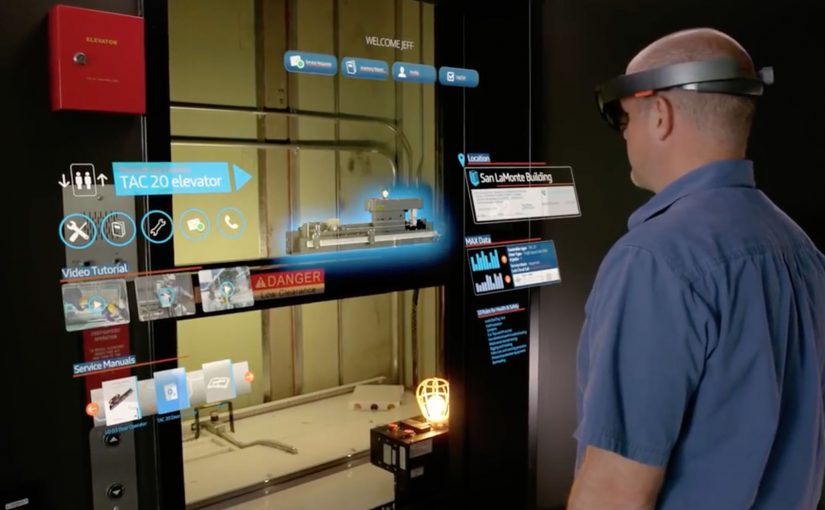
Microsoft HoloLens: Elevator Maintenance

Augmented reality leaves the demo room

Microsoft HoloLens is not only about futuristic consumer experiences. Its real power emerges in enterprise environments.

A strong example is ThyssenKrupp, which uses HoloLens to redefine how elevator maintenance is performed in the field.

Instead of relying on manuals, phone calls, or trial and error, technicians receive contextual, real-time information directly in their line of sight.

How HoloLens changes elevator servicing

With HoloLens, elevator technicians see what they need while keeping their hands free.

Technical documentation, schematics, and checklists appear as holograms overlaid onto the physical elevator system.

Remote experts can see exactly what the technician sees and guide them step by step.

This turns maintenance into a guided, collaborative process rather than an isolated task.

Why this matters for industrial operations

The impact goes beyond convenience.

  • Reduced downtime
  • Shorter training cycles
  • Improved first-time fix rates

Most importantly, expertise becomes scalable.

Knowledge is no longer locked in the heads of a few specialists. It becomes part of the workflow.

A glimpse of the future of work

This use case shows what augmented reality does best.

It does not replace workers. It augments them.

Complex tasks become easier. Errors decrease. Confidence increases. Work becomes safer and more efficient.

This is where mixed reality stops being a novelty and starts being infrastructure.


A few fast answers before you act

What is the Microsoft HoloLens elevator maintenance use case?

ThyssenKrupp uses Microsoft HoloLens so field technicians can see schematics, checklists, and contextual guidance overlaid onto the elevator system while working hands-free.

How does HoloLens change the maintenance workflow?

It puts documentation and step-by-step instructions into the technician’s line of sight, and enables remote experts to see what the technician sees so they can guide the job in real time.

Is this only relevant for elevators?

No. The same pattern applies to any field service or industrial maintenance scenario where hands-free guidance, fast troubleshooting, and expert escalation reduce downtime and errors.

What is the measurable value driver in enterprise AR like this?

Reduced downtime, faster training, and higher first-time fix rates. The key is that expertise becomes repeatable and scalable inside the workflow instead of remaining locked in a few specialists.

100% Real Virtual Reality

A passerby in Tbilisi puts on a VR headset and starts touring Ireland. Irish countryside. The streets of Dublin. A traditional Irish bar. Then the headset comes off, and the “virtual” bar is suddenly real. A pop-up pub has been built around them in seconds, complete with actors and Irish stereotypes, and beer in hand. The reveal does not explain the slogan. It makes the slogan unavoidable.

The idea in one line

Use virtual reality as misdirection, then land the brand promise by turning the “virtual” experience into a physical surprise.

What happens in the stunt

Old Irish is a new craft beer entering Georgia. Leavingstone takes a line that could sound like every other beer claim, “100% real,” and makes it literal.

  1. Invite the public into VR
    People on the streets of Tbilisi are offered a VR “tour of Ireland,” including nature, Dublin streets, and a typical Irish bar.
  2. Build the punchline in real life
    While they are inside VR, a crew builds a pop-up Irish bar around them. The space is filled with actors performing how locals imagine Ireland.
  3. Reveal the brand promise as a lived moment
    The moment the headset comes off, the audience is already “in Ireland,” except it is physically there, and the product is part of the scene.

Why this works

Beer marketing often tries to borrow authenticity through language. This one manufactures it through experience.

The proof is theatrical, but the reaction is real

The campaign bets on ordinary people’s genuine surprise. That reaction becomes the content people want to share.

VR is not the product. VR is the setup

Virtual reality is used as a temporary attention lock so the physical transformation can happen without explanation. The innovation is the transition, not the headset.

The brand promise is delivered in one clean, repeatable beat

“100% real” is not argued. It is demonstrated when the environment jumps from virtual to physical.

Results the agency reports

Leavingstone states the video is posted with a modest placement budget, reaches more than 50% of internet users in Georgia, hits 1 million views in 72 hours, and is followed by first-month sales of 515,698 liters, described as 2x.

The deeper point

When a category leans heavily on claimed authenticity, the advantage goes to the brand that can turn authenticity into an event. This is not “VR marketing.” It is live communication disguised as emerging technology.


A few fast answers before you act

What is the core mechanic?

A VR tour of Ireland distracts participants while a real pop-up Irish bar is built around them, so the reveal converts “virtual” into physical.

Why use VR at all?

It creates a believable reason to pause someone in public, and it buys time to build the physical environment unnoticed.

What makes it shareable?

The surprise is immediate, visual, and human. Ordinary people’s reactions are the story engine.

What is the transferable pattern?

Use an emerging-tech interface as a controlled setup, then deliver the brand promise through a physical, social payoff people can experience together.

What is the biggest risk?

If the reveal does not map cleanly to the product truth, the stunt becomes spectacle with no belief gain.