
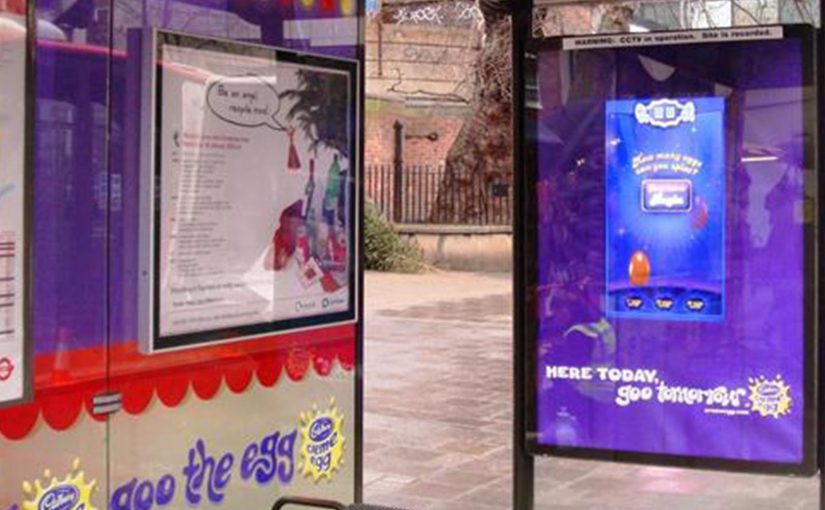
Cadbury Creme Egg: Egg-Splatting Bus Stands

Turning bus-stop boredom into a reason to play

Only available from New Year’s Day to Easter Day, the Cadbury Creme Egg is one of the best selling confections in the U.S., Canada, and the United Kingdom.

In a bid to boost Creme Egg sales in the lead-up to Easter, Cadbury’s has come up with some really unique bus shelter ideas in the UK.

Waiting for a bus is boring. Now though, you can fill this time by playing Cadbury’s first ever interactive outdoor game called Splat the Egg.

How the idea works: time, place, and a simple interaction loop

The mechanism is classic context hijack. By “context hijack”, I mean using the place’s existing purpose and dwell time as the trigger for a simple action. You take a moment with unavoidable waiting, add a clear instruction, and reward participation with a small burst of fun. The shelter becomes the interface, and the product becomes the “game object”. Because the action is legible and the payoff is immediate, people can join in without needing a long explanation.

In European FMCG launches with seasonal availability, interactive out-of-home can act as both reminder and recruiting surface, converting passive footfall into active brand experience.

Why it lands: it gives the viewer control over the medium

It works because it reframes waiting as choice. Instead of being stuck, you get something to do. And once one person starts, the social proof pulls in the next. A bus stop is already a small crowd. The game turns it into a moment people watch and talk about. The real question is whether your out-of-home placement gives people something to do, not just something to read. Interactive out-of-home should earn attention by turning waiting into play, not by piling on more claims.

Extractable takeaway: If your medium comes with unavoidable dwell time, build a two-second, self-explanatory action that rewards participation and makes spectators part of the experience.

The business intent: make seasonal scarcity feel like an event

Creme Egg’s limited availability is built for anticipation. This activation makes that anticipation physical. It pushes mental availability ahead of Easter and ties the product to a playful ritual rather than just a purchase.

A neat extension for people who cannot try it in person

Is this the future of advertising. Every lamp post and bus shelter calling out to be stroked, touched or hit?

For those who won’t have the chance to experience the real thing. You can have a go at the online version at www.cremeegg.co.uk/greateggscape/.
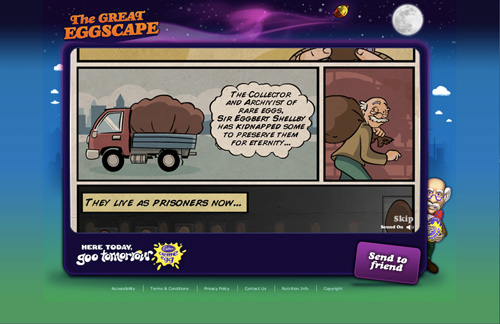
The Great Eggscape

What to steal for interactive out-of-home without overbuilding it

  • Exploit dwell time. Bus stops, queues, and waiting areas are built-in attention pockets.
  • Keep the interaction legible in two seconds. If it takes explanation, it will not scale in the street.
  • Design for spectators as well as players. The crowd is part of the distribution.
  • Connect the physical to an accessible fallback. An online version extends reach beyond the locations.

A few fast answers before you act

What is Cadbury’s “Splat the Egg” bus shelter idea?

An interactive out-of-home activation that turns a bus shelter into a playable game, letting people waiting for a bus engage with a Creme Egg-themed experience.

Why choose bus shelters for an interactive campaign?

Because they come with natural dwell time. People are already waiting, so the activation converts idle minutes into engagement without asking for extra effort.

What is the core mechanism?

Context hijack plus a simple interaction loop. A clear instruction turns a waiting moment into a quick burst of fun, and the shelter becomes the interface.

What is the business goal behind this activation?

To build anticipation for a seasonal product and tie scarcity to a playful ritual that increases mental availability ahead of Easter.

What is the most transferable takeaway?

Build simple viewer control into the medium at moments of forced waiting, and design for spectators as well as participants so the crowd becomes distribution.

Eichborn: Flyvertising at the Frankfurt Book Fair

Jung von Matt just redefined advertising for their client Eichborn at the Frankfurt Book Fair by attaching tiny banners to 200 flies and setting them loose as miniature “sky ads” around the halls. The idea was coined Flyvertising, or “Fliegenbanner”.

A stunt that makes the logo literal

Eichborn’s brand mark is a fly. So instead of printing the fly on a poster and hoping people notice, the campaign turns the fly into the medium and lets it wander through the crowd, uninvited, and impossible to fully ignore.

The weight of the banner itself, attached with a string and some sticky stuff that allowed it to eventually fall off without harming the fly, was so that the fly could fly with it, but not very high and they kept landing on visitors.

How Flyvertising works

The execution uses ultralight banners attached with a string and a sticky material described as designed to let the banner fall off later without harming the fly. The extra weight keeps the insects from flying high, which means they repeatedly land on visitors and surfaces. In a crowded fair, that turns a wandering fly into a moving pointer that creates attention and helps people find the Eichborn stand.

In European trade-show marketing, a stunt wins when it turns wayfinding into a story people cannot ignore in a crowded hall.

Why this lands

The campaign exploits a simple truth about exhibitions. People are overloaded with signage and trained to filter it out, but an interruption that breaks the “expected media” pattern cuts through instantly. Here, the interruption also feels on-brand, because the fly is not a random prop. It is the identity asset brought to life.

Extractable takeaway: If your brand owns a distinctive symbol, find a way to make that symbol behave like media in the real environment where attention is hardest to earn, and let the medium carry the message.

What Eichborn is really buying

The real question is whether a trade-show stunt can turn a hard-to-find stand into the story people repeat across the hall. This is smart exhibition marketing because it fuses wayfinding with a brand asset people will talk about. This is not about explaining a book list. It is about generating foot traffic, conversation, and memorability around a stand number in a hall full of publishers. The flies do the work of a promoter, and the story spreads faster than any brochure.

What to steal for your next event activation

  • Let the identity asset drive the idea. The closer the stunt is to the brand symbol, the less it feels like random noise.
  • Design for physical proximity. A trade show is won at arm’s length. Make the experience land close enough to be felt.
  • Build a “tellable” moment. If a visitor can summarize it in one sentence, it travels through the venue for you.
  • Plan the ethics and the optics. If living things are involved, the “no harm” claim needs to be credible and easy to defend.

A few fast answers before you act

What is Flyvertising?

Flyvertising is an ambient trade-show stunt where Eichborn released flies carrying ultralight mini-banners, turning the insects into moving ads that drew attention and guided visitors toward the publisher’s stand.

Why does this kind of “living media” cut through at exhibitions?

Because visitors are conditioned to ignore static signage. A moving, unpredictable interruption breaks that filter, especially when it happens in personal space.

What makes it feel on-brand rather than a generic stunt?

Eichborn’s identity includes a fly, so the medium directly expresses the brand symbol. That alignment makes the execution easier to remember and retell.

What is the transferable principle behind Flyvertising?

The transferable move is to turn a brand-owned symbol into the delivery system for attention in the exact environment where people normally ignore messages.

What are the risks with this pattern?

Ethics, hygiene perception, and venue rules. If people feel the stunt is harmful or unhygienic, the attention flips from curiosity to backlash.

Vodafone NZ: 1000 phones, 53 ringtones, 1 song

When “viral” requires real engineering

To create a viral video these days, you need to do something great and unique. Vodafone NZ hired a production team to orchestrate cellphones into “playing” Tchaikovsky’s 1812 Overture.

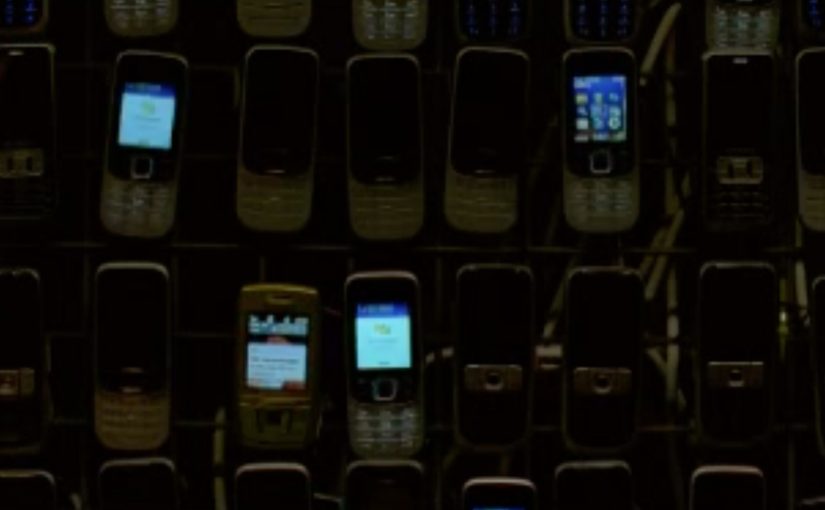
This was done using 1000 phones and 53 different ringtone alerts, synchronized to recreate the classical piece.

How 1000 phones became an orchestra

The mechanism was constraint-driven composition.

Instead of instruments, the “sound palette” was a fixed set of ringtone alerts. The team then arranged phones like sections in an orchestra and synchronized their playback so the combined output recreated the music.

What makes this work on camera is that you can see the system. Rows of devices. Repetition at scale. A human-built machine producing a familiar piece.

In global telecom marketing, the most shareable films often work because the effort is visible.

Why the idea lands with viewers

It lands because it is both absurd and precise, and the visible synchronization lets the viewer sense the complexity without needing the full production process.

Extractable takeaway: When the constraint is instantly legible and the build is visibly real, the craft becomes the hook that earns attention and sharing.

It also bridges cultures. Highbrow music meets everyday tech, creating an unexpected contrast that feels fresh instead of forced.

The business intent behind the ringtone orchestra

The intent was to associate Vodafone with coordination, scale, and modern connectivity, without having to say those words.

The real question is whether your “viral” idea would still be interesting if the camera had to capture a real system doing the work.

This is the right kind of brand film for a telco. It shows coordination and connectivity instead of claiming it.

Steal this pattern from the ringtone orchestra

  • Make effort visible. When the craft can be seen, viewers reward it with attention and sharing.
  • Use a constraint as the hook. “Only ringtones” creates a clear challenge people instantly understand.
  • Engineer a spectacle that reads in one frame. Scale should be obvious without explanation.
  • Let the metaphor do the branding. Show coordination and connectivity instead of claiming it.

If you like the resulting tune, you can download it to your computer, as well as the 53 ringtones used to create it, from www.vodafone.co.nz/symphonia.


A few fast answers before you act

What did Vodafone NZ create?

A film where 1000 mobile phones, using 53 different ringtone alerts, were synchronized to perform Tchaikovsky’s 1812 Overture.

What is the core mechanism?

Constraint-driven composition. A fixed set of ringtone sounds becomes the “instrument set”, and synchronization plus physical arrangement makes the system readable on camera.

Why does it work as shareable content?

The effort is visible. The scale reads instantly, and the contrast between classical music and ringtones creates a surprising but coherent hook.

What business goal does this support for a telco brand?

It turns “connectivity at scale” into a watchable metaphor. Many devices acting as one becomes an entertaining proof of coordination and network promise.

What is the most transferable takeaway?

If you can make the constraint and the craft legible in one frame, the build itself becomes the reason people share.