
LG: My Wife Smashed My TV

LG: My Wife Smashed My TV

A husband walks in the door, does what he always does, and reaches for the TV. This time, his wife beats him to it, smashing the set in front of him.

LG takes that familiar “couch potato” tension and turns it into a candid-camera series. Five households are set up with hidden cameras while the men are away at work. When they return, the TV gets destroyed, and the immediate reactions are captured on film. The footage becomes five viral videos that were reported to reach over 200,000 views on Flix, described as a leading video host in Israel.

The stunt mechanic

The mechanic is a controlled, in-home prank with a single, irreversible trigger. The TV is smashed in real time, the reaction is the content, and the series format multiplies the shareable moments across multiple “types” of husband responses.

In consumer electronics marketing, tapping into a real household ritual can make a product story travel further than feature claims because it feels like lived culture, not advertising.

Why it lands

The idea works because it is instantly legible. Everyone understands the setup in one second, and the shock produces unscripted emotion. The campaign also benefits from a simple moral frame. The TV is the symbol of the habit, so breaking it reads like breaking the routine. That makes each clip feel like a punchline people can retell without context.

Extractable takeaway: If your category is part of a daily habit, build the story around the habit itself, and let genuine reactions do the persuasion work that scripted messaging usually struggles to earn.

What LG is really buying

The real question is whether surprise can turn a familiar domestic ritual into a brand story people want to retell. LG is buying talkability here, not just views. It inserts LG into a domestic conversation about screen time and routines, then uses surprise and authenticity to earn distribution on platforms where polished product films are easy to ignore.

Takeaways from LG’s reaction-led stunt

  • Use a single clear trigger. One decisive moment creates an easy hook and a clean thumbnail narrative.
  • Design for repeatability. A series lets you capture variation, not just one lucky reaction.
  • Keep the framing simple. The fewer moving parts, the more credible the reactions feel.
  • Plan the ethical boundaries early. Surprise can work, but only if consent, safety, and aftercare are treated as part of the production, not an afterthought.

A few fast answers before you act

What is “My Wife Smashed My TV”?

A candid-camera series where wives smash their husbands’ TVs when they come home, capturing authentic reactions and packaging them as viral clips.

Why does the idea spread so easily?

Because the setup is universal and the payoff is immediate. The audience understands the relationship dynamic instantly, then watches the unscripted reaction.

What did the campaign claim as a result?

The legacy write-up reports over 200,000 views on Flix for the set of videos.

What is the main risk with prank-based advertising?

If it feels cruel, unsafe, or non-consensual, the attention flips into backlash and the brand becomes the villain of the story.

When is a reaction-led format a good fit?

When your message can be carried by a recognizable everyday situation, and the emotional response communicates the point better than exposition.
Gesture Sharing using Microsoft Surface

Gesture Sharing using Microsoft Surface

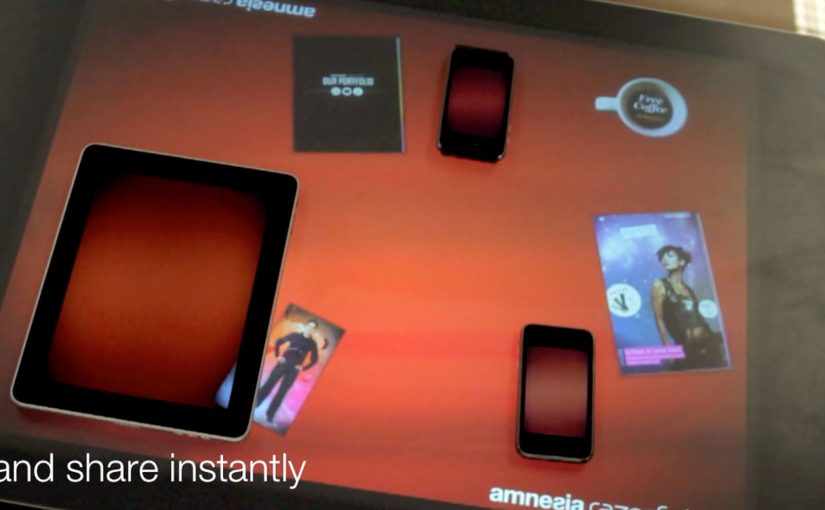
You place two iPhones and an iPad around a Microsoft Surface table. With a single gesture, a photo slides off one device, travels across the tabletop, and drops into another device. The transfer is instant, and the UI makes it feel like content is physically moving between screens.

Amnesia Razorfish is back in the news with the launch of Amnesia Connect. It is software that enables instant, seamless sharing and transfer of content, including photos, music, and embedded apps, between multiple handheld devices using a Microsoft Surface table and a single gesture. Here, gesture sharing means a swipe across the Surface table that triggers a direct handoff of content between nearby devices.

How the “single gesture” illusion works

In the moment, the Surface table connects devices over WiFi and shares in real time. The table tracks each object’s position, so the visual effect stays locked to the device placement. Because the visuals stay locked to each device’s position, the transfer feels credible rather than arbitrary. Content appears to move in and out of the iPad and iPhone exactly where they sit on the table.

What is supported right now, and what comes next

The software works with Apple iOS devices, and it is being developed to work with Android, Windows Phone, and BlackBerry smartphones. The concept scales anywhere multiple devices need to share quickly without cables, menus, or friction. In multi-device brand experiences, that matters because several people can understand the transfer at the same time.

Why brands care about gesture-based sharing

As smartphones become omnipresent, this kind of interaction opens a different design space for brand experiences. The strongest part of the idea is not the transfer alone, but the way it turns sharing into something people can instantly see and understand together. The real question is not whether the table can pass content between devices, but whether the brand can make that transfer feel natural, social, and self-explanatory. The business value is that the interaction demonstrates the benefit in public, instead of relying on explanation.

Extractable takeaway: When a digital action is turned into a visible group moment, the brand does less explaining and the product benefit becomes easier to grasp.

What to steal for multi-device sharing

  • Make “sharing” visible. If content looks like it physically moves between screens, people immediately understand what happened.
  • Remove menus from the core action. The gesture should be the transfer, not a shortcut to a dialog box.
  • Use spatial consistency as the magic trick. When the UI stays locked to where devices sit, the illusion feels real.
  • Design for group participation. Multi-device interactions work best when they create a moment people can do together, in plain sight.

A few fast answers before you act

What is gesture sharing in a multi-device experience?

Gesture sharing is when users move content between devices through physical gestures, like swiping an item from one screen to another, rather than using menus, Bluetooth pairing, or file dialogs.

How does a Microsoft Surface table enable this?

The table tracks where devices sit and aligns the interface to that physical layout. It also supports real-time connectivity so content can transfer while the visuals stay spatially consistent.

What makes this feel “seamless” to users?

The key is removing steps. No selecting recipients, no attaching files, no waiting screens. The motion itself becomes the transfer, and the UI reinforces that mental model.

Why is this stronger than a normal send flow?

A normal send flow hides the action inside menus and confirmations. This pattern makes the transfer visible, immediate, and shared, so people understand both the feature and the benefit at a glance.

Where can brands apply this pattern?

Anywhere shared exploration matters. Retail demonstrations, event installations, collaborative product discovery, and multi-screen storytelling all benefit when “sharing” becomes a visible group interaction.

Toyota: A Glass of Water

Toyota: A Glass of Water

A Glass of Water is a challenge created by Saatchi & Saatchi Stockholm for Toyota in Sweden. Its mission is to help drivers cut down their fuel consumption by 10% and reduce CO2 emissions, aligned with Toyota’s stated zero-emission vision.

When drivers register on the program website, they accept the challenge to place a glass of water on their dashboard or cup holder, then drive in a smooth manner that avoids spillage.

According to Toyota, the less you spill, the gentler you drive. Therefore the less fuel you consume.

A rule you can test on your next drive

The brilliance is the simplicity. No special car, no expert coaching, no complicated scorecard. Just a physical feedback loop that makes every harsh brake and every aggressive turn visible in the most basic way possible.

How the mechanism teaches eco-driving

Spilling is the metric. If you keep the water steady, you are accelerating, braking, and cornering more smoothly. That smoother style tends to reduce wasteful energy spikes, which is the same principle behind most eco-driving advice, translated into something you can feel immediately.

In European automotive marketing, behavior-change challenges work best when the rule is simple enough to try on the next drive.

Why it lands

It turns an abstract goal. “reduce fuel consumption”. into a personal game with instant feedback. The glass makes you self-correct without being told what to do, and it makes eco-driving feel like mastery rather than sacrifice. It also travels well as a story because anyone can explain it in one sentence.

Extractable takeaway: If you want people to change a daily behavior, give them a physical, low-effort indicator that converts “doing better” into a visible result they can improve on.

What Toyota is really buying

This is not just awareness. It is repeatable participation. Each drive becomes a new attempt, and each attempt reinforces the brand’s association with smarter, calmer driving rather than with lecturing about emissions.

The real question is how to make smoother driving feel self-evident and repeatable, not how to explain eco-driving more forcefully.

What to steal from the water-glass challenge

  • Use a single, legible metric. Spills are binary and instantly understood.
  • Make the feedback loop physical. Physical cues outperform abstract dashboards for habit shifts.
  • Lower the start barrier to almost zero. If people can start today, they will.
  • Turn restraint into skill. People adopt habits faster when it feels like competence.

A few fast answers before you act

What is A Glass of Water?

A driving challenge where you place a glass of water on the dashboard or cup holder and try to drive smoothly enough not to spill, as a proxy for reducing fuel consumption.

Why does “not spilling” relate to fuel savings?

Because avoiding spills requires gentler acceleration, braking, and cornering. That smoother driving style tends to reduce inefficient energy spikes.

What makes this different from typical eco-driving advice?

It replaces instructions with immediate feedback. The glass shows you how you are driving without needing an expert or a complex display.

What is the biggest risk with this kind of challenge?

If people treat it as a stunt rather than a habit tool, the effect fades quickly. The challenge needs repetition to translate into lasting driving style change.

How should a brand measure success for a behavior challenge like this?

Participation volume, repeat participation, and any measured or self-reported fuel consumption improvement among participants, not only views or clicks.