
Faktum Hotels: Book a Night Outside

Faktum Hotels: Book a Night Outside

Gothenburg in Sweden is reported to have about 3,400 homeless people. Most find a roof over their heads with a friend or at a refuge, but some even sleep in the open air.

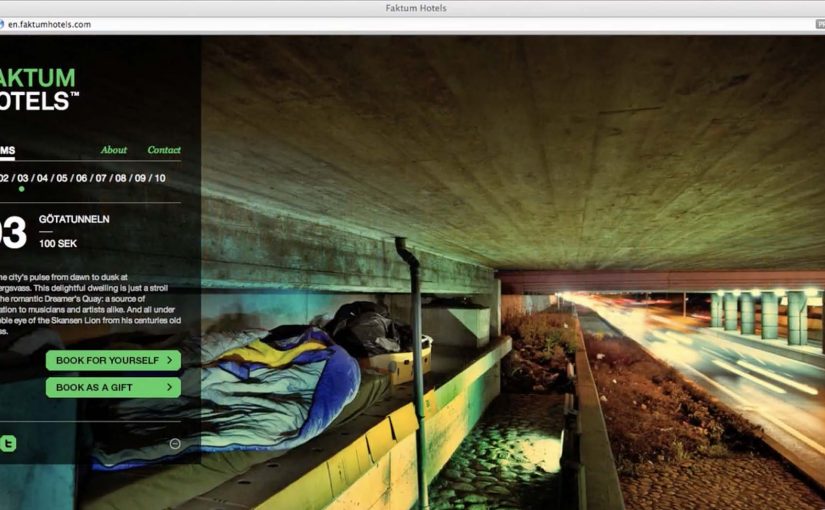
So in a charity campaign that tries to harness the spirit of giving and consideration, Forsman & Bodenfors chose ten places where people might spend the night and made it possible for any one of us to book them, just like any hotel. All the money raised through this www.faktumhotels.com project is then directed towards Faktum’s work for the homeless.

A hotel with no walls

The mechanism is brutally literal. Take locations that are normally ignored, photograph them like “rooms”, write the descriptions in the familiar language of travel booking, and put a price on the night. The booking flow becomes the donation flow, and the “inventory” is a list of public places that should not be inventory at all.

In European cities, social impact campaigns often struggle to turn sympathy into a concrete action that is simple, immediate, and shareable.

Why the idea hits so quickly

It works because it steals a format people trust. A hotel booking interface is a comfort ritual, full of predictable signals. Then it swaps the comfort for cold reality. That contrast creates instant moral clarity without a lecture, and it invites action without asking people to research charities or navigate guilt.

Extractable takeaway: When awareness is not the problem but inertia is, borrow a mainstream interface people already know, and map your desired behaviour onto it. Reduce the action to one familiar choice and one familiar transaction.

What the “booking” really means

Because these are public places, the booking is best understood as symbolic support, not a guaranteed reservation. In this case, symbolic support means paying to fund Faktum’s work, not claiming the place for personal use. The point is not to encourage tourism-by-hardship. The point is to make the hidden visible, and to route money to Faktum’s work through a frictionless, culturally legible mechanic.

The real question is how to turn a familiar commercial action into an ethical act of support without diluting the reality behind it.

This is not about selling the experience of homelessness. It is about converting recognition into support.

Proof, not a promise

The concept is also a craft statement. The photography and the deadpan hotel language do the persuasion work. The campaign received major industry recognition, including a Guldägg and a One Show Gold Pencil for its craft, which underlines how well the execution carries the idea.

What to steal from the booking mechanic

  • Hijack a trusted format. Use an interface or ritual your audience already understands, then subvert it with purpose.
  • Make the donation feel like a normal purchase. Familiar steps reduce hesitation and increase completion.
  • Let craft do the arguing. Straight photography and restrained copy can outperform emotive pleas when the concept is strong.
  • Design for sharing without adding share buttons. If the mechanic is surprising, people share it naturally.

A few fast answers before you act

What is Faktum Hotels?

It is a fundraising concept that presents outdoor sleeping locations as “hotel rooms” you can book online. The payment functions as a donation to support Faktum’s work related to homelessness.

Why use a hotel booking mechanic?

Because it is familiar and low-friction. The contrast between a comfortable interface and uncomfortable reality creates attention and makes the next step obvious.

Is the booking a real reservation?

No. The locations are public, so the booking is best treated as symbolic support rather than a guaranteed spot.

Who created the campaign?

It was created for Faktum with Forsman & Bodenfors credited as the agency behind the idea and execution.

What is the transferable lesson for other causes?

Turn support into a simple, recognisable transaction. Borrow a mainstream choice model, then route the payment directly into impact.
Canadian Tire: Christmas Spirit Tree

Canadian Tire: Christmas Spirit Tree

Canadian Tire wanted to re-energize Christmas spirit and reinforce its position as Canada’s leading Christmas store. So they built a public symbol of the season that behaves like a live dashboard for holiday cheer.

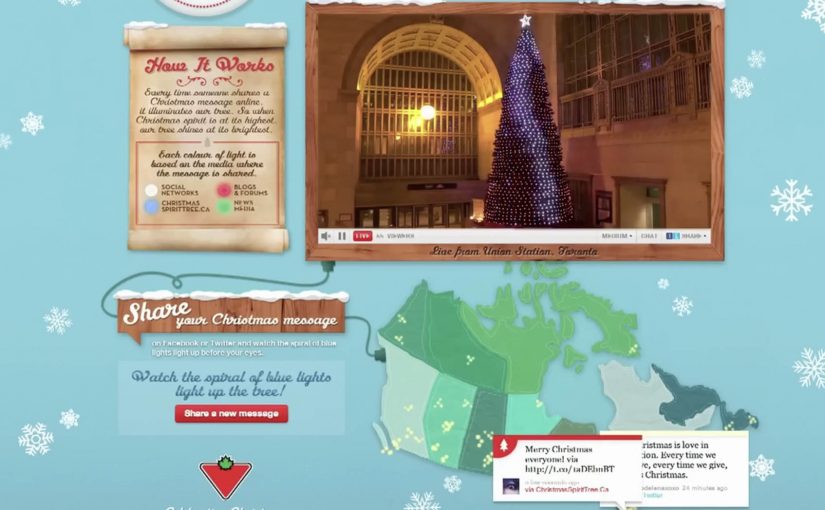
The result was a 30-foot Christmas tree wrapped with 3,000 individually programmed LED lights, powered by the nation’s collective online Christmas spirit. Social monitoring tools scanned blogs, forums, social networks, and news sites for Christmas keywords, then software translated that data into real-time light patterns on the tree.

Turning sentiment into a light show

The mechanic is a clean loop. Capture real-world language at scale. Reduce it to signals a system can interpret. Visualize those signals instantly as a physical experience people can gather around. That translation layer is the whole idea, because it makes something intangible, “spirit”, visible and shared. Here, the translation layer is the software bridge that converts online holiday language into visible light behavior.

In large-scale retail brands, public installations like this can turn social chatter into a measurable, collective ritual that reinforces seasonal ownership.

Why it lands

It gives people a role that feels meaningful without feeling like work. You do not have to download an app or learn a new behavior. You just post a message the way you already would, and the tree responds. That cause-and-effect is what makes the story travel, because the installation feels like it is listening, not just broadcasting.

Extractable takeaway: If you want “community” to feel real, build a visible feedback loop where everyday audience behavior directly changes a shared public object. Then make the transformation obvious enough that people can connect their action to the outcome.

What the campaign is really optimizing for

The objective is not only brand warmth. It is reclaiming seasonal leadership by creating a national-scale proof point that Canadian Tire can own, film, and redistribute. The real question is how to make seasonal sentiment visible in a way only Canadian Tire can own. The tree becomes a repeatable centerpiece for earned media, social sharing, and store association without having to lead with price.

What to steal for your own seasonal playbook

  • Make the idea self-explanatory. “Messages make lights” is a one-sentence mechanic people can repeat.
  • Turn digital into physical. Physical experiences feel more “real” than dashboards or microsites, even when the inputs are purely online.
  • Design for spectators and participants. The best public work rewards both the person who posts and the person who just watches.
  • Build a content engine. If the installation produces fresh patterns continuously, you get ongoing footage and reasons to talk about it.

A few fast answers before you act

What is the core idea of the Christmas Spirit Tree?

A large LED Christmas tree that lights up in response to holiday messages detected online, turning seasonal sentiment into a live public experience.

Why use social monitoring as the “power source”?

Because it makes the audience feel like the energy behind the display. The installation becomes a collective mirror, not a one-way broadcast.

What makes this more effective than a standard Christmas film?

The live feedback loop. People can influence the outcome, and that influence creates participation, talk value, and repeat attention.

Why does the physical tree matter more than a digital counter?

Because a public object turns online sentiment into something people can gather around, film, and talk about. The physical response makes the mechanism feel shared rather than abstract.

What is the biggest execution risk?

If the response feels delayed, random, or unconnected to real posts, the magic breaks. The system must feel immediate and believable.

Denon VisYOUalizer: feel the music

Denon VisYOUalizer: feel the music

Denon wants to bring to life the idea that with its line of lifestyle headphones you do not just hear the music, you feel it. So BBDO New York, described alongside Jam3 in production write-ups, creates an engaging experience for younger audiences who are not yet familiar with Denon’s long-running audio heritage.

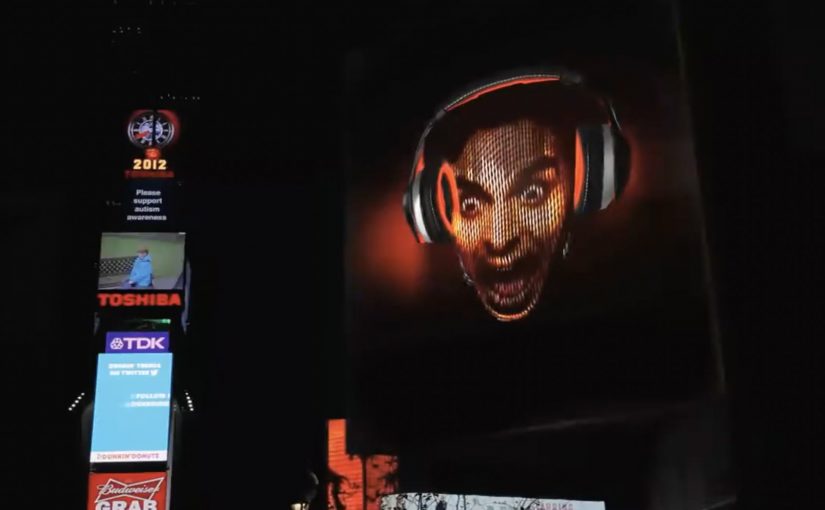
A Denon VisYOUalizer app is created that lets people try on the headphones virtually and turn their faces into a dynamic, customized music visualizer.

How the VisYOUalizer turns “sound” into something you can see

The mechanic is simple. Your face becomes the canvas, the music becomes the driver. You line up to a camera, the headphones snap into place virtually, and the experience maps a moving visual layer to your expression and the track’s energy. Because the visual layer responds in real time to both the track and your expression, the “feel it” promise reads as proof rather than copy.

In consumer electronics and lifestyle brands, face-based interactivity works best when the visual payoff is immediate and the product benefit is embodied rather than explained.

Why it lands for a younger audience

Headphone marketing often leans on specs, heritage, or famous musicians. This goes the other way. It starts with play and self-expression, then backfills the brand story through the experience and its share value. The real question is whether you can make an intangible promise visible enough that people want to play with it before they care who you are. When awareness is the constraint, a participatory demo beats a spec-led pitch.

Extractable takeaway: If your benefit is sensory or emotional, make the user’s own face or movement the proof, and deliver the payoff before you ask for attention to the brand story.

That matters when awareness is the real problem. If people do not know Denon, a participatory demo can earn attention faster than a product film.

What the brand is really doing here

This is a virtual try-on wrapped around a music visualizer. The try-on makes the product tangible. The visualizer makes the “feel it” claim legible. And the combination gives Denon an interaction that people can show to friends without needing to explain anything.

Steal this for your next “feel it” product idea

  • Turn an abstract benefit into a visible response. If “feel” is the promise, show a reaction that moves with the input.
  • Make the first 10 seconds rewarding. The hook should work before anyone reads instructions.
  • Use virtual try-on as the entry point. It lowers friction because people already know what to do.
  • Let personalization do the marketing. When people see themselves in the output, they are more likely to share.

A few fast answers before you act

What is the Denon VisYOUalizer?

It is a face-based interactive experience that lets you virtually try on Denon lifestyle headphones and transforms your face into a music-driven visualizer.

What product message is it designed to prove?

It translates “you do not just hear the music, you feel it” into a visual reaction that changes in real time with the sound and the participant’s presence.

Why combine a visualizer with a virtual try-on?

The try-on makes the product concrete and recognizable on your face, while the visualizer supplies the emotional payoff that makes people stick around and share.

What do you measure to judge success?

Time spent, completion rate, share rate, repeat plays, and click-through to product pages are more meaningful than raw impressions for an experience like this.

What is the biggest failure mode for this format?

If the camera alignment is finicky or the output looks generic, people bounce fast. The experience needs instant feedback and obvious personalization.