
FRANK Oslo: Giuliani 9/11 Tweets

FRANK Oslo: Giuliani 9/11 Tweets

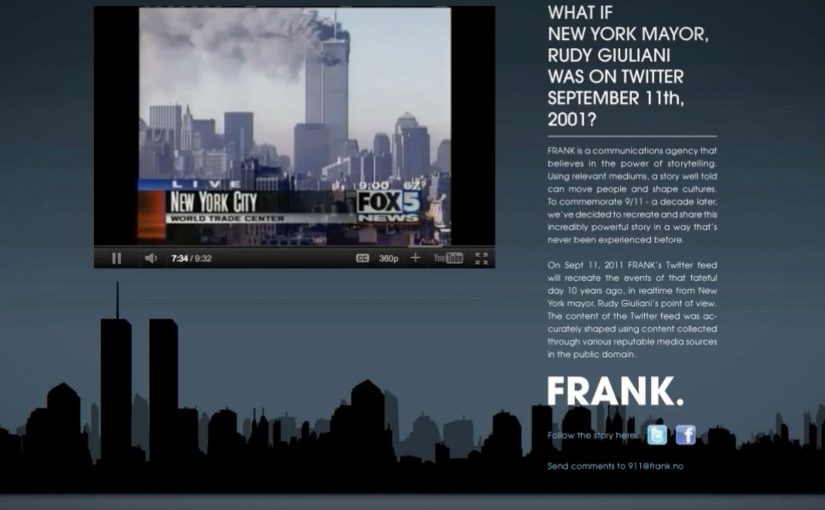
You follow a Twitter feed as if it is happening now. Updates arrive minute by minute, building confusion into urgency, then urgency into shock. The feed is written from New York mayor Rudy Giuliani’s point of view, and it recreates September 11, 2001 in real time.

FRANK is a communications agency from Oslo that wants to demonstrate the power of storytelling through the right medium. To commemorate 9/11 a decade later, they recreate and share the day as a live social stream experience.

On September 11, 2011, FRANK’s Twitter feed recreated the events of that day ten years earlier in real time from Giuliani’s point of view. The feed is described as being shaped using content collected from reputable public-domain media sources.

Real-time remembrance as a platform-native documentary

The mechanism is simple and specific. A single account publishes a paced sequence of posts that map to the original timeline, written in a constrained perspective, so the audience experiences the narrative in the same format they use for breaking news.

Here, platform-native means the story is built for the feed itself, not merely promoted through it.

In crisis and remembrance communications, real-time formats can make historical events feel immediate without changing the facts.

Why it lands

The power is in the temporal constraint. Real-time pacing prevents the viewer from jumping to the ending, which recreates uncertainty and heightens attention. The Giuliani viewpoint acts as a narrative spine, giving the stream a human decision-maker and a consistent voice, rather than a collage of headlines. It is a reminder that storytelling is not only what you tell, but also how you sequence it and where you let people experience it.

Extractable takeaway: If you want audiences to feel the weight of a known story, constrain the format. Pick one viewpoint, match the original timeline, and let pacing do what exposition cannot.

What the campaign is really doing

This is a proof of medium choice. The real question is whether the medium can carry remembrance with the same urgency as the original news cycle. Twitter is not used as a promotion channel. It is used as the container for the story. The campaign demonstrates that a platform-native structure can increase empathy and attention for complex events, while staying grounded in documented reporting.

What to steal from this real-time storytelling pattern

  • Choose one perspective. A single viewpoint makes large events navigable and coherent.
  • Use timing as a creative constraint. Real-time sequencing creates tension and attention without additional production.
  • Build credibility into the sourcing. If you rely on archival material, describe your source discipline clearly.
  • Match story to medium. The most persuasive channel is sometimes the format people already trust for “live” information.

A few fast answers before you act

What is FRANK Oslo’s “Giuliani 9/11” idea?

A real-time Twitter reconstruction of September 11, 2001 from Rudy Giuliani’s viewpoint, published ten years later to let audiences experience the timeline through a live-feed format.

Why use Twitter instead of a film or article?

Because the platform format is the point. A feed is how people experience unfolding events, so the campaign uses that native behavior to recreate pacing and uncertainty.

How does the single viewpoint help?

It creates narrative continuity. Viewers follow one decision-making perspective rather than switching between fragmented sources.

What is the main credibility requirement for this pattern?

Source discipline. If you claim accuracy, you need a clear method for selecting, verifying, and sequencing archival material.

When should you use real-time reconstruction?

When the goal is remembrance, education, or empathy, and when pacing and sequence are essential to understanding the human experience of the event.
SNS Bank: I Want Interest on My Current Account

SNS Bank: I Want Interest on My Current Account

SNS Bank promotes a simple product shift. Paying interest on a normal current account. Instead of leading with rates and fine print, the work frames it as something worth protesting for.

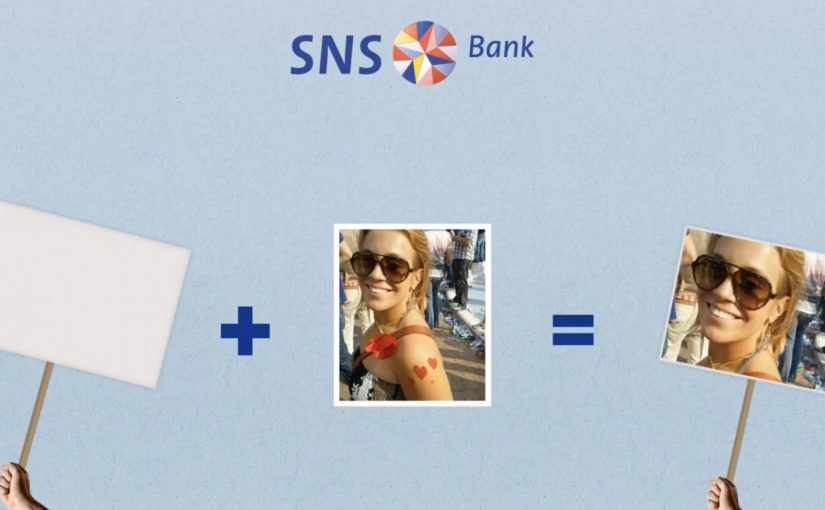
People “join” the protest using their Facebook or Twitter account. Their profile picture then becomes the campaign’s moving unit, connected into live rich media placements running on Dutch publisher inventory such as msn.nl and telegraaf.nl. Here, the moving unit is the participant’s profile picture reused as the visible building block of the protest crowd.

How the protest mechanic is built

The mechanism is straightforward. Sign up with a social account, capture the profile image, then re-render that image as part of a marching crowd inside dynamic banners. The same identity asset travels from social sign-up, to landing experience, to high-impact display formats, including what is described as a homepage takeover on telegraaf.nl.

In European retail banking, feature-led propositions like “interest on current accounts” often need a memorable way for customers to visibly participate to cut through price parity and low attention.

Why it lands

It takes a boring benefit and gives it a human visual. A rate becomes a crowd. That shift matters because it makes the offer feel socially validated and easy to explain. It also turns ordinary display inventory into a live proof point, because the banners visibly update with real people rather than generic stock photography. This is the right strategic move because the campaign makes participation itself the proof of relevance.

Extractable takeaway: When your proposition is a small financial feature, convert it into a visible social object. One reusable profile image can power sign-up, storytelling, and proof across every paid placement.

What SNS Bank is really trying to achieve

The business intent is to make “interest on a current account” feel like a category change, not a marginal tweak. The protest framing gives SNS Bank permission to be louder than the feature itself, and it creates a participation funnel that can be measured from social sign-up to on-site conversion.

The real question is how to make a marginal banking feature feel like a public movement rather than a line item in a comparison table.

What to steal from this protest-led banking launch

  • Turn the benefit into a visual system. If the offer is intangible, give it a repeating picture that accumulates and grows.
  • Use one identity artifact everywhere. A single profile image can unify sign-up, landing experience, and ad formats into one story.
  • Make paid media feel live. Dynamic creative that visibly changes reads as proof, not just persuasion.
  • Respect permission and platform rules. If you are pulling profile images, ensure consent is explicit and the experience stays compliant.

A few fast answers before you act

What is the core mechanic of this campaign?

People join via Facebook or Twitter, and their profile image is then reused as the creative building block inside a marching protest rendered across rich media banners.

Why use display banners for something that starts in social?

Because banners can function as visible proof at scale. The audience sees real faces moving through the ad units, which makes the proposition feel active rather than purely claimed.

What is the main advantage of the “protest” framing?

It makes a dry feature feel like a cause. That reframing increases memorability and gives people a simple story to repeat.

What is the biggest risk in copying this approach?

Using social identity assets without clear consent creates trust and compliance issues. If the sign-up step is not explicit, the same mechanic can backfire fast.

When does this kind of mechanic work best?

It works best when the product feature is real but visually weak. The participation layer gives the feature a public shape without changing the underlying offer.

Foursquaropoly: Real-World Monopoly via Foursquare

Foursquaropoly: Real-World Monopoly via Foursquare

Can you imagine playing a real-world version of Monopoly wherever you go, 24/7. A bunch of students decide to explore exactly that, and the result is a concept video that mashes up Foursquare-style check-ins with classic Monopoly rules.

Mechanic in plain terms: your location becomes the board. You “move” by going places, you “claim” by checking in, and ownership plus rewards become part of everyday movement through a city.

In mobile-first consumer experiences, location-based play works best when it turns routine movement into a simple loop of progression, competition, and collectible status.

Why it lands

It takes an abstract board game and makes it instantly legible in the real world. Because the check-in becomes both the move and the proof, the player gets status feedback without learning new controls. The joy comes from recognition. Streets become properties, venues become squares, and everyday decisions get a light layer of consequence. The real question is whether you can keep the loop fair and legible once real places and real rewards enter the rules.

Extractable takeaway: When you translate a familiar game into a real-world experience, keep the rules understandable in one sentence and the feedback immediate. The faster a player can see “what I did” and “what it unlocked,” the longer the concept stays sticky.

What this hints at for brands

The intriguing angle is not just “Monopoly in the streets.” It is the reward layer. By “reward layer,” I mean a simple, visible benefit attached to a check-in. Brands could join in by sponsoring virtual rewards that are redeemable for real-world objects, using check-ins as the trigger and redemption as the payoff. Done carefully, the value exchange is clear: attention and footfall in return for something tangible. This works best as an opt-in, time-boxed layer, not a permanent loyalty system.

Steal these mechanics for location activations

  • Turn geography into progress. Make “being somewhere” the action, so participation feels effortless.
  • Use scarcity that maps to reality. Limited locations, limited time windows, and visible ownership are more compelling than generic points.
  • Reward the behavior you actually want. If you want visits, reward arrivals. If you want repeat, reward streaks and routes.
  • Keep the redemption simple. The moment the payoff is confusing, the game stops being a game and becomes admin.

A few fast answers before you act

What is Foursquaropoly?

A concept for turning Monopoly into a 24/7, location-based game where check-ins and real-world movement replace dice rolls and board squares.

Why is Monopoly a good fit for a real-world location game?

Because it already maps cleanly to places, ownership, and rivalry. Those ideas translate naturally into neighborhoods, venues, and repeat visits.

What makes a location-based game loop feel sticky?

It feels sticky when each check-in produces immediate feedback, such as status or ownership, and the rules stay understandable without a manual.

How could brands participate without breaking the experience?

By sponsoring rewards that feel additive, such as limited-time bonuses at specific locations, and keeping the rules consistent so the game still feels fair.

What is the biggest risk in making this real?

Player fatigue and confusion. If the rules are too complex or the rewards feel arbitrary, people stop understanding what to do next and the loop collapses.