
A Non Smoking Generation: Ugly Models

A Non Smoking Generation: Ugly Models

A teenage girl applies to a glamorous new modelling agency called “U-Models”. She fills in her age, height, and other details, uploads a photo, and waits for the call-back.

Then the twist lands. “U-Models” is revealed as “Ugly Models”, and the campaign’s message is blunt: smoking doesn’t just damage you in the long run. It shows up on your face, sooner than you think.

A fake model search that weaponises the application form

The execution is built like a real talent hunt. Recruitment happens online, and the “application” is the product. Applicants are asked for basics like age and an uploaded photo. Smoking status is part of the form, too.

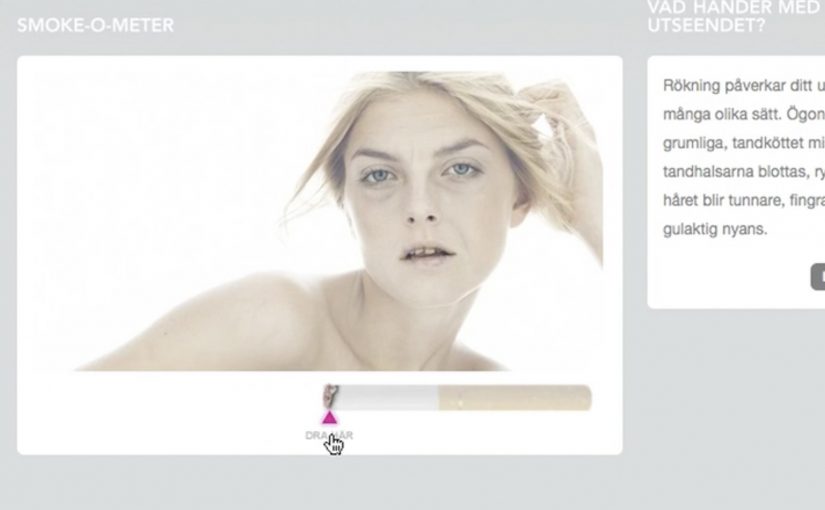
After the sign-ups, the campaign responds at scale. Applicants are told they are “too cute” for this agency because it is looking for “ugly models”. They are then shown a retouched version of their own photo that visualises how they might look after years of smoking.

How it turns a health warning into personal evidence

Most anti-smoking messages rely on abstract futures: disease, risk, statistics. This one drags the consequence into a mirror. It converts “smoking is harmful” into “this is what it can do to you”, using the viewer’s own face as proof, and using the modelling world as the attention hook.

In Scandinavian youth health communication, campaigns often have to compete with fashion and celebrity culture for attention.

The real question is how you make a long-term health risk feel socially immediate to a teenager.

Why it lands with the target group

The psychological move is simple: it swaps distant health outcomes for immediate social stakes. For teenagers, “identity now” usually beats “health later”. The campaign borrows the exact mechanics young audiences already understand. Casting calls, celebrity endorsement, online applications. Then it flips those mechanics into an uncomfortable reveal that is hard to unsee. That works because a personalised image collapses an abstract warning into an immediate identity threat.

Extractable takeaway: If your audience discounts long-term risk, translate the consequence into a near-term identity signal, and make the “proof” feel personally addressed rather than generally broadcast.

The intent, and the ethical edge you can’t ignore

This is a deliberately provocative form of social marketing. It uses deception, and it leans on appearance anxiety to get attention. That friction is part of the spread. People talk about it because it feels shocking, and because it breaks the usual public-service tone.

The pattern is effective, but it should only be used where the public-good case is strong and the safeguards are explicit. If you borrow the pattern, borrow it with care. The line between “wake-up call” and “harmful shaming” is thin, especially when the audience is young. The execution works because it is sharp, but it also raises real questions about consent, data handling, and emotional impact.

What to steal for your next behavior-change idea

  • Use a familiar cultural container. Here it is modelling and celebrity culture. Pick a container your audience already pays attention to.
  • Make the interaction do the persuasion. The form, the upload, and the response are the message. Not the headline.
  • Deliver a personalised “receipt”. The retouched photo turns a general warning into concrete evidence.
  • Design the reveal as the share trigger. The moment of “wait, this isn’t what I thought” is the social fuel.

A few fast answers before you act

What is “Ugly Models” in this context?

It is an anti-smoking campaign framed as a modelling recruitment drive called “U-Models”, later revealed as “Ugly Models”, designed to warn teenagers about the visible impact smoking can have on appearance.

How does the campaign mechanism work?

Teenagers apply online to a supposed model agency and upload a photo. The campaign then responds with a reveal message and a retouched version of the applicant’s own photo that visualises the effects of smoking over time.

Why is the personalised photo so powerful?

Because it turns a general warning into something that feels directly attached to the viewer’s own identity. The consequence stops being abstract and starts feeling immediate, visible, and personal.

Why focus on appearance instead of health consequences?

The idea is that long-term health warnings are often ignored by teenagers, while near-term identity and appearance cues are harder to dismiss. The campaign makes the risk feel immediate and personal.

What’s the main risk in copying this approach?

The tactic uses deception and can slide into shaming. If the audience is young, you need extra care around consent, safeguarding, and avoiding harm while still delivering a clear public-good message.
Domino’s: Pizza Holdouts

Domino’s: Pizza Holdouts

When your friends “rat you out” to a pizza brand

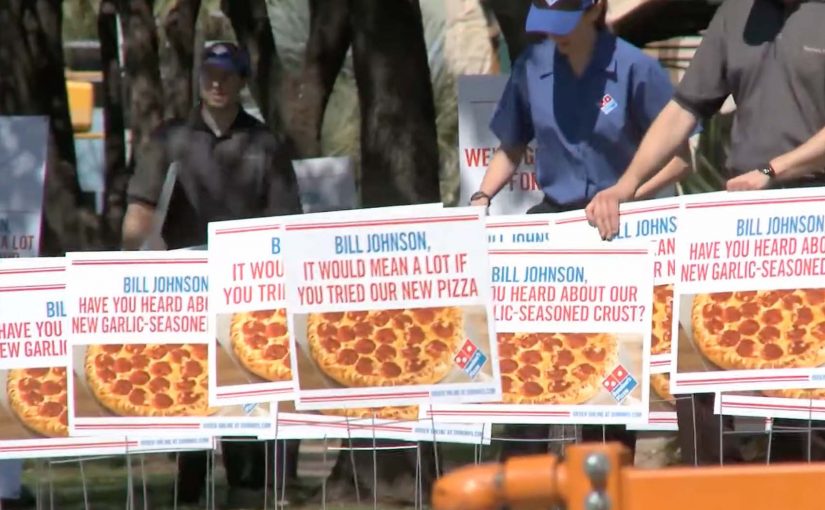
Domino’s campaign against consumers who cannot stand its pizza continues. Crispin Porter + Bogusky is back with a new facet of the “New Pizza” campaign. The brand sets out to harass three poor unsuspecting souls who have been ratted out as not eating Domino’s.

The premise is that “only a handful” of people have not tried the new pizza recipe Domino’s came out with.

The mechanic: turn trial into a social bounty hunt

The mechanism is simple and slightly mean in a way that makes people watch. Identify the “holdout”. Make their resistance a story. Then recruit their friends as the distribution layer, so the campaign spreads through personal networks instead of brand channels alone. Because the invitation comes from someone you know, it carries social proof and mild pressure that paid media cannot.

In US quick-service marketing, “get them to try it once” is often the hardest job, because taste perceptions and jokes about quality can become cultural default settings.

Why it lands: public call-out plus a clear path to redemption

This works because the tension is real. People do have strong opinions about Domino’s. Making the holdout visible creates social pressure, but the campaign balances that pressure by offering an easy way out. Try the new recipe. Join the conversation. Stop being the exception.

Extractable takeaway: When you use public call-out, pair it with a low-friction “redemption” action so people can update their stance without losing face.

The real question is whether your trial problem is a product problem or a permission problem, and which one you can solve fastest.

The business intent: accelerate reappraisal of the product

This is not a love-brand play. It is a credibility reset. Domino’s wants lapsed and sceptical customers to re-test the product, so the “new recipe” can replace the old mental model.

After this, Domino’s reported doubling its profits last quarter to $23.6 million.

Forcing first trial at scale: practical moves

  • Make the barrier explicit. “You have not tried it” is a clearer friction point than “please consider our brand”.
  • Recruit friends, not audiences. Social pressure works best when it comes from someone the holdout knows.
  • Give the story a role people can play. “Bounty hunter” is a participation frame, not just a message.
  • Link the stunt to a measurable behaviour. The only KPI that matters here is trial, not views.

So do you know a pizza holdout? Find out how to become a Taste Bud Bounty Hunter at www.PizzaHoldouts.com. A “Taste Bud Bounty Hunter” is the friend who nominates a holdout and nudges them to try the new recipe.


A few fast answers before you act

What is Domino’s “Pizza Holdouts” in one sentence?

A campaign that targets people who still have not tried the “new” Domino’s recipe, using friends to identify them and turning first-trial into a playful hunt.

What is the core mechanism?

Social recruitment plus a role people can play. Friends “rat out” holdouts, and the brand reframes outreach as a bounty-hunt style participation story.

Why does using friends change the effectiveness?

Because social pressure is more persuasive when it comes from someone you know. The message is carried by relationships, not just media.

What is the real KPI this format is trying to move?

Trial. The stunt is designed to force the first bite, not just generate views or talk.

What is the most transferable takeaway?

If your growth problem is “first experience”, make the barrier explicit, recruit peer influence, and design a participation frame that points to the behaviour you want.

Ogilvy: The World’s Greatest Salesperson

Ogilvy: The World’s Greatest Salesperson

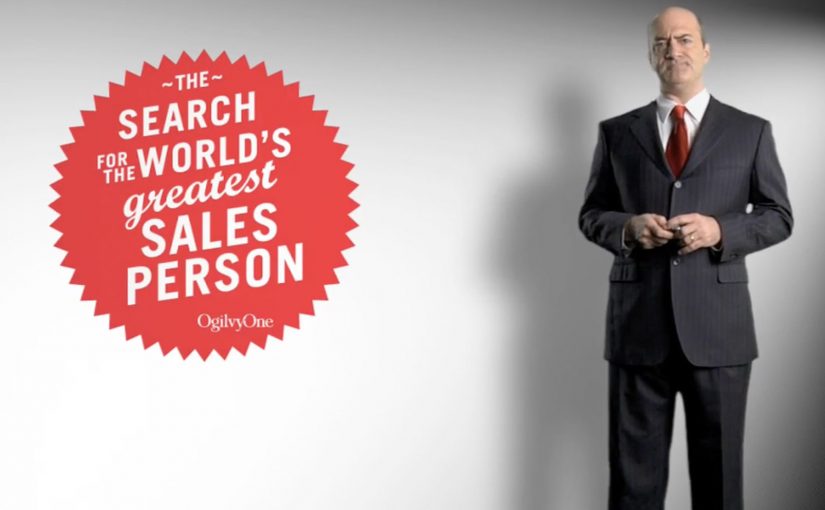
News just out. Ogilvy & Mather Worldwide is looking for “The World’s Greatest Salesperson”.

Ogilvy’s founder, David Ogilvy, went door to door selling stoves before he got into advertising. He was so good at it that the company asked him to write a manual for other salesmen. Now, after decades as one of the best-known agencies in the world, Ogilvy is creating a contest to celebrate the art of selling.

The contest is designed to live where modern pitching lives: on YouTube. Entrants are asked to prove they can sell, not just claim they can sell, by submitting a short video pitch.

A recruiting idea disguised as a sales lesson

The mechanism is simple. Use a public challenge to attract people who can communicate clearly under constraints, then let the internet do the first round of filtering through visibility and voting signals. Because the entry is a short video work sample, the first screen is proof, not claims.

In global agency recruiting and employer branding, open challenges like this turn hiring into content and let capability show up in public rather than on a CV.

This is a stronger recruiting filter than a conventional careers campaign because it forces proof under a shared constraint.

The real question is whether a video-first work sample can replace traditional screening without diluting quality.

Why it lands

It works because the entry format turns “sales ability” into a comparable work sample, so judgment starts with evidence instead of self-description.

Extractable takeaway: The best recruiting campaigns behave like a job preview. A job preview is a small, real slice of the role. They ask candidates to demonstrate the exact skill you care about in a constrained, comparable format, then use curation to turn submissions into a public proof of standards.

It makes “sales ability” observable. The work samples are the application. You can see clarity, empathy, structure, and persuasion in minutes.

It borrows the founder’s origin story without turning it into nostalgia. The David Ogilvy reference sets a standard. Selling is treated as craft, not hype.

It rewards ambition with a real stage. The promised prize, including a Cannes Lions trip and a seminar slot, gives the contest a credible career upside rather than a token reward.

Borrowable moves for video-first recruiting

  • Ask for a work sample, not a statement. Make the entry itself the evidence.
  • Use one consistent prompt. A shared constraint makes submissions comparable and curation easier.
  • Build a reward that signals seriousness. A meaningful stage and exposure attracts serious entrants.

The three winners of this contest will win a trip to the 57th annual Cannes Lions International Advertising Festival. They will also get to make a presentation at the festival seminar on June 21.


A few fast answers before you act

What is Ogilvy actually trying to find with this contest?

Someone who can sell convincingly, on camera, with a clear structure and customer understanding, not just someone with a polished resume.

Why run it on YouTube?

Because sales is performance plus clarity. Video makes both visible, and it scales submissions globally without heavyweight logistics.

What makes this more than a PR stunt?

The entry format is a real work sample, and the prize includes a meaningful industry stage. That combination turns attention into a talent pipeline.

What does David Ogilvy’s backstory add to the idea?

It anchors the contest in a specific belief: selling is foundational craft. The founder story is used to justify why sales ability is being celebrated publicly.

What is the most transferable lesson for leaders hiring for commercial roles?

Design selection as demonstration. Give candidates a single prompt that mirrors the real job, then judge the work, not the claims.