

Vodafone: Power to You

A telco ad built around a painfully human moment

This spot does not try to impress you with technology. It starts with a situation that feels familiar, that split-second where you finally get what you want and then do not quite know what to do with it.

The mechanic: make the service invisible, make the feeling unforgettable

The mechanism is classic restraint. The product sits in the background as the enabler, while the story puts all the weight on a single emotional beat and a clean punchline.

That works because people remember the awkward human payoff more easily than they remember another service claim.

In global telco advertising, the fastest way to make connectivity feel valuable is to tie it to a moment people recognize from real life.

Why this lands

Because it refuses to oversell. The humor comes from recognition, not exaggeration, and the brand benefit lands as a by-product of the scene rather than a claim you are asked to believe.

Extractable takeaway: When you sell an invisible utility, stop explaining the utility. Show the human outcome in one tight scene, and let the audience supply the meaning.

What Vodafone is really doing here

The real question is how a utility brand makes an invisible service feel personally valuable without falling into feature talk.

It is not a feature demo. It is permission. The brand frames itself as the thing that gives you the ability to act, even if you still have to handle the awkwardness of being human once the connection is made.

That is the right strategic choice for a telco brand.

What to borrow from Vodafone’s restraint

  • Pick one emotion and commit. A single relatable moment beats a list of capabilities.
  • Keep the product in the background. Let the story deliver the proof indirectly.
  • Write for instant recognition. If people can say “that is me”, you have the ad.
  • End on a clean beat. One punchline. One memory.

A few fast answers before you act

What is this “Power to You” spot trying to achieve?

It makes Vodafone’s promise feel human by anchoring the brand to a recognizable emotional moment rather than to technical claims.

Why does the low-feature approach work for a telecom brand?

Because the service is largely invisible when it works. The best proof is often the outcome it enables, not the infrastructure behind it.

What is the core creative pattern here?

Understatement plus recognition. Build the story around a real-life feeling, then let the brand show up as the quiet enabler.

Why use humor instead of product proof?

Because recognition lowers resistance. When people see themselves in the scene, the brand benefit feels inferred rather than imposed.

What is the transferable principle?

If your product is a utility, sell the human moment it unlocks. The clearer the moment, the less you need to explain.

Eichborn: Flyvertising at the Frankfurt Book Fair

Jung von Matt just redefined advertising for their client Eichborn at the Frankfurt Book Fair by attaching tiny banners to 200 flies and setting them loose as miniature “sky ads” around the halls. The idea was coined Flyvertising, or “Fliegenbanner”.

A stunt that makes the logo literal

Eichborn’s brand mark is a fly. So instead of printing the fly on a poster and hoping people notice, the campaign turns the fly into the medium and lets it wander through the crowd, uninvited, and impossible to fully ignore.

The weight of the banner itself, attached with a string and some sticky stuff that allowed it to eventually fall off without harming the fly, was so that the fly could fly with it, but not very high and they kept landing on visitors.

How Flyvertising works

The execution uses ultralight banners attached with a string and a sticky material described as designed to let the banner fall off later without harming the fly. The extra weight keeps the insects from flying high, which means they repeatedly land on visitors and surfaces. In a crowded fair, that turns a wandering fly into a moving pointer that creates attention and helps people find the Eichborn stand.

In European trade-show marketing, a stunt wins when it turns wayfinding into a story people cannot ignore in a crowded hall.

Why this lands

The campaign exploits a simple truth about exhibitions. People are overloaded with signage and trained to filter it out, but an interruption that breaks the “expected media” pattern cuts through instantly. Here, the interruption also feels on-brand, because the fly is not a random prop. It is the identity asset brought to life.

Extractable takeaway: If your brand owns a distinctive symbol, find a way to make that symbol behave like media in the real environment where attention is hardest to earn, and let the medium carry the message.

What Eichborn is really buying

The real question is whether a trade-show stunt can turn a hard-to-find stand into the story people repeat across the hall. This is smart exhibition marketing because it fuses wayfinding with a brand asset people will talk about. This is not about explaining a book list. It is about generating foot traffic, conversation, and memorability around a stand number in a hall full of publishers. The flies do the work of a promoter, and the story spreads faster than any brochure.

What to steal for your next event activation

  • Let the identity asset drive the idea. The closer the stunt is to the brand symbol, the less it feels like random noise.
  • Design for physical proximity. A trade show is won at arm’s length. Make the experience land close enough to be felt.
  • Build a “tellable” moment. If a visitor can summarize it in one sentence, it travels through the venue for you.
  • Plan the ethics and the optics. If living things are involved, the “no harm” claim needs to be credible and easy to defend.

A few fast answers before you act

What is Flyvertising?

Flyvertising is an ambient trade-show stunt where Eichborn released flies carrying ultralight mini-banners, turning the insects into moving ads that drew attention and guided visitors toward the publisher’s stand.

Why does this kind of “living media” cut through at exhibitions?

Because visitors are conditioned to ignore static signage. A moving, unpredictable interruption breaks that filter, especially when it happens in personal space.

What makes it feel on-brand rather than a generic stunt?

Eichborn’s identity includes a fly, so the medium directly expresses the brand symbol. That alignment makes the execution easier to remember and retell.

What is the transferable principle behind Flyvertising?

The transferable move is to turn a brand-owned symbol into the delivery system for attention in the exact environment where people normally ignore messages.

What are the risks with this pattern?

Ethics, hygiene perception, and venue rules. If people feel the stunt is harmful or unhygienic, the attention flips from curiosity to backlash.

Road Safety: The Bleeding Billboard

A roadside warning that reacts to rain

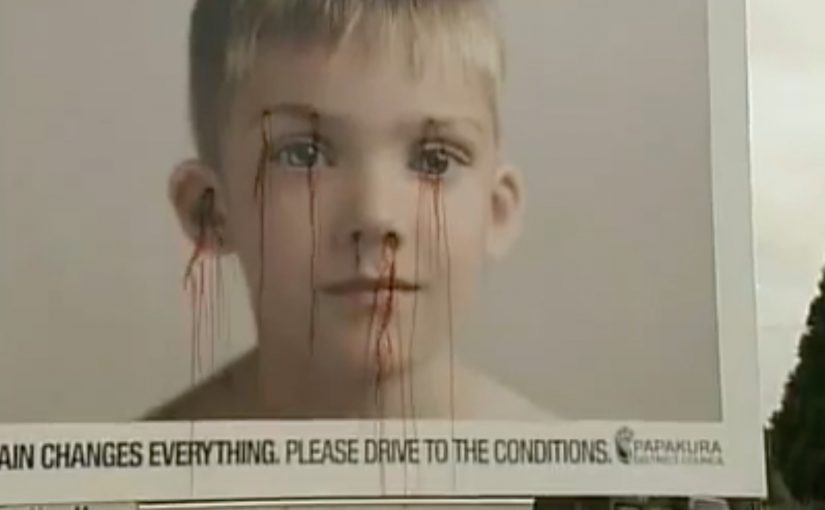
An impressive device was concocted by Colenso BBDO to demonstrate to drivers that vigilance is needed when it rains. The special billboards were installed on the roadsides in Papakura District, New Zealand.

When it began to rain these billboards started bleeding profusely.

How the device works as a message, not just a stunt

The mechanism is environmental trigger plus instant consequence. Rain does not just “set the scene”. It activates the medium, turning weather into the switch that makes the warning unavoidable.

In public-safety communication, linking a message to the exact moment of risk can outperform awareness-style reminders, because it removes the gap between knowing and doing.

The real question is whether you can make the risk cue appear at the exact moment a driver still has time to react.

Why it lands: it makes the danger feel present

The effect is deliberately uncomfortable. Blood signals harm, urgency, and the possibility of impact. It forces a driver to confront “what could happen” precisely when conditions are deteriorating.

Extractable takeaway: When a warning changes with conditions, the risk feels present, and instinctive self-correction becomes easier. “Rain changes everything. Adjust speed to conditions on the road”.

The business intent: behaviour change at the point of decision

This is less about recall and more about compliance. The goal is to interrupt automatic driving habits and create a micro-moment of self-correction: slow down because the road has changed. Here, “micro-moment” means a split-second decision point where a driver can adjust speed.

This is worth using when the behaviour change needs to happen in seconds, not after a campaign is remembered.

Stealable patterns for safety, infrastructure, and behaviour-change briefs

  • Trigger the message when the risk is real. Tie the communication to a condition the audience can see and feel.
  • Make the medium part of the proof. The environment becomes the “reason” the message is credible.
  • Choose a signal that reads instantly. Drivers have seconds, so the cue must be immediate and universal.
  • Design for instinct, not analysis. Behaviour change often happens through emotion and interruption, not persuasion.

A few fast answers before you act

What is the “bleeding billboard” campaign?

It is a road-safety outdoor installation where special billboards appear to bleed when it rains, warning drivers to adjust speed to conditions.

What is the core mechanism?

An environmental trigger plus instant consequence. Rain activates the medium, turning the weather into the switch that makes the warning unavoidable.

Why is the timing of the message so important here?

Because it collapses the distance between “knowing” and “doing”. The warning appears precisely when risk increases, at the point of decision.

Why use an uncomfortable visual like blood?

It reads instantly and signals harm without explanation. Drivers have seconds, so the cue must be immediate and universal.

What is the most transferable takeaway?

If you can trigger a behaviour-change message when the risk is real, the environment itself becomes the proof, and compliance becomes more likely than with generic reminders.