
Lux: Magic Shower Rooms

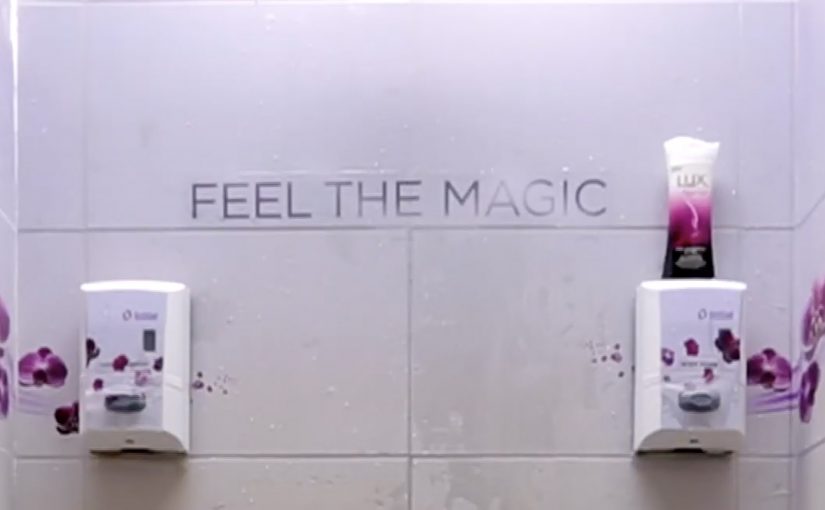
Unilever samples the new Lux Magic Spell shower soap in ladies’ shower rooms across spas, clubs and gyms in Singapore. But instead of handing out a bottle and hoping for recall later, the sampling moment is engineered into the space itself.

The walls and floors are covered with special stickers made using hydrochromic ink. Hydrochromic ink is a water-reactive coating that changes appearance when it gets wet. As soon as water hits the surface, the white layer disappears to reveal the message and beautiful trails of orchids, so the shower moment becomes a small piece of “magic” tied directly to the product experience.

When the environment becomes the sampler

The mechanism is water-activated reveal. The user does not need instructions, scanning, or a download. The shower triggers the transformation automatically, and the brand message arrives as part of the ritual.

In APAC beauty and personal-care sampling, the most efficient activations reduce the gap between trial and emotion by making the first-use moment feel special.

Why it lands

This works because it avoids the typical sampling failure mode. The product is tried, but nothing memorable happens. Here, the reveal creates a clear “before and after” moment, and that moment is inseparable from using water and being in the shower, which is exactly where the product belongs. In-space triggers beat a handout when the product is used in a fixed ritual and the trigger is unavoidable.

Extractable takeaway: If you want sampling to drive preference, attach the product trial to a sensory trigger in the same environment where the product is naturally used, and make the payoff immediate and unmistakable.

The real question is whether your sampling moment creates a memorable “before and after” that only happens in the product’s natural context.

Moves to borrow for your next ambient sampling activation

  • Make the trigger inevitable. Water is not optional in a shower room. So the reveal is guaranteed to happen.
  • Let the brand behave like a “feature” of the space. The message is not pasted on top. It is revealed by the environment.
  • Use beauty cues that match the promise. Orchids and floral trails visually echo fragrance and sensoriality without needing copy-heavy explanation.
  • Design for the first five seconds. The moment someone sees the reveal, they understand what changed and why it is interesting.

A few fast answers before you act

What is “Magic Shower Rooms” in one sentence?

A Lux sampling activation where shower-room stickers reveal orchids and messaging only when water hits them, turning product trial into a live, in-context surprise.

Why use hydrochromic ink here?

Because it converts water contact into a visible transformation, making the shower itself the interaction trigger.

What makes this stronger than a normal sampling handout?

It creates a memorable moment during first-use, in the exact environment where the product is meant to be experienced.

Where does this idea work best?

In environments where the trigger is unavoidable and the product ritual is already happening, so the reveal feels native instead of staged.

What is the main execution risk?

If the reveal is hard to notice, messy, or poorly maintained, the magic becomes confusion, and the brand association turns negative.


ETN: The Howling Football

The European Football Championship is going to kick off in a few months, and brands are already getting ready with their advertising pitch. However the brands are not the only ones who want to grab people’s attention.

In Ukraine there are street dogs and cats that are reported to be being killed to make the country cleaner and ready to welcome thousands of football tourists. So pan-European animal charity ETN has conceived an attention grabbing ambient campaign in Hamburg to get people involved in its animal protection program.

A football that stops being fun for a second

The execution borrows the most universal gesture around the tournament. A casual kick. Then it interrupts that habit with a jolt that does not belong on a pitch, pulling a distant issue into the middle of the street.

How the mechanism works

The campaign is built around a physical football installation placed in public space. When someone kicks it, the “game” produces an unexpected emotional cue, and the surrounding prompts push you toward a simple next step to support ETN’s protection work. The route to action is designed to be immediate, not research-heavy.

In European cause marketing, the fastest way to mobilize help is to turn a distant issue into a local, physical moment that asks for one simple response.

Why it lands

Football creates permission. People approach without suspicion, because the object feels familiar and playful. The switch from play to discomfort is what makes the message stick. The moment re-frames “preparation for a tournament” as something with consequences, then it uses that heightened attention window to ask for help while the feeling is still fresh.

Extractable takeaway: If you can hijack a familiar public behavior and replace its expected feedback with a values signal, you get instant comprehension and a much higher chance of follow-through than a poster ever delivers.

What ETN is really trying to achieve

This is not awareness for awareness’ sake. The real question is whether a street encounter can convert concern into immediate support before attention fades. It is a conversion play, meaning the point is to turn attention into donations or sign-ups. Make the issue legible in ten seconds, then make support doable in the next ten. The ambient moment is the top of funnel. The donation and sign-up paths are the business end.

What to steal from ETN’s street intervention

  • Use a culturally loaded object. Football already carries meaning during a tournament build-up.
  • Change the feedback, not the instruction. The surprise does the teaching.
  • Design the “next step” to be instant. If action requires effort, the moment evaporates.
  • Keep the story single-threaded. One cause, one emotion, one ask.
  • Place it where the behavior naturally happens. Public space is the medium and the distribution.

A few fast answers before you act

What is “The Howling Football”?

An ambient street installation that uses a football-triggered moment to spotlight a reported animal-welfare issue and direct people to support an animal protection program.

Why tie an animal charity message to a football tournament?

Because the tournament creates attention and shared behavior. The campaign uses that attention to make a neglected topic visible to people who otherwise would not seek it out.

What makes this different from a normal charity poster?

It interrupts a real action in real space. That interruption creates emotional salience, then it immediately offers a next step while attention is still high.

What is the biggest execution risk with shock-based ambient?

If the moment feels gimmicky or unclear, people disengage. The cue has to be instantly interpretable, and the path to help has to be frictionless.

How do you measure success for a campaign like this?

Track conversions first. Donations, sign-ups, and cost per action. Then look at earned reach and press as secondary amplification.

Durex: Xerud, The Lover’s Fortune Teller

Durex Taiwan’s sales were in decline, but reminding a young audience about the risks of unprotected sex came with a local constraint. Sampling works well in many markets, yet in Taiwan the category carries enough taboo that street promoters struggled to start conversations and hit daily contact targets.

OgilvyAction’s answer is a low-budget distribution idea disguised as something people already seek out. An unbranded fortune-teller machine called “Xerud”, placed in bars, nightclubs and karaoke venues.

The machine prints playful “predictions” about relationships and sex, then dispenses a discreet sample condom pack matched to the forecast and the product benefit. The pack also includes simple educational tips about safer sex.

A sampling machine that earns permission first

The core mechanic is not the giveaway. It is the cover story, meaning the socially acceptable reason to approach the machine. People approach “Xerud” for curiosity, not for condoms, which changes the emotional posture from embarrassment to play. The venue context does the rest. Lower inhibition, higher openness, and a built-in reason to talk about love.

In mainstream consumer marketing, the most efficient way to handle taboo topics is to place them inside a familiar cultural ritual, then let that ritual create permission to engage.

Why it lands

This works because it swaps confrontation for self-service. Nobody is being “sold” to in public. The user opts in privately, receives a personalized message, and gets a product sample that feels relevant rather than generic. The experience also makes the first sentence easier. It gives people a prompt to laugh about, which is often the fastest route into a serious subject.

Extractable takeaway: When your category is socially sensitive, design distribution that people can initiate themselves, inside a context that already legitimizes the topic. That one design choice can triple throughput versus direct promotion.

What the numbers are really saying

The case write-up reports that an average street promoter hands out about 23 samples per hour, while “Xerud” dispenses about 77. The real question is whether the framing removes enough shame to make self-initiated sampling scale better than promoter-led outreach. The headline is not “a clever machine”. It is that the right framing can outperform manpower when the bottleneck is shame, not reach.

What taboo-category marketers can steal

  • Use an unbranded entry point. Let the experience earn consent before the logo arrives.
  • Match the venue to the conversation. Nightlife lowers barriers for relationship and intimacy topics.
  • Personalize the “why this sample”. Relevance reduces awkwardness and increases retention.
  • Make education feel like a bonus. Tips land better when they arrive inside a playful ritual.
  • Measure throughput honestly. Compare against the real baseline, not a best-case scenario.

A few fast answers before you act

What is Xerud, in one sentence?

An unbranded fortune-teller machine placed in nightlife venues that prints love predictions and discreetly dispenses matched condom samples with safer sex tips.

Why does the “fortune teller” disguise matter?

It gives people a culturally familiar reason to approach, which reduces embarrassment and makes the first interaction feel voluntary rather than confrontational.

What is the main marketing objective?

Increase trial and restart conversation in a category where social taboo blocks normal sampling and awareness tactics.

What is the biggest execution risk?

If the machine feels too obviously “a condom stunt”, the protective disguise collapses and usage drops. The socially acceptable reason to approach has to feel legitimate in the venue.

How can other taboo categories borrow this approach?

Pick a trusted ritual or interface people already opt into, then embed sampling and education as an unobtrusive “extra” that follows the ritual’s logic.