
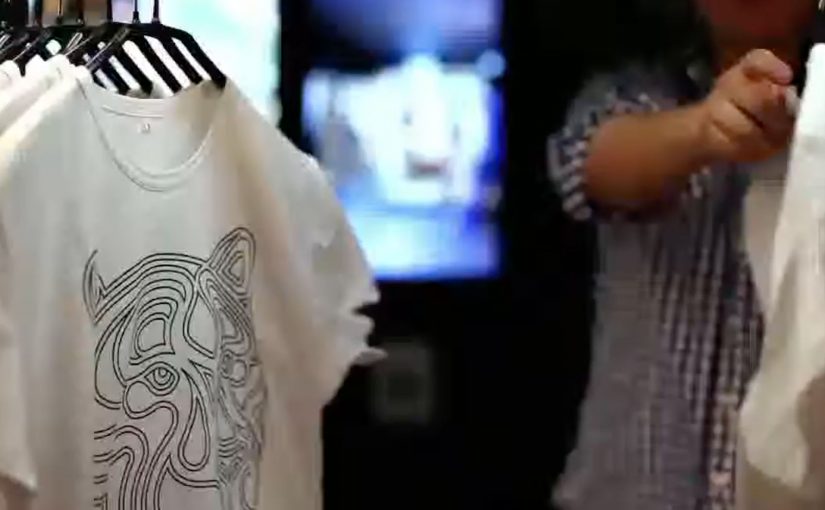
WWF: Augmented Reality Tiger T-Shirt

WWF: Augmented Reality Tiger T-Shirt

A retail AR gut-punch for WWF’s Siberian tiger

This is a great piece of Augmented Reality for WWF aimed at raising awareness around the plight of the Siberian tiger, created by Leo Burnett Moscow.

WWF printed thousands of tiger t-shirts and distributed them online and to key stores in Moscow featuring specially placed AR video mirrors that would instantly activate the AR experience the moment a tiger t-shirt was detected. An AR video mirror is a camera plus screen installation that overlays digital effects on your live reflection in real time. And at that moment, the experience became quite graphical to anyone wearing the t-shirt, complete with bullet wounds, huge amounts of blood and sound effects to match it.

How the “video mirror” mechanic does the heavy lifting

The setup is simple. Put the message on the body. Put the trigger in the store. Put the reveal in a mirror people already trust as “truth”.

An AR video mirror is a camera plus screen installation that shows your live reflection while overlaying digital effects in real time. In this case, the mirror detects the tiger shirt and then renders the simulated injuries and audio as if they are happening to you. Because the overlay is pinned to your live reflection, the reveal feels immediate, which is why the message hits before you can distance yourself from it.

In retail environments and public spaces, AR activations work best when the interaction is instant, unmistakable, and socially visible to bystanders.

Why the experience lands so hard

It converts an abstract cause into a first-person moment. You do not just look at an endangered animal. You temporarily “become” the target.

Extractable takeaway: If you want awareness to stick, bind the reveal to a trusted routine and reduce viewer control, so the audience feels the story in their own reflection before they can rationalize it away.

The intent behind making it graphic

The creative choice forces attention and memory. A polite AR overlay would be easy to ignore. A visceral one is harder to dismiss and more likely to be retold, especially when friends are watching from behind you.

The real question is whether the shock serves the story or becomes the story.

Graphic AR is a valid tool only when the cause is unmistakable and the reveal points back to it within seconds.

Design moves to borrow from this AR mirror

  • Use a frictionless trigger. Detection happens automatically. No app download. No QR hunt. No instructions.
  • Choose a culturally “trusted” surface. Mirrors feel like evidence, which makes overlays feel more real than a phone screen effect.
  • Make the message social. The bystander view matters. People react together, and that reaction becomes the spread mechanism.
  • Design the reveal as a single sentence. “This is what it feels like to be hunted.” If the concept cannot be repeated instantly, it will not travel.

A few fast answers before you act

What is the core idea of the WWF tiger t-shirt AR campaign?

It uses an AR video mirror to detect a tiger t-shirt and instantly overlay a graphic “poaching” simulation on the wearer, turning awareness into a first-person experience.

Why use an AR mirror instead of a mobile AR app?

The mirror removes friction and makes the moment public. Everyone nearby sees the same reveal at the same time, which increases impact and sharing.

What makes this activation effective as cause marketing?

It translates a distant problem into a personal reaction. The wearer feels shock and vulnerability, and that emotional spike improves recall and conversation.

What are the key components if you want to replicate the mechanism?

You need a clear trigger (the shirt), a camera plus screen “mirror” setup, real-time overlay rendering, and a reveal that communicates the message in seconds.

What is the main risk with shock-based AR experiences?

If the graphic content overwhelms the cause, people remember only the stunt. The message has to be explicit enough that the emotional reaction points to the intended story.
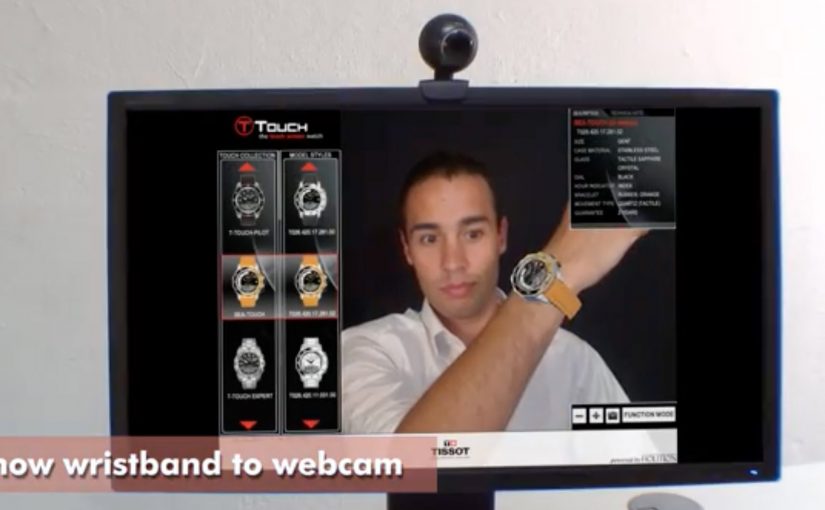
Tissot Augmented Reality Product Experience

Tissot Augmented Reality Product Experience

You hold your wrist up to a webcam and a Tissot watch appears on your arm in real time. You switch models instantly, compare styles, and explore the range without touching a physical display.

The idea. Try before you buy, without inventory

Tissot uses augmented reality to remove friction from product exploration. Here, augmented reality means a live webcam feed with a watch overlay that tracks your wrist as you move. The experience delivers the “try-on” moment digitally, so the brand can show more models than a physical counter typically allows.

The real question is whether your customer needs to see the product on themselves, and whether you can make that comparison instant.

For products where “look on me” drives choice, a fast try-on loop is worth building.

How it works. Wrist tracking plus real-time overlays

  • The user places their wrist in front of a webcam.
  • The system tracks position and angle so the overlay stays aligned.
  • Different watch models can be selected and applied instantly.
  • The experience helps users compare look and fit before committing.

In consumer retail and ecommerce, webcam-based virtual try-on is a practical way to expand assortment and comparison without stocking every variant.

Why it works. The product benefit is visual

Watches are bought with the eye as much as with the spec sheet. Because the overlay stays aligned as the wrist moves and switching is instant, the user can judge look and fit in seconds. Augmented reality makes the key decision input. How it looks on me. Available immediately, with minimal effort.

Extractable takeaway: When the decision hinges on “how it looks on me,” prioritize instant, body-anchored comparison over more static content.

What to take from it. Make comparison effortless

  • Anchor the experience to the body. It turns browsing into ownership imagination.
  • Optimize for fast switching. Comparison drives choice.
  • Keep the setup simple. A clear “put your wrist here” moment lowers drop-off.
  • Scale the catalog digitally. Show the full range without needing the full range in-store.

A few fast answers before you act

What is the Tissot augmented reality product experience?

A virtual try-on experience that overlays Tissot watches onto a user’s wrist via a webcam in real time.

What does the user do?

Hold their wrist in front of the camera and switch between watch models to compare styles.

Why is AR a good fit for watches?

Because the decision depends heavily on how the watch looks on the wrist, not only on specifications.

What is the main business benefit?

It enables broad product exploration and comparison without requiring physical inventory or a large display.

What is the transferable pattern?

If “fit and look” drives conversion, build a fast, body-anchored try-on loop that makes comparison frictionless.

AT&T: ZugMO webcam heading banner game

AT&T: ZugMO webcam heading banner game

The AT&T banner brings you right into the game, using Zugara’s augmented reality motion capture technology called ZugMO. Here, “augmented reality” means webcam-based motion capture with game graphics layered over live camera input. ZugMO translates head movement into game input. You use your webcam to “head” crosses toward goal, with five shots to score as many as possible. There isn’t much more to it than that. But it is a very cool concept, especially because it is described as having run as a banner placement on ESPN.com with BBDO and Zoic Studios involved.

Why this banner feels different to click on

Most banners ask for a click and then try to convince you after the fact. This one flips the sequence. It gives you a tiny game first, then lets AT&T benefit from the time, focus, and small dopamine hit that comes from trying to score.

Extractable takeaway: A playable banner works when the mechanic is instantly legible, the interaction is frictionless, and the reward arrives fast enough that people try “just one more shot.”

What “augmented reality” means here

In this execution, “augmented reality” is less about 3D worlds and more about webcam-based motion capture layered with game graphics. Your movement is the controller. The screen overlays the ball path and goal feedback on top of live camera input, so the interaction feels physical even though you are still inside a standard banner unit.

The mechanic is the message

There are only a few moving parts. A webcam feed. Face and head tracking. A corner-kick animation. A simple scoring loop with five attempts. That minimalism matters because banners do not have time for onboarding. If the player cannot understand it in one glance, the banner has already lost.

In performance-driven digital advertising, the fastest way to earn attention is to let people experience the message with their own body in seconds.

The real question is whether your ad can earn five seconds of voluntary play without explaining itself.

Playable banners are worth doing when the first interaction is immediate, legible, and ends quickly enough to invite a replay.

The business intent behind the “cool concept”

Positioned around football attention, the deeper message is speed and responsiveness. Not by claiming it, but by making the ad itself respond to you. It is a small but smart translation of “fast network” into an experience you can feel.

Steal this pattern for playable banners

  • Design for zero instructions. If the mechanic cannot be understood instantly, simplify it.
  • Use the body as the controller. Webcam motion beats mouse clicks when you want memorability, not just reach.
  • Keep loops short. Five shots is a clear session boundary. It invites replay without feeling endless.
  • Make the feedback loud. Clear “goal” and “miss” cues turn confusion into compulsion.
  • Let the format prove the claim. If your message is speed, make the interaction snappy and responsive.

A few fast answers before you act

What is a “playable banner”?

A playable banner is a display ad that includes a lightweight interactive experience, usually a mini game, inside the ad unit itself. The goal is to trade passive impressions for active participation.

Why does webcam motion capture increase engagement?

Because it turns the user from a viewer into the controller. When your body movement drives the outcome, attention becomes harder to drop and easier to remember.

What makes this AT&T banner easy to understand?

The interaction maps to a real-world action. You head the ball. The scoring loop is obvious. The session is short. That combination removes the need for instructions.

What is ZugMO in simple terms?

ZugMO is Zugara’s webcam-based motion capture layer that detects user movement and converts it into game input. In this case, it translates head movement into a “header” action.

What is the biggest failure mode for interactive banner ads?

Too much friction. If the ad requires setup, permissions confusion, slow loading, or unclear controls, most people leave before the first reward moment arrives.