
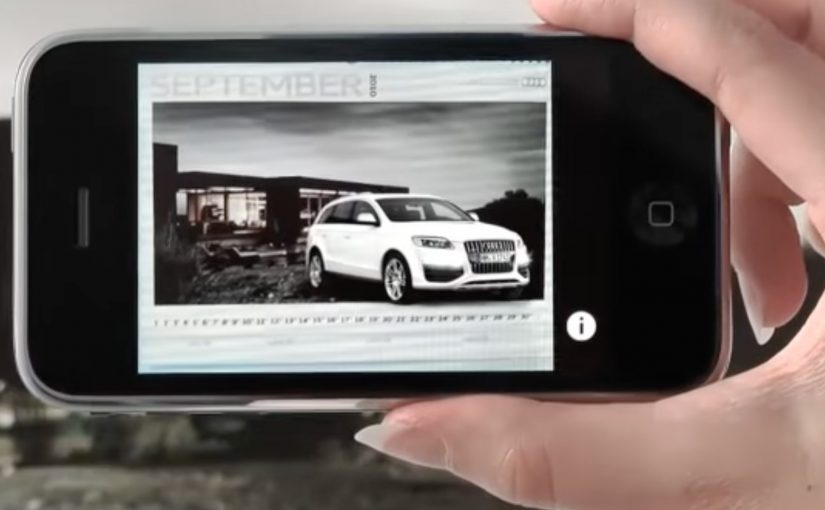
Augmented Reality Calendar by Audi

Augmented Reality Calendar by Audi

An Audi calendar arrives and it looks almost wrong. Each month is a beautiful landscape, with a deliberate empty space and no car in sight. You open Audi’s iPhone app, point the camera at the page, and the missing piece appears. An Audi A1 fills the blank area in augmented reality, sitting inside the printed scene as if it belongs there. Here, augmented reality means the app renders a 3D car model aligned to the printed page.

The idea. A car calendar without cars

Audi takes a familiar format. The premium calendar. Then it removes the expected hero asset. The car. The calendar becomes an invitation to discover, not a static brand object.

The real question is how to make a physical brand object earn interaction without adding friction.

How it works. Print as trigger, iPhone as lens

  • The printed calendar pages feature landscapes and intentional negative space.
  • People download and open the dedicated Audi iPhone app.
  • They point the phone’s camera at the calendar page.
  • The app overlays a car into the empty area, turning the page into a live scene.

The interaction is simple, but the effect is surprising because it uses a physical artifact as the interface. The calendar is not just content. It is the marker that activates the experience. Because the page is the trigger, the reveal feels like it belongs to the object, not like a separate digital stunt.

In brand marketing, the hardest part of physical brand objects is earning a second interaction without adding friction.

Why this works. A tangible product that earns a second look

This is not augmented reality for the sake of augmented reality. It is a clean integration of print and mobile that rewards curiosity. The calendar builds anticipation with absence, and the app completes the story in the moment you engage.

Extractable takeaway: Design intentional absence in the physical layer, then use mobile to deliver one earned reveal that completes the scene with minimal effort.

Augmented reality earns its keep when it completes a physical moment, not when it competes with it.

This idea is developed by Neue Digitale / Razorfish Berlin and executed for Audi.

What to take from it. Designing the reveal

  • Use restraint to create intrigue. Removing the obvious element can be more powerful than showcasing it.
  • Make the physical object the trigger. When the real-world asset is the interface, the digital layer feels earned.
  • Keep the action obvious. Point camera. See result. Low friction beats complex onboarding.
  • Build around a single wow moment. One crisp reveal is often enough to make the experience memorable.

A few fast answers before you act

What is Audi’s augmented reality calendar?

Audi’s augmented reality calendar is a printed calendar designed to work with a dedicated iPhone app, where pointing the phone camera at a page reveals an Audi car overlaid in augmented reality.

What is the core creative twist?

The creative twist is a car calendar without cars. The car appears only when you view the page through the app.

What role does the calendar page play?

The calendar page acts as the trigger, using the printed layout and empty space as the designed area the AR overlay “completes.”

What makes it effective as a brand experience?

It turns a passive object into an interactive reveal, linking print, mobile, and product desire in one simple action.

What is the transferable pattern for other brands?

Create curiosity in a physical artifact, then use mobile to deliver a single high-impact reveal with minimal friction.

Dentsu: iButterfly Location-Based Coupons

Dentsu: iButterfly Location-Based Coupons

Coupons with wings: iButterfly turns deals into a mobile hunt

Here is a great example of Online, Mobile and Shopper Marketing converging with Augmented Reality (AR), where the phone camera view becomes the backdrop while digital objects are overlaid and tied to location signals like GPS. Integrated Marketing literally put into the hands of the people.

Japanese ad agency Dentsu has started this experimental coupon download platform called iButterfly on the iPhone. The free iPhone app transforms the habit of collecting coupons into a fun little game using AR and the device’s GPS.

The mechanic: catch a butterfly, unlock a coupon

The app tasks its users with catching virtual butterflies that are flying around, each representing one or more coupons. You can even share “butterflies” with your friends via Bluetooth.

In this context, the phone camera view becomes the backdrop, while digital objects, here butterflies, are overlaid and tied to location signals like GPS.

In retail and FMCG shopper marketing, the value of this approach is that promotions become a location-linked experience, not a passive download.

Why this format works for targeted promotions

The key shift is motivation. People are not “clipping” coupons. They are playing a simple collecting game, and the reward is a deal that feels earned. That feeling is why the offer holds attention long enough to drive action.

Extractable takeaway: When an offer is packaged as a collectible tied to place and moment, it feels context-aware rather than generic. Treat location as part of the experience, and keep the capture-to-redemption path short so the “find” turns into a real reward.

What Dentsu is really prototyping here

This is less about novelty AR and more about a new distribution behavior. Turning offers into collectible objects changes how often users open the app, how long they stay in it, and how naturally they talk about it with friends.

The real question is whether your promotion can create a repeat habit, not just a one-time redemption.

This format is worth copying when you can tie the reward to a real place and keep redemption friction near zero.

It is also a rare example where “share with a friend” is not a marketing CTA. It is a gameplay action that carries the promotion with it.

Shopper activation moves to copy from iButterfly

  • Make the reward immediate. Catch. Unlock. Redeem. Long funnels kill the game loop, the simple repeat cycle of catch, unlock, redeem.
  • Use location as a story, not a filter. Place rewards where people already go, so the map feels meaningful.
  • Let sharing be part of the mechanic. A tradable object beats a generic “share this” button.
  • Keep the collection simple. If users need a manual, they will not hunt.

A few fast answers before you act

What is iButterfly?

iButterfly is a mobile coupon platform that turns deal collection into a location-based AR game. Users catch virtual butterflies on their phone and unlock coupons as rewards.

How does the AR coupon mechanic work?

Users view the real world through the phone camera. Virtual butterflies appear and can be “caught”. Each butterfly contains one or more offers, which unlock after capture.

Why is this relevant for shopper marketing?

It shifts promotions from passive browsing to active discovery. Location and gameplay increase attention, repeat usage, and the likelihood of in-the-moment redemption.

What makes it feel targeted rather than random?

Butterflies can be tied to locations and contexts via GPS. That links the offer to where the shopper is, not just who they are.

What is the biggest execution risk?

If redemption is hard or the rewards feel weak, the novelty wears off fast. The game loop only survives when the payoff is clear and friction stays low.

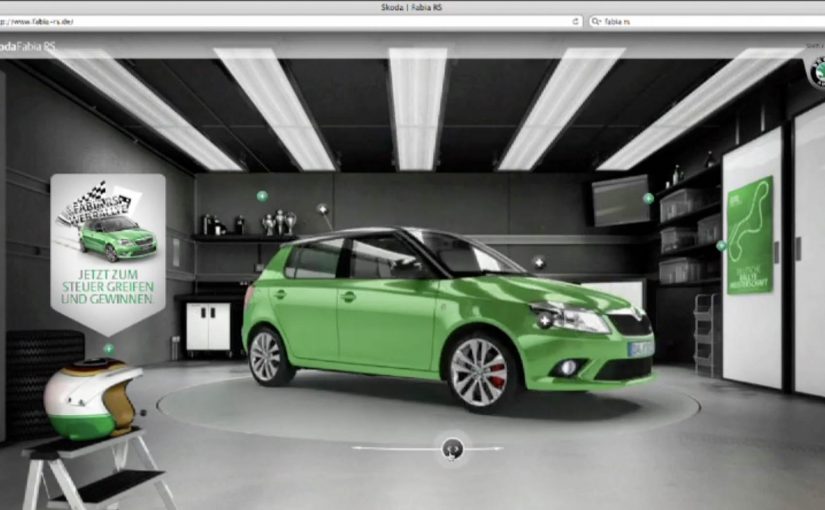
Skoda Fabia RS: Augmented Reality Test Drive

Skoda Fabia RS: Augmented Reality Test Drive

Skoda has just released a rally-based, augmented reality test drive for the Fabia RS. Here, “augmented reality test drive” means an AR overlay combined with a live webcam feed so you appear inside the cockpit view. The hook is simple and instantly personal: you become the driver, right down to a helmet view that pulls your face in via the webcam.

A rally fantasy built on a very real webcam

The execution borrows the language of motorsport. Helmet cam framing, tight cockpit perspective, and the feeling that you are inside the run rather than watching an ad.

Mechanically, the idea is an AR layer plus a live camera feed. The interface does not just show the car. It places you into the experience so the “test drive” feels like a game you are starring in.

In European automotive launch teams, webcam-first interactivity can differentiate faster than another spec-led asset.

In automotive launches where feature parity is high, interactive test drives create faster differentiation than another spec sheet or beauty film.

Why the helmet view is the smartest detail

Most virtual test drives keep the viewer outside the car. This one pulls the viewer into the cockpit, which changes the emotional contract. You are no longer evaluating. You are participating.

Extractable takeaway: Move the viewer from evaluator to participant, and the demo becomes something they remember and share without being asked.

That participation is what makes the concept naturally shareable, even without shouting for shares. People want to show the version where their own face is in the helmet view, because it is proof they “did the thing.”

What the brand is really reinforcing

The real question is whether the experience makes performance identity feel personal, not just visible.

On the surface, it is a playful rally twist. Underneath, it signals performance identity. The Fabia RS is framed as a car with motorsport DNA, not just a faster trim level.

The AR wrapper also makes an implicit promise: this is a modern car for people who like modern interfaces. The experience becomes a proxy for the product personality.

How to borrow the webcam POV trick

  • Make the viewer the protagonist, not just the audience. Webcam and POV tricks do more than cinematic polish.
  • Choose one unmistakable motif that communicates the category story fast, here it is rally and helmet cam.
  • Turn “try” into “play” so the time spent feels like entertainment, not evaluation.
  • Design a single talkable detail people can retell in one sentence, for example “it pulls your face into the helmet view.”

A few fast answers before you act

Is this more ad or more game?

It sits in the middle. The structure behaves like a lightweight game, while every element points back to a single product identity, rally performance.

What is the core mechanism that makes it work?

Personalization through webcam plus a strong point-of-view frame. The experience feels like it is happening to you, not in front of you.

Why does AR help here, instead of just a normal virtual drive?

AR adds “presence.” It creates the feeling of being inside the moment, which is harder to achieve with a standard video or configurator flow.

What is the biggest execution risk with webcam-based experiences?

Friction and permission. If setup is clunky or people feel uncertain about using the camera, completion drops fast. The first 10 seconds must feel safe and effortless.

What is the transferable lesson for other categories?

Put a real person into the proof. When the viewer’s face, voice, or choices become part of the demo, the demo becomes content people want to share.