Track My Macca’s: Supply Chain Transparency

McDonald’s in Australia decided to use technology to tackle one of its biggest problems, the disbelief that its ingredients are fresh, locally sourced and of decent quality. So with image recognition, GPS, augmented reality and some serious integration with its supply chain, they put together a full story behind every ingredient people came across while buying food at McDonald’s.

The real challenge: trust, not awareness

This is not a campaign built to shout louder. It is built to answer the skeptical question that sits in the customer’s head at the moment of choice: “Is this actually fresh, and where did it come from”.

Instead of responding with claims, it responds with traceable context. Ingredient by ingredient.

Why the tech stack matters only if it is integrated

Image recognition, GPS, and augmented reality are the attention layer. The credibility layer is the supply chain integration. Without that, the experience would be a glossy story. With it, the experience becomes proof.

  • Image recognition. Identify what the customer is looking at or buying.
  • GPS. Connect the experience to location and local sourcing claims.
  • Augmented reality. Make information feel immediate and tangible in the buying moment.
  • Supply chain integration. Ensure the “story” maps to real sourcing and logistics data.

What makes this a strong model for brand transparency

Transparency only works when it is easy. People will not dig through PDFs or corporate sustainability pages while they are ordering lunch.

This approach brings the information to the moment and to the object. It reduces friction and increases believability.

What to take from this if you run CX, MarTech, or operations

  1. Start with the objection. The customer’s doubt defines the experience.
  2. Proof beats promise. If you want trust, show traceability, not slogans.
  3. Integrate the system of record. Experiences that depend on trust must connect to operational data.
  4. Design for the moment of choice. The best transparency is delivered exactly when people need it.

A few fast answers before you act

What is “Track My Macca’s”?

It is a McDonald’s Australia initiative that uses mobile technology to show a story behind ingredients, aiming to build trust in freshness, local sourcing, and quality.

Which technologies were used?

Image recognition, GPS, augmented reality, and strong integration with McDonald’s supply chain to connect the experience to real sourcing and logistics.

Why is supply chain integration the critical piece?

Because the experience depends on credibility. Without operational data behind it, the story would feel like marketing. With it, it can function as proof.

What customer problem does this solve?

It addresses disbelief about ingredient freshness and quality by making provenance and context visible at the point of purchase.

What is the transferable lesson for other brands?

If trust is your barrier, design transparency into the customer journey and connect it to your systems of record, so the experience can stand up to scrutiny.

Making magazines instantly interactive

Enabling readers to buy directly from magazines or newspapers is slowly going to become the industry standard, as revenues from print continue to slip.

Last year Ikea re-imagined their catalog via a special visual recognition app that brought its pages and offerings within to life. Now Marie Claire has taken it one step further by letting their readers use the Netpage app, to interact with its printed pages i.e. clip, save, share, watch and buy.

The Netpage app uses a combination of image recognition, augmented reality and digital twin technology. Hence no special codes, watermarks or special printing processes are required.

The future is all about content being fused with commerce so that it’s a quick step from reading about an item to buying it. So get ready! 😎

Jameson Irish Whiskey: Blippar Space Invaders

Outdoor ads that turn into a game

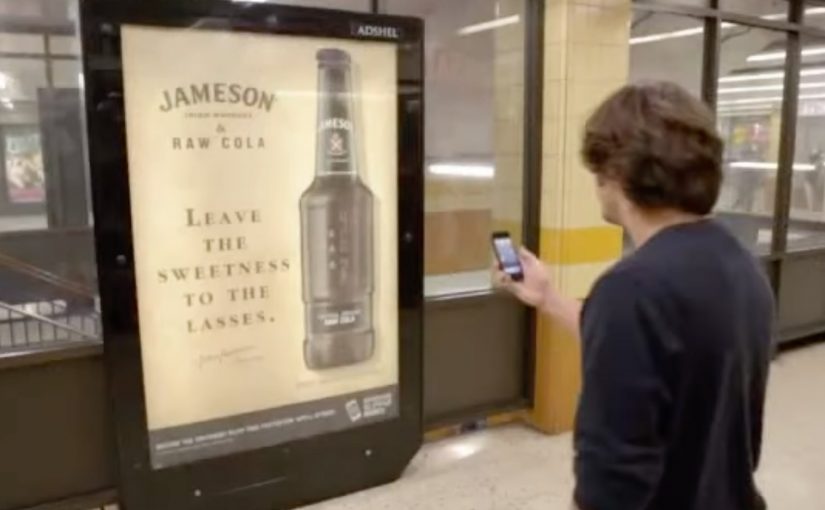
Jameson Irish Whiskey recently launched a huge outdoor campaign, teaming up with augmented reality specialist Blippar for image recognition technology.

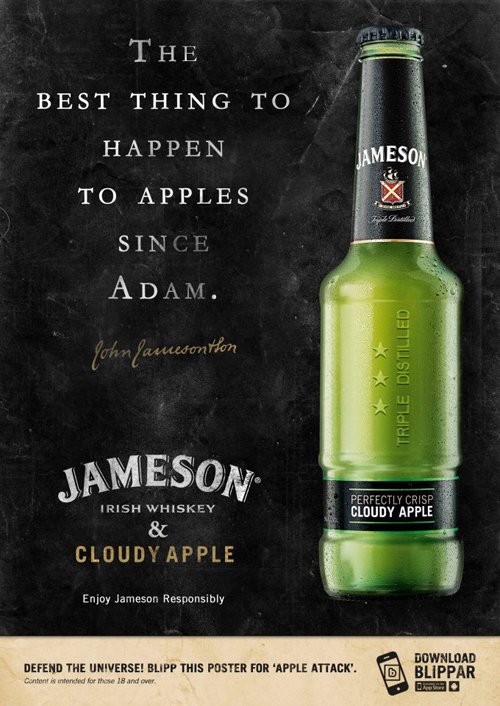
People with the Blippar app could scan any Jameson Irish Whiskey ad or bottle and immediately get immersed in a Jameson Irish Whiskey version of Space Invaders.

How the Blippar scan-to-play mechanic worked

The mechanism was straightforward. A phone camera scan triggered Blippar’s image recognition. That recognition launched an interactive AR experience on the device.

In practice, the physical media became the “portal”. The ad or bottle was the entry point. The phone was the display and controller. The game was the reward.

Why it landed, and where the interaction could be smoother

The win is immediacy. Scan and you are inside the brand world without a long setup. That kind of instant payoff makes an outdoor poster feel alive rather than static.

After playing the game myself, I found it would have been a better experience if they had allowed viewer control through tilting the phone around, instead of non stop tapping at the screen. However, it is still good to see more brands innovating like this.

What the brand was really buying

This was not just about novelty. It was about extending an outdoor campaign into a personal, interactive moment that people could not get from a standard print execution.

The intent was clear. Increase attention time. Add talk value. Create a reason to engage with the bottle and the ads beyond the first glance.

What to steal for your next AR activation

  • Make the entry point universal. “Scan any ad or bottle” reduces friction and increases participation.
  • Reward immediately. If the scan does not pay off fast, the experience loses the environment it depends on.
  • Design the controls for comfort. Favor natural motion and simple gestures over repetitive tapping when sessions run longer than a few seconds.
  • Use AR to earn time, not impressions. The value is the extra seconds of focused attention, not the novelty headline.

If you would like to give it a try, download the Blippar app on your smartphone and scan the below bottle to start playing.

Jameson Irish Whiskey


A few fast answers before you act

What was Jameson doing with Blippar?

They used Blippar’s image recognition so people could scan Jameson ads or bottles and launch an interactive AR game experience on a smartphone.

What was the core mechanic?

Scan the physical creative with the Blippar app. The scan triggers recognition. The phone immediately launches the game.

Why does scan-to-play work well for outdoor advertising?

It turns a passive glance into an active moment. The ad becomes a portal to content that holds attention longer than print.

What interaction improvement could make this smoother?

More natural viewer control, such as tilting the phone, can reduce fatigue compared to continuous tapping during gameplay.

What is the main takeaway for brands?

Use AR to earn time and engagement by delivering an immediate reward, and make the control scheme comfortable enough to sustain play.